
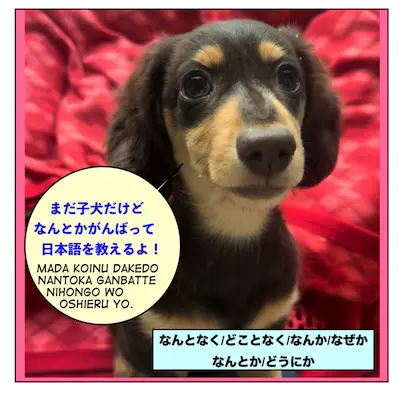
「まだ子犬だけどなんとかがんばって日本語を教えるよ。」
= まだこいぬだけどなんとかがんばってにほんごをおしえるよ。
= Mada koinu dakedo nantoka ganbatte nihongo wo oshieru yo.
= I’m still just a puppy, but I’ll do my best to somehow manage to teach you Japanese.
Hi everyone! I’m your guest teacher today, Donut!
Today’s lesson is by request. I’m going to teach you how to use なんとなく, どことなく, なんか, なぜか, なんとか, どうにか = nantonaku, dokotonaku, nanka, nazeka, nantoka, dounika.
Do you know the differences?
なんとなくわかりますか?
= Nantonaku wakarimasu ka?
= Do you kind of understand it?
First, let’s divide them into two groups:
⭐️Adverbs that express one’s vague feelings or opinions:
→なんとなく, どことなく, なんか, なぜか = nantonaku, dokotonaku, nanka, nazeka
⭐️Adverbs that express managing to do something somehow / something working out somehow:
→なんとか, どうにか = nantoka, dounika
Some of them are very similar and can be used interchangeably, but I’ll give you plenty of example sentences to help you understand the subtle differences in nuance. OK, I’m going to explain them one by one.
OK, I’m going to explain them one by one.
⭐️Adverbs that express one’s vague feelings or opinions:
🔹なんとなく = nantonaku : somehow / in some way / for some reason / to do something without a clear reason / without knowing why
1) When you express your own physical symptoms or feelings but you can’t explain exactly what it is or why it happens: “I don’t know why, but ~.”
Ex. この頃、なんとなく体が疲れやすい。
= このごろ、なんとなくからだがつかれやすい。
= Konogoro, nantonaku karada ga darui.
= I’ve been getting tired easily lately.
Ex. 揚げ物を食べた後はなんとなく胃が重い。
= あげものをたべたあとはなんとなくいがおもい。
= Agemono wo tabeta ato wa nantonaku i ga omoi.
= After eating fried food, my stomach somehow feels heavy.
Ex. 朝起きたときなんとなくだるい。仕事のし過ぎかなあ。
= あさおきたときなんとなくだるい。しごとのしすぎかなあ。
= Asa okita toki nantonaku darui. Shigoto no shisugi kana.
= When I wake up in the morning, I just feel kind of tired. Maybe I’ve been working too much.
2) When you express your vague impression of something or someone.
Ex. 最近、彼の様子がなんとなくおかしかったのでそれとなく聞いたら会社を首になったらしい。
= さいきん、かれのようすがなんとなくおかしかったのでそれとなくきいたらかいしゃをくびになったらしい。
= Saikin, kare no yousu ga nantonaku okashikatta node soretonaku kiitara kaisha wo kubi ni nattarashii.
= Recently, he somehow seemed a bit strange, so when I asked him indirectly, it turned out he had been fired from his company.
📝Note: それとなく = soretonak = casually, in a round‑about way, without being too direct
Ex. 久しぶりにうちの犬を遠くの公園まで散歩に連れて行ったらなんとなく嬉しそうだった。
= ひさしぶりにうちのいぬをとおくのこうえんまでさんぽにつれていったらなんとなくうれしそうだった。
= Hisashiburi ni uchi no inu wo tooku no kouen made sanpo no tsurete ittara nantonaku ureshisou datta.
= I took my dog to a park far away for the first time in a while, and he seemed somehow happy.
Ex. 妹が一人暮らしを始めてからなんとなく寂しそうだったので夕食に誘った。
= いもうとがひとりぐらしをはじめてからなんとなくさびしそう(さみしそう)だったのでゆうしょくにさそった。
= Imouto ga hitorigurashi wo hajimete kara nantonaku sabishisou (samishisou ) datta node yuushoku ni sasotta.
= Since my little sister started living on her own, she seemed a little lonely somehow, so I invited her to dinner.
3) When you do something without a clear/specific purpose or reason.
Ex. なんとなく誰かと話したくなって昔の友達に電話をかけた。
= なんとなくだれかとはなしたくなってむかしのともだちにでんわをかけた。
= Nantonaku dareka to hanashitaku natte mukashi no tomodachi ni denwa wo kaketa.
= For no particular reason, I suddenly felt like talking to someone, so I called an old friend.
Ex. なんとなく顔が見たくなったから会いにきちゃった。(casual)
= なんとなくかおがみたくなったからあいにきちゃった。
= Nantonaku kao ga mitaku natta kar ai ni kichatta.
= I don’t know why, but I suddenly felt like seeing you, so I came to visit.
Ex. なんとなく一人旅がしたくなり気がついたら電車に乗っていた。
= なんとなくひとりたびがしたくなりきがついたらでんしゃにのっていた。
= Nantonaku hitoritabi ga shitaku nari ki ga tsuitara densha ni notte ita.
= I suddenly felt like taking a solo trip, and before I knew it, I was already on a train.
Ex. A: 「どうして東京に行くの?」
= どうしてとうきょうにいくの?
= Doushite Toukyou ni iku no?
= Why are you going to Tokyo?
B: 「ただなんとなく行きたくなって…」
= ただなんとなくいきたくなって…
= Tada nantonaku ikitaku natte…
= I don’t know… I just kind of felt like going.
Ex. なんとなくテレビを観ていたら知っている人が出てきた。
= なんとなくテレビをみていたらしっているひとがでてきた。
= Nantonaku terebi wo mite itara shitteiru hito ga detekita.
= I was casually watching TV when someone I know happened to appear on TV.
📝Note: For usages 1), 2), and 3), you can also replace なんとなく ( = nantonaku) with なんか ( = nanka) .
They mean almost the same, but なんか ( = nanka) sounds more conversational.
Also, なんか ( = naka) focuses one’s vague feeling or impression, while なんとなく ( = nantonaku) focuses on doing or feeling something without knowing exactly why.
For example:
Ex. 今日は、なんか疲れた。
= きょうは、なんかつかれた。
= Kyou wa, nanka tsukareta.
= I’m kind of tired today.
(Expressing a vague feeling or mood.)
Ex. 今日は、なんとなく疲れた。
= きょうは、なんとなくつかれた。
= Kyou wa, nantonaku tsukareta.
= I feel tired today for some reason.
(Feeling tired without a clear reason.)
4) When something happens or works somehow without a clear reason.
Ex. 壊れたと思ったゲーム機をなんとなく触っていたら動いた。
= こわれたとおもったゲームきをなんとなくさわっていたらうごいた。
= Kowareta to omotta geemuki wo nantonaku sawatteitara ugoita.
= I was just fiddling with the game console that I thought was broken, and somehow it started working.
Ex. このソフトはマニュアルを読まなくてもなんとなく使っていたらわかるよ。
= このソフトはマニュアルをよまなくてもなんとなくつかっていたらわかるよ。
= Kono sofuto wa manyuaru wo yomanakute mo nantonaku tsukatte itara wakaru yo.
= You don’t even have to read the manual. If you just play around with this software, you’ll kind of get the hang of it.
5) When you vaguely or intuitively understand or realize something, even though you can’t explain it clearly.
Ex. 後ろ姿を見ただけでなんとなく彼だとわかった。
= うしろすがたをみただけでなんとなくかれだとわかった。
= Ushirosugata wo mita dake de nantonaku kare dato wakatta.
= I could somehow tell it was him just by seeing him from the back.
Ex. 彼女の気持ちはなんとなくわかる。
= かのじょのきもちはなんとなくわかる。
= Kanojo no kimochi wa nantonaku wakaru.
= I kind of understand how she feels.
Ex. 言いたいことはなんとなくわかります。
= いいたいことはなんとなくわかります。
= iitai koto wa nantonaku wakarimasu.
= I kind of understand what you’re trying to say.
Ex. あの二人が付き合っているのはなんとなく気がついていた。
= あのふたりがつきあっているのはなんとなくきがついていた。
= Ano futari ga tsukiatte iru nowa nantonaku kiga tsuite ita.
= I kind of knew those two were dating.
Ex. この本は、知らない漢字や言葉が多いですが、なんとなく書いてあることはわかります。
= このほんは、しらないかんじやことばがおおいですが、なんとなくかいてあることはわかります。
= Kono hon wa, shiranai kanji ya kotoba ga ooi desu ga, nantonaku kaite aru koto wa wakarimasu.
= This book has a lot of kanji and words I don’t know, but I can kind of understand what’s written.
🔹どことなく= dokotonaku : somehow / in some subtle way
When something/someone gives a slight impression, but you can’t say exactly what it is. It’s often used to describe someone’s appearance, mood, resemblance, or atmosphere.
Ex. この犬は、どことなくマギーに似ている。
= このいぬは、どことなくマギーににている。
= Kono inu wa, dokotonaku Maggie ni niteiru.
= This dog somehow resembles Maggie.
→You notice the resemblance overall, but can’t identify a specific feature.
You can rephrase these with なんとなく ( = nantonaku) or なんか ( = nanka)
The translation could be the same (somehow / for some reason) but
どこ = doko(何処) originally means “which part / aspect,” so どことなく ( = dokotonaku) implies there are many features or aspects, but you can’t pinpoint exactly which one. It’s a little like the English expression: “I can’t put my finger on it.
Ex. 彼女は初めて会ったときからどことなく寂しげな表情をしていた。
= かのじょははじめてあったときからどことなくさびしげ(さみしげ)なひょうじょうをしていた。
= Kanojo wa hajimete atta toki kara dokotonaku sabishige(samishige) na hyoujou wo shiteita.
= Since I first met her, she has somehow seemed a bit lonely.
Ex. 彼は最近どことなく様子がおかしい。
= かれはさいきんどことなくようすがおかしい。
= Kare wa saikin dokotonaku yousu ga okashii.
= He’s been acting somehow a little weird lately.
Ex. 田中さんはどことなく疲れてみえた。
= たなかさんはどことなくつかれてみえた。
= Tanaka-san wa dokotonaku tsukarete mieta.
=Tanaka-san somehow looked a little tired.
📝Note: You can rephrase these with なんとなく ( = nantonaku) or なんか ( =
nanka) The translation could be the same (somehow/for some reason) but
どこ(何処)( = doko) originally means “which part/aspect,” so どことなく ( =dokotonaku) implies there are many features or aspects, but you can’t
pinpoint exactly which one.
Also you don’t usually use どことなく ( = dokotonaku) when you describe your
own appearance or feelings about yourself.
*I’m kind of tired today.
→(Not natural) 今日は、どことなく疲れたなあ。
= きょうは、どことなくつかれたなあ。
= Kyou wa dokotonaku tsukareta naa.
It will be more natural to say:
→今日は、なんとなく疲れたなあ。
= きょうは、なんとなくつかれたなあ。
= Kyou wa, nantonaku tsukaretanaa.
→(More conversational) きょうは、なんか疲れたなあ。
= きょうは、なんかつかれたなあ。
= Kyouwa, nanka tsukareta naa.
🔹なんか ( = 何か) ( = nanka) : kind of / somehow/ a little / for some reason
I made a lesson on なんか ( = nanka)
Link: Click here
It has various usages, but in this lesson we focus on expressing vague feelings or opinions.
(This is usage 2 in that lesson: to express unexplainable feelings ― “somehow / kind of / a little ~ / for some reason” ― when you’re being ambiguous or trying to find the right word.)
As I mentioned above, なんか ( = nanka) is more conversational and general compared with なんとなく ( = nantonaku) and どことなく ( = dokotonaku) .
It is used when you express your feelings, impressions, or opinions about something or someone vaguely: kind of / a little / for some reason (when you are being ambiguous or trying to find the right word.)
1) Expressing your own feelings:
Ex. 料理番組を観ていたらなんかお腹がすいてきた。
= りょうりばんぐみをみていたらなんかがおなかすいてきた。
= Ryouriganbumi wo miteitara nanka onaka ga suite kita.
= I’m kind of getting hungry watching a cooking show.
Ex. すみません。なんか朝から体調が悪いので早退してもいいですか?
= すみません。なんかあさからたいちょうがわるいのでそうたいしてもいいですか?
= Sumimasen. Naka asa kara taichou ga warui node soutai shitemo ii desu ka?
= Excuse me. I’m kind of not feeling well since this morning, so may I leave early?
📝Note: 早退する= そうたいする = soutai suru = to leave work/school earlier
than usual for personal reasons
2) Expressing one’s impression or opinion of someone / something
Searching for the right word / being ambiguous to soften your statement, “I can’t explain it well, but…” or “I don’t know what this is, but…”
Ex. A: 「今、投資したら2年後は倍になるんだって。」
= いま、とうししたらにねんごはばいになるんだって。
= Ima, toushi shitara ninengo wa bai ni narun datte.
= I heard that if you invest now, it will double in two years.
B: 「その話、なんか怪しいなあ。」
= そのはなし、なんかあやしいなあ。
= Sono hanashi, nanka ayashii naa.
= That offer / deal sounds kind of fishy, you know.
Ex. 最近、なんか忙しそうだね。
= さいきん、なんかいそがしそうだね。
= Saikin, nanka isogashisou dane.
= You seem kind of busy lately.
Ex. この教科書はなんか難しくてわかりにくい。
= このきょうかしょはなんかむずかしくてわかりにくい。
= Kono kyoukasho wa nanka muzukashikute wakarinikui.
=This textbook is kind of difficult and hard to understand.
Ex. なんか怒っているの?(casual)
= なんかおこっているの?
= Nanka okotteiru no?
= Are you upset or something?
Ex. この歌、なんかいいんだよね。
= このうた、なんかいいんだよね。
= Kono uta, nanka iindayone.
= I like this song for some reason.
🔹 なぜか(何故か)= naze ka = for some reason / somehow (unknown reason)
It expresses the idea of なぜかわからない (= naze ka wakaranai) / (more conversational) なんでかわからないけど ( = nande ka wakaranai kedo) = I don’t know why, but…
It’s used to describe a feeling or situation that feels unexpected, contradictory, or hard to explain logically.
Ex. 秋になるとなぜか物悲しくなる。
= あきになるとなぜかものがなしくなる。
= Aki ni naru to naze ka monoganashiku naru.
= For some reason, I feel a little sad when autumn comes.
📝Note: Again, you can rephrase this sentence with なんか ( = nanka) or なんとなく ( = nantonaku) , and the English translation may still be “for some reason.” However, the nuance is slightly different.
* なぜか物悲しくなる。
= なぜかものがなしくなる。
= Nazeka monoganashiku naru.
→ focusing on the unclear reason
→ I don’t know why, but I feel sad.
* なんとなく物悲しくなる
= なんとなくものがなしくなる
= Nantonaku monoganashiku naru.
→ Describing your vague feelings
→ I can’t explain this feelings clearly but I kind of feel sad.
📝Note:
物悲しくなる = ものがなしくなる = monoganashikunaru = to feel vaguely, quietly sad / melancholic,/to feel a gentle, bittersweet sadness that’s hard to put into words. It’s more poetic and atmospheric than plain 悲しくなる = かなしくなる = kanashikunaru.
* なんか物悲しくなる
= なんかものがなしくなる
= Nanka monoganashiku naru
→ a casual way to express a feeling you can’t quite explain (also with “kind of / a little” nuance)
→ I kind of feel sad.
Ex. 先生はなぜか私ばかりを当てる。
= せんせいはなぜかわたしばかりをあてる。
= Sensei wa nazeka watashi bakari wo ateru.
= For some reason, the teacher keeps calling on me.
Ex. 今日はなぜか救急車と消防車が町の中心に向かっているけれども何かあったのかな。
= きょうはなぜかきゅうきゅうしゃとしょうぼうしゃがまちのちゅうしんにむかっているけれどもなにかあったのかな。
= Kyou wa naze ka kyuukyuusha to shoubousha ga machi no chuushin ni mukatte iru keredomo nanika atta no kana.
= For some reason, ambulances and fire trucks are heading toward the center of town today. I wonder if something happened.
Ex. 佐々木さんはいつも時間通りに来るのになぜか今日は9時になっても来ない。
= ささきさんはいつもじかんどおりにくるのになぜかきょうは9じになってもこない。
= Sasaki san wa itsumo jikan doori ni kuru noni naze ka kyou wa kuji ni natte mo konai.
= Sasaki-san always arrives on time, but for some reason he hasn’t come yet today even though it’s already 9:00.
Now let’s move on to the next expressions.
⭐️Adverbs that express managing to do something somehow / something working out somehow
🔹なんとか (= 何とか), どうにかなんとか (= 何とか) = nantoka , どうにか = dounika
These are very similar expressions, and a lot of the time they are interchangeable.
They are both often used with the verbs する ( = suru) and なる ( = naru).
なんとかする / どうにかする = nantoka suru/ dounika suru
→ to somehow manage to do something / to find a way to deal with something
なんとかなる / どうにかなる = nantoka naru/donika naru
→ things will somehow work out / it will work out somehow.
I’ll show you how to use them in example sentences:
1) When things works / worked out somehow:
Ex. 心配しないで、なんとかなるよ。/どうにかなるよ。
= しんぱいしないで、なんとかなるよ。/どうにかなるよ。
= Shinpai shinaide, nantoka naru yo/ dounika naru yo.
= Don’t worry, things will work out somehow.
Ex. 途中、渋滞していたがなんとか / どうにか時間通りに着くことができた。
= とちゅう、じゅうたいしていたがなんとか / どうにかじかんどおりにつくことができた。
= Tochuu, juutai shite ita ga nantoka/dounika jikan doori ni tsuku koto ga dekita.
= There was a traffic jam on the way, but I somehow managed to arrive on time.
Ex. うちの娘がなんとか / どうにか大学に入ることができた。
= うちのむすめがなんとか / どうにかだいがくにはいることができた。
= Uchi no musume ga nantoka/dounika daigakuk ni hairu koto ga dekita.
= My daughter somehow managed to get into university.
Ex. 給料は少ないがなんとか / どうにか食べていけます。
= きゅうりょうはすくないがなんとか / どうにかたべていけます。
= Kyuuryou wa sukunai ga nantoka / dounika tabete ikkemasu.
= My salary is low, but I can somehow get by / make ends meet.
2) When you have to, or want to, somehow manage or get something done, even though the situation is difficult.
🍩From the picture above:
「まだ子犬だけどなんとかがんばって日本語を教えるよ。」
= まだこいぬだけどなんとかがんばってにほんごをおしえるよ。
= Mada koinu dakedo nantoka ganbatte nihongo wo oshieru yo.
= I’m still just a puppy, but I’ll do my best to somehow manage to teach you
Japanese.
🗒️Note: It implies I don’t know how but I’ll do my best.
I would use なんとかがんばって ( = nantoka ganbatte) in this case because it sounds slightly more positive, while どうにかがんばって ( = dounika kanbatet) sounds less confident.
Ex. 厳しい試合だったがなんとか/どうにか乗り切った。
= きびしいしあいだったがなんとか/どうにかのりきった。
= Kibishii shiai datta ga nantoka / dounika norikitta.
= It was a tough game, but we somehow managed to get through it.
🗒️ Note: Nuance difference is
* なんとか ( = nantoka) → we got through it successfully, emphasizing effort and a slightly positive feeling
* どうにか ( = dounika) → we barely got through it, with more tension or uncertainty about the game
Ex. この問題が大きくなる前になんとか / どうにかしないといけない。
= このもんだいがおおきくなるまえになんとか / どうにかしないといけない。
= Kono mondai ga ookiku naru mae ni nantoka / dounika shinai to ikenai.
= I have to somehow handle this problem before it gets worse (focusing on making it work / finding a way).
Ex. なんとかして / どうにかして4月までに日本に行きたい。
= なんとかして / どうにかしてしがつまでににほんにいきたい。
= Nantoka shite/Dounika shite shigatsu made ni nihon ni ikitai.
= I want to find some way to go to Japan by April.
Ex. 今日は、なんとか / どうにか9時までには仕事を終えたい。
= きょうは、なんとか / どうにかくじまでにはしごとをおえたい。
= Kyou wa, nantoka / dounika kuji made niwa shigoto wo oetai.
= I want to somehow finish work by 9 today.
Ex. 期日までになんとか / どうにかレポートを仕上げたい。
= きじつまでになんとか / どうにかレポートをしあげたい。
= Kijitsu made ni nantoka / dounika repooto wo shiagetai.
= I want to somehow finish the report by the deadline.
3) When you want someone to do something or make a difficult request.
Ex. 今週末なんとか / どうにか二部屋予約できませんか?
= こんしゅうまつなんとか / どうにかふたへやよやくできませんか?
= Konshuumatsu nantoka/dounika futaheya wo yoyaku dekimasen ka?
= Is there any way that I could book two rooms for this weekend?
📝Note: It implies that I know it’s difficult / that it’s a last-minute request,
but I’m asking anyway.
Ex. 今夜は友達と約束があるのにまた残業しなくてはいけない。もうなんとか / どうにかしてほしい。
= こんやはともだちとやくそくがあるのにまたざんぎょうしなくてはいけない。もうなんとか / どうにかしてほしい。
= Kon’ya wa tomodachi to yakusoku ga aru no ni mata zangyou shinakute wa ikenai. Mou nantoka/dounika shite hoshii.
= I have plans with my friends tonight, but I have to work overtime again. I can’t take this anymore.
Ex. お店の人:「申し訳ございません。その日は満席でご予約いただけません。」
= おみせのひと: もうしわけございません。そのひはまんせきでごよやくいただけません。
= Omise no hito: Moushiwake gozaimasen. Sono hi wa manseki de goyoyaku itadakemasen.
= Restaurant staff: I’m very sorry. That day is fully booked, so we cannot take your reservation.
客 : 「そこをなんとかお願いします。」
= きゃく: そこをなんとかおねがいします。
= Kyaku: Soko wo nantoka onegai shimasu.
= Customer: Could you somehow make an exception for me? / Is there any way you could help me with that?
📝Note: In this case, using どうにか ( = dounika) is not wrong, but なんとか ( = nantoka) is more commonly used.
Bonus! Idiomatic expression:
🔸頭がどうにかなりそう (or どうかなる) 🤯
= あたまがどうにかなりそう (or どうかなる)
= I feel like I’m losing it. / I’m about to lose my mind.
📝Note: For this expression, you don’t use なんとか ( = nantoka)
Ex. 一人でこれだけの作業をしなければいけないと考えただけで頭がどうにかなりそうだ。
= ひとりでこれだけのさぎょうをしなければいけないとかんがえただけであたまがどうにかなりそうだ。
= Just thinking about having to do all this work alone makes me feel like I’m losing my mind.
OK, that’s all for now! Do you know how to use them now?
使い方がなんかわかってきましたか?😉
= つかいかたがなんかわかってきましたか?
= Tsuaikata ga nanka wakatte kinmashita ka?
= Do you think you’re getting how to use them now?
******
 マギー先生より = マギーせんせいより = Maggie Sensei yori = From Maggie Sensei
ドーナツ先生、ありがとう!
= ドーナツせんせい、ありがとう!
= Doonatsu Sensei, arigatou!
= Thank you Donut Sensei!
初めて日本語を教えてくれましたが、なぜかベテランの先生に見えますよ。
= はじめてにほんごをおしえてくれましたが、なぜかベテランのせんせいにみえますよ。
= Hajimete nihongo wo oshiete kuremashita ga, nazeka beteran no sensei ni miemasu yo.
= This is your first time teaching Japanese, but somehow you look like a veteran teacher.
****
My Patrons can access the audio file
Audio Files for this lesson →Click here
PDF file without ads (One with romaji & One without romaji) →Click here
I appreciate your support! サポートありがとう! !
My supporters can access tons of audio files, PDF files, and special lessons on my Patreon page.
❤️ありがとう x 2: Mini lessons, PDF files with audio for all the lessons here from 2018
❤️ありがとう x 5 In addition to the previous benefit + Daily Japanese
Check the index of Daily Japanese Series →Index
❤️ありがとう x 10 In addition to the previous benefit + PDF file of all my Twitter lessons for a month (average 10 ~ 18 pages) with an audio file. Please check the details here

One-time support ↓ ありがとう!

2 Comments
Thank you for this! It was very helpful for the nuanced aspect of these grammar points. Especially between なんとか・どうにか
Hi Kimmeran
I’m so happy to hear that you find this lesson helpful! ☺️