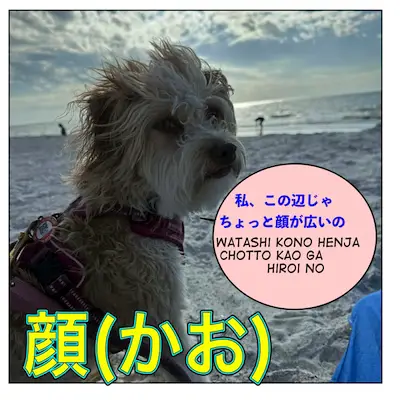
「私、この辺じゃちょっと顔が広いの。」
= わたし、このへんじゃちょっとかおがひろいの。
= Watashi, konohen ja chotto kao ga hiroi no.
= I’m pretty well-connected around here.
Hi everyone! I’m your guest teacher, Dolly. I come to this beach all the time and know a lot of people and dogs around here.
OK, we’re going to continue our lesson on body-related expressions and idioms. Last time, we studied expressions and idioms using 頭 (あたま = atama = head).
In today’s lesson, we’ll learn expressions and idioms with:
* 顔 = かお = kao = face
* 髪 = かみ = kami = hair
* 眉 = まゆ = mayu = eyebrow
* 額 = ひたい = hitai = forehead
* 頬 = ほお (ほほ) = hoo (hoho) = cheek
* 顎 = あご = ago = chin/jaw
Let’s start with…
⭐️顔 = かお = kao = face
* 顔が青くなる = かおがあおくなる = kao ga akaku naru = to turn pale
Literal meaning: one’s face turns blue.
→(stronger) 顔が真っ青になる = かおがまっさおになる = kao ga masao ni naru
= to go completely pale
Literal meaning: one’s face turns deep blue.
Ex. 彼はクレジットカードをなくしたことに気がついて顔が真っ青になった。
= かれはクレジットカードをなくしたことにきがついて、かおがまっさおになった。
= Kare wa kurejittokaado wo nakushita koto ni kigatsuite, kao ga massao ni
natta.
= He went completely pale when he realized he had lost his credit card.
* 顔が赤くなる = かおがあかくなる = kao ga akaku naru = to blush, one’s face turns red
Literal meaning: one’s face turns red.
* 顔を赤くする = かおをあかくする = kao wo akaku suru = to blush, to turn red
Literal meaning: to make one’s face red.(from embarrassment, anger, etc.)
→ (stronger)
* 顔が真っ赤になる = かおがまっかになる = kao ga makka ni naru = to become bright red, to turn bright red
Literal meaning: one’s face turns bright red.
* 顔を真っ赤にする = かおをまっかにする = kao wo makka ni suru = to make one’s face turn bright red, to blush deeply
Literal meaning: to make one’s face bright red.
Note: Both expressions can be used when someone’s face turns red from embarrassment, anger, or drinking to much alcohol, etc.
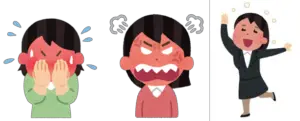
Ex. 若い頃は、好きな人と目が合っただけで顔が赤くなった。
= わかいころは、すきなひととめがあっただけでかおがあかくなった。
= Wakai koro wa, suki na hito to me ga atta dake de kao ga akaku natta.
= When I was young, I would blush just from making eye contact with someone I liked.
Note: There is a similar expression
* 頬を赤くする = ほおをあかくする/ 頬が赤くなる = ほおがあかくなる = hoo wo akaku suru / hoo ga akaku naru = to blush
Check 頬 = ほお (ほほ) = hoo/hoho = cheeks
Ex. お酒を飲むとすぐに顔が赤くなる。
= おさけをのむとすぐにかおがあかくなる。
= Osake wo nomu to sugu ni kao ga akaku naru.
= My face turns red as soon as I drink alcohol.
Ex. その客は、店員の失礼な態度に顔を真っ赤にして怒った。😡
= そのきゃくは、てんいんのしつれいなたいどにかおをまっかにしておこった。
= Sono kyaku wa, ten’in no shitsurei na taido ni kao wo makka ni shite okotta.
= The customer became red-faced with anger because of the clerk’s rude attitude.
* 顔から火が出る = かおからひがでる = kao kara hi ga deru = to be extremely
embarrassed
Literal meaning: fire comes out of one’s face.
Ex. 小学生のとき、先生のことを間違えて「お母さん」と呼んでしまい、顔から火が出るほど恥ずかしかった。
= しょうがくせいのとき、せんせいのことをまちがえて「おかあさん」とよんでしまい、かおからひがでるほどはずかしかった。
= Shougakusei no toki, sensei no koto wo machigaete “okaasan” to yonde shimai, kao kara hi ga deru hodo hazukashikatta.
= When I was in elementary school, I accidentally called my teacher “Mom,” and I was so embarrassed that I felt like my face was on fire.
*顔色が変わる = かおいろがかわる = kaoiro ga kawaru = to turn pale / to lose composure suddenly / to show visible surprise or anger
Literal meaning: complexion changes
Ex. 彼は真相を聞いてさっと顔色が変わった。
= かれはしんそうをきいてさっとかおいろがかわった。
= Kare wa shinsou wo kiite satto kaoiro ga kawatta.
= His expression changed when he was told the truth.
* 顔が広い = かおがひろい = kao ga hiroi = well-connected
Literal meaning: one’s face is wide.
Ex. うちの社長は顔が広いから、いろいろな業界に知り合いがいる。
= うちのしゃちょうはかおがひろいから、いろいろなぎょうかいにしりあいがいる。
hi no shachou wa kao ga hiroi kara, iroirona gyoukai ni shiriai ga iru.
= Our company president is well-connected and knows people in many different industries.
From the cover picture:
🐶「私、この辺じゃちょっと顔が広いの。」
= わたし、このへんじゃちょっとかおがひろいの。
= Watashi, kono hen ja chotto kao ga hiroi no.
= I’m pretty well-connected around here.
* 顔が売れる = かおがうれる = kao ga ureru = to become well-known / recognizable to the public.
Literal meaning: one’s face is sold.
Ex. そのグループはYouTubeで顔が売れ始めすぐにプロになった。
= そのグループはユーチューブでかおがうれはじめ、すぐにプロになった。
= Sono guruupu wa YouTube de kao ga urehajime, sugu ni puro ni natta.
= The group started becoming well-known on YouTube and soon went professional.
* 顔をつぶす = かおをつぶす = kao wo tsubusu = to make someone lose face
Literal meaning: to crush someone’s face.
Ex. 知り合いに紹介してもらった仕事を数日でやめてしまい、その人の顔をつぶしてしまった。
= しりあいにしょうかいしてもらったしごとをすうじつでやめてしまい、そのひとのかおをつぶしてしまった。
= Shiriai ni shoukaishitemoratta shigoto wo suujitsu de yamete shimai, sono hito no kao wo tsubushiteshimatta.
= An acquaintance helped me get a job, but I quit after only a few days and ended up making them lose face.
↓
(Stronger)
* 顔に泥を塗る = かおにどろをぬる = kao ni doro wo nuru = to disgrace / dishonor someone / to bring shame upon someone
Literal meaning: to smear mud on someone’s face.
Ex. 四代目の息子は、不祥事で100年続く老舗の顔に泥を塗ってしまった。
= よんだいめのむすこは、ふしょうじでひゃくねんつづくしにせのかおにどろをぬってしまった。
= Yondaime no musuko wa, fushooji de hyaku nen tsuzuku shinise no kao ni doro wo nutteshimatta.
= The fourth-generation son tarnished the reputation of the century-old business because of his scandal.
* 顔を立てる = かおをたてる = kao wo tateru = to save someone’s face
Ex. 怒る気持ちもわかるけど、ここは私の顔を立てて許してやってくれない?
= おこるきもちもわかるけど、ここはわたしのかおをたててゆるしてやってくれない?
= Okoru kimochi mo wakaru kedo, koko wa watashi no kao wo tatete yurushite yatte kurenai?
= I understand why you’re angry, but could you do this for my sake and forgive him / her / them?
* 顔を見せる = かおをみせる = kao wo miseru = to show up
Literal meaning: to show one’s face.
Ex. 最近、顔を見せないけど、元気にしてる?(casual)
= さいきん、かおをみせないけど、げんきにしてる?
= Saikin, kao wo misenai kedo, genki ni shiteru?
= I haven’t seen you lately. How have you been?
Note: In casual speech, い is often dropped: している ( = shiteiru ) → してる ( = shiteru)
(A mother is talking to her son who lives away from home.)
Ex. (母)忙しいのはわかるけどたまには顔を見せなさいよ。
= (はは)いそがしいのはわかるけどたまにはかおをみせなさいよ。
= (Haha) Isogashii nowa wakaru kedo tamaniwa kao wo misenasai yo.
= (Mother) I know you’re busy, but come see me once in a while.
* 顔を出す = かおをだす = kao wo dasu = to drop by / to show up
Literal meaning: to stick one’s face out.
Ex. 明日の歓迎会、少しだけ顔を出します。
= あしたのかんげいかい、すこしだけかおをだします。
= Ashita no kangeikai, sukoshi dake kao wo dashimasu.
= I’ll just stop by the welcome party briefly tomorrow.
* 顔を貸す = かおをかす = kao wo kasu = to spare someone a moment / to meet someone briefly
Literal meaning: to lend one’s face.
(A boss is talking to a subordinate).
Ex. ちょっと顔貸して。
= ちょっとかおかして。
= Chotto kao kashite.
= Can you spare me a moment?
Note: You use this expression when asking someone for a moment of their time. It is a casual expression and can sound rude, so avoid using it with clients, customers, or your boss.
* 顔を合わせる = かおをあわせる = kao wo awaseru = to meet face-to-face / to see each other
Literal meaning: to face each other.
Ex. 今年の4月に彼の両親と私の両親は初めて顔を合わせた。
= ことしのしがつにかれのりょうしんとわたしのりょうしんははじめてかおをあわせた。
= Kotoshi no shigatsu ni kare no ryoushin to watashi no ryoushin wa hajimete kao wo awaseta.
= My boyfriend’s parents and my parents met for the first time in April this year.
Related expressions:
* 初顔合わせ = はつかおあわせ = hatsukao awase = first meeting / first face-to-face meeting
Literal meaning: first face-to-face gathering.
Ex. 今日が、両家の初顔合わせだ。
= きょうが、りょうけのはつかおあわせだ。
= Kyou ga, ryouke no hatsu kaoawase da.
= Today is the first time the two families are meeting each other.
* 顔見知り = かおみしり = kaomishiri = acquaintance / someone you know by sight / familiar face
Literal meaning: a familiar face
Ex. あの人、顔見知りですか?
= あのひと、かおみしりですか?
= Ano hito, kaomishiri desu ka?
= Do you know that person?
* 顔が揃う = かおがそろう = kao ga sorou = everyone is present
Literal meaning: everyone’s faces are gathered in one place.
Ex. うちの家族は皆ばらばらに暮らしているので、正月ぐらいしか顔を揃えることがない。
= うちのかぞくはみんなばらばらにくらしているので、しょうがつぐらいしかかおをそろえることがない。
= Uchi no kazoku wa minna barabara ni kurashite iru node, shougatsu gurai shika kao wo soroeru koto ga nai.
= My family members all live separately, so New Year’s is about the only time we all get together.
Ex. やっとみんなの顔が揃ったね。乾杯!🍻
= やっとみんなのかおがそろったね。かんぱい!
= Yatto minna no kao ga sorotta ne. Kanpai!
= Looks like everyone’s finally here. Cheers!
* 顔が利く = かおがきく = kao ga kiku = to have influence / connections
Literal meaning: one’s face has influence.
Ex. あそこの店は顔が利くからいつでも予約が取れるよ。
= あそこのみせはかおがきくからいつでもよやくがとれるよ。
= Asoko no mise wa kao ga kiku kara itsu demo yoyaku ga toreru yo.
= I have connections at that restaurant, so I can get a reservation anytime.
* 顔色をうかがう = かおいろをうかがう = kaoiro wo ukagau = to read someone’s mood / worry about someone’s reactions
Literal meaning: to observe the color of someone’s face.
Ex. 彼はいつも奥さんの顔色をうかがってばかりいるみたいだけど疲れないのかな。
= かれはいつもおくさんのかおいろをうかがってばかりいるみたいだけどつかれないのかな。
= Kare wa itsumo okusan no kaoiro wo ukagatte bakari iru mitai dakedo tsukarenai no kana.
= I wonder if he doesn’t find it exhausting to always seem to be worrying about his wife’s reactions.
* 顔向けができない = かおむけができない = kaomuke ga dekinai
= to be too ashamed to face someone / to be unable to face someone because of shame or guilt
Literal meaning: unable to turn one’s face toward someone.
Ex. もっと日本語をがんばらないと… これでは学費を出してくれた両親に顔向けができない。
= もっとにほんごをがんばらないと… これではがくひをだしてくれたりょうしんにかおむけができない。
= Motto nihongo wo ganbaranai to… Kore dewa gakuhi wo dashite kureta ryoushin ni kaomuke ga dekinai.
= I should study Japanese harder… I won’t be able to look my parents in the eye after they’ve paid my tuition.
⭐️髪 = かみ = kami = hair
* 後ろ髪を引かれる = うしろがみをひかれる = ushirogami wo hikareru = to feel reluctant to leave, to be emotionally pulled back
Literal meaning: to have one’s hair pulled from behind.
Ex. せっかく友達と楽しく飲んでいたのに急用で一人先に帰ることになり後ろ髪を引かれる思いだった。
= せっかくともだちとたのしくのんでいたのにきゅうようでひとりさきにかえることになりうしろがみをひかれるおもいだった。
= Sekkaku tomodachi to tanoshiku nondeita noni kyuuyou de hitori saki ni kaeru koto ni nari ushirogami wo hikareru omoi datta.
= I was having such a good time drinking with my friends, but I had to leave early because something urgent came up, and it was killing me to leave
* 間髪(を)いれず(入れず/容れず) = かんはつ(を)いれず = kanhatsu (wo) irezu
= without a moment’s delay
Literal meaning: without allowing even a hair’s breadth of time in between.
Ex. 彼女はどんな難しい質問に対しても間髪いれず的確に答えていた。
= かのじょはどんなむずかしいしつもんにたいしてもかんはついれずてきかくにこたえていた。
= Kanojo wa donna muzukashii shitsumon ni taishite mo kanhatsu irezu tekikaku ni kotaete ita.
= She answered every difficult question accurately without a moment’s hesitation.
* 間一髪 = かんいっぱつ = kanippatsu = by a hair’s breadth / a very close call / at the last possible moment
Literal meaning: one hair’s breadth apart.
Ex. 間一髪のところで、自転車にぶつかるところだった。
= かんいっぱつのところで、じてんしゃにぶつかるところだった。
= Kanippatsu no tokoro de, jitensha ni butsukaru tokoro datta.
= I almost hit a bicycle. (That was close.)
Ex. 間一髪で終電に間に合った。
= かんいっぱつでしゅうでんにまにあった。
= Kan ippatsu de shuuden ni maniatta.
= I just barely made the last train.
* 危機一髪 = ききいっぱつ = kiki ippatsu = a close call / a narrow escape (talking about a very dangerous situation)
Literal meaning: a crisis within a hair’s breadth
Ex. 危機一髪で爆発寸前の車から逃げ出した。
= ききいっぱつでばくはつすんぜんのくるまからにげだした。
= Kiki ippatsu de bakuhatsu sunzen no kuruma kara nigedashita.
= I escaped from a car that was about to explode in the nick of time.
⭐️ 眉 = まゆ = mayu = eyebrow
* 眉をひそめる = まゆをひそめる = mayu wo hisomeru = to frown
Literal meaning: to draw one’s eyebrows together.
Ex. 電車の中で携帯が大きく鳴り、周りの人に眉をひそめられた。
= でんしゃのなかでけいたいがおおきくなり、まわりのひとにまゆをひそめられた。
= Densha no naka de keitai ga ookik nari, mawari no hito ni mayu wo hisomerareta.
= My cellphone rang loudly on the train, and people around me frowned.
*眉間に皺を寄せる = みけんにしわをよせる = miken ni shiwa wo yoseru = to furrow one’s brow
Literal meaning: to gather wrinkles between one’s eyebrows.
A: 眉間に皺寄せて何を読んでいるの?
= A: みけんにしわよせてなにをよんでいるの?
= A: Miken ni shiwa yosete nani wo yonde iru no?
= A: “What are you reading with that frown?”
B:「うん、論文読んでいるんだけど難しすぎて…」
= B:「うん、ろんぶんよんでいるんだけどむずかしすぎて…」
= B: “Un, ronbun yonde iru n da kedo muzukashisugite…”
= B: Yeah… I’m reading a research paper, but it’s way too difficult…
* 眉に唾をつける = まゆにつばをつける = mayu ni tsuba wo tsukeru = to take with a grain of salt, to be skeptical, to be on one’s guard against being deceived
Literal meaning: to put saliva on one’s eyebrows.
Ex. あの人の話は眉に唾をつけて聞かないといけない。いつも嘘ばかりついている。
= あのひとのはなしはまゆにつばをつけてきかないといけない。いつもうそばかりついている。
= Ano hito no hanashi wa mayu ni tsuba wo tsukete kikanai to ikenai. Itsumo uso bakari tsuite iru.
= You have to take what that person says with a grain of salt. They always lie.
Related expression: 眉唾物 = まゆつばもの = mayutsubamono (casual 眉唾もん = まゆつばもん = mayutsubamon)= something doubtful, something hard to believe, a dubious story/claim
Literal meaning: a “saliva-on-the-eyebrows” thing.
Ex. そんな話は、眉唾物だ。
= そんなはなしは、まゆつばものだ。
= Sonna hanashi wa, mayutsuba mono da.
= That story is highly doubtful / sounds suspicious / I wouldn’t believe that story.
⭐️ 額 = ひたい = hitai = forehead
* 額を集める = ひたいをあつめる = hitai wo atsumeru = to gather together
Literal meaning: to gather foreheads together.
Ex. 町内会の人達は、額を集めて夏祭りの費用について話し合った。
= ちょうないかいのひとたちは、ひたいをあつめてなつまつりのひようについてはなしあった。
= Chonaikai no hitotachi wa, hitai wo atsumete natsumatsuri no hiyou ni tsuite hanashiatta.
= The neighborhood association members leaned in closely, discussing the summer festival costs.
* 猫の額 = ねこのひたい = neko no hitai = tiny space
Literal meaning: a cat’s forehead
Ex. うちの庭は、猫の額ほどの大きさだ。
= うちのにわは、ねこのひたいほどのおおきさだ。
= Uchi no niwa wa, neko no hitai hodo no ookisa da.
= My yard is as small as a cat’s forehead (very tiny).
* 額に汗する = ひたいにあせする = hitai ni asesuru = to work hard
Literal meaning: to have sweat on one’s forehead
Ex. 額に汗して貯めたお金だから大切に使わないといけない。
= ひたいにあせしてためたおかねだからたいせつにつかわないといけない。
= Hitai ni ase shite tameta okane dakara taisetsu ni tsukawanai to ikenai.
= I worked very hard to save this money, so I have to use it carefully.
⭐️ 頬 = ほお(ほほ) = hoo (hoho) cheek/(casual) ほっぺた = hoppeta / (cuter:for children) ほっぺ = hoppe
* 頬を赤くする = ほおをあかくする = hoo wo akaku suru = to blush, to make one’s cheeks turn red
Literal meaning: to make one’s cheeks red.
Ex. 小さい頃は、知らない人に話しかけられただけで頬を赤くしていたらしい。
= ちいさいころは、しらないひとにはなしかけられただけでほおをあかくしていたらしい。
= Chiisai koro wa, shiranai hito ni hanashikakerareta dake de hoo wo akaku shiteitarashii.
= I heard that when I was little, I would blush just from being spoken to by strangers.
* 頬が赤くなる = ほおがあかくなる= hoo ga akaku naru = to blush, one’s cheeks to turn red
Literal meaning: one’s cheeks turn red.
Ex. 友達はクラスの好きな子に服を褒められて頬が赤くなった。
= ともだちはクラスのすきなこにふくをほめられてほおがあかくなった。
= Tomodachi wa kurasu no suki na ko ni fuku wo homerarete hoo ga akaku natta.
= My friend’s cheeks turned red when the girl he likes in class complimented his clothes.
* 頬をゆるめる = ほおをゆるめる = hoo wo yurumeru = to smile softly / to grin with delight
Literal meaning: to relax one’s cheeks.
Ex. 両親は孫の話になると頬をゆるめる。
= りょうしんはまごのはなしになるとほおをゆるめる。
= Ryoushin wa mago no hanashi ni naru to hoo wo yurumeru.
= Whenever my parents talk about their grandchild / grandchildren, they soften their expression / can’t help smiling.
* ほっぺたが落ちる = ほっぺたがおちる = hoppeta ga ochiru = so delicious your cheeks fall off / incredibly delicious
Literal meaning: one’s cheeks fall off.
Ex. 美味しくてほっぺたが落ちそう!
= おいしくてほっぺたがおちそう!
= Oishikute hoppeta ga ochisou!
= This is sumptuous/ so good/delicious!
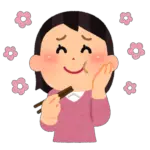
⭐️ 顎 = あご = ago = chin
* 顎で人を使う = あごでひとをつかう = ago de hito wo tsukau = to order people around
Literal meaning: to use people with one’s chin.
Ex. 顎で人を使うような上司とは働きたくない。
= あごでひとをつかうようなしょうしとははたらきたくない。
= Ago de hito wo tsukau you na joushi to wa hatarakitakunai.
= I don’t want to work with a boss who treats people like servants / orders people around arrogantly.
* 顎が外れるほど笑う
= あごがはずれるほどわらう
= ago ga hazureru hodo warau.
= to laugh one’s head off/to laugh extremely hard
Literal meaning: to laugh so hard that your jaw comes off.
Ex. ああ、面白かった!久しぶりに顎が外れるほど笑ったよ。😂
= ああ、おもしろかった!ひさしぶりにあごがはずれるほどわらったよ。
= Aa, omoshirokatta! Hisashiburi ni ago ga hazureru hodo waratta yo.
= That was hilarious!! I haven’t laughed that hard in a long time.
***
 マギー先生より = マギーせんせいより = Maggie Sensei yori = From Maggie Sensei
Dolly先生、ありがとう! = Dolly Sensei, Arigatou! = Thank you, Dolly-Sensei!
私のそのビーチに行って、顔見知りになりたいな。
= わたしもそのビーチにいって、かおみしりになりたいな。
= Watashi mo sono biichi ni itte, kaomishiri ni naritai na.
= I’d like to go to that beach and get to know you, too.
****
My Patrons can access the audio file
Audio Files for this lesson →Click here
PDF file without ads (One with romaji & One without romaji) →Click here
I appreciate your support! サポートありがとう! !
My supporters can access tons of audio files, PDF files, and special lessons on my Patreon page.
❤️ありがとう x 2: Mini lessons, PDF files with audio for all the lessons here from 2018
❤️ありがとう x 5 In addition to the previous benefit + Daily Japanese
Check the index of Daily Japanese Series →Index
❤️ありがとう x 10 In addition to the previous benefit + PDF file of all my Twitter lessons for a month (average 10 ~ 18 pages) with an audio file. Please check the details here
One-time support ↓ ありがとう!