
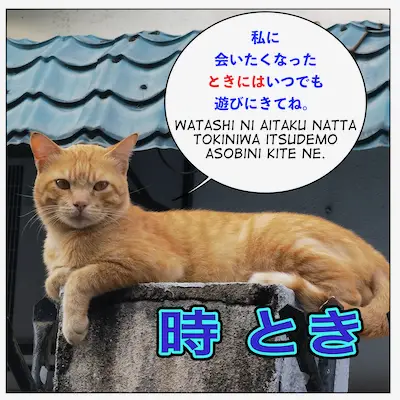
「私に会いたくなったときは、いつでも遊びに来てね。」
= わたしにあいたくなったときは、いつでもあそびにきてね。
= Watashi ni aitaku natta toki wa, itsudemo asobini kite ne.
= When you want to see me, feel free to come and visit anytime.
Hi everyone! I’m your guest teacher, Doggo. I like teasing doggies on the street so I got this name. 😉 (BTW if your family members or friends 🐶😺 want to be our guest teachers, please feel free to send their pictures.) →About Us
Today, we are going to study how to use とき ( = toki).
First, the kanji for とき ( = toki) is 時.
Though you see people use them both for both kanji and hiragana in daily writing, the basic rule for official documents or legal documents in Japanese is to use the kanji 時 ( = とき= toki) when you refer to the specific time, but when you discuss some situation/state or event, you would use とき ( = toki) .
I will use hiragana in this lesson except for certain expressions in the last part of this lesson.
⭐️How to form:
🔸With Verbs
* dictionary form + とき ( = toki)
行く= いく = iku = to go
→行くとき = いくとき = iku toki
(negative form)
行かないとき = いかないとき = ikanai toki
(past tense)
行った = いった = went
→行ったとき = いったとき = itta toki
(negative form)
行かなかったとき = いかなかったとき = ikanakatta toki
🔹You can use this form with auxiliary verbs, verbs in passive form, causative form, potential form, progressive form, honorific form, etc.
I will just give you a few examples here, I but will try to show you many example sentences.
* Vたい
見たい = みたい = mitai = want to see
→見たいとき = みたいとき = mitaitoki
(negative form)
見たくないとき = みたくないとき = mitakunai toki
(past tense)
見たかった = みたかった = wanted to see
→見たかったとき = みたかったとき = mitakatta toki
(negative form)
見たくなかったとき = みたくなかったとき = mitakunakatta toki
*Causative passive form
読まされる = よまされる = yomasareru = to be made to read
→読まされるとき = よまされるとき = yomasareru toki
(past tense)
読まされたとき = よまされたとき = yomasareta toki
* progressive form
行っている = いっている = itteiru = to be going
→行っているとき = いっているとき = itteiru toki
(past tense)
行っていた = いっていた = itteita
→行っていたとき = いっていたとき = itte ita toki = was going/used to go
🔸With Adjectives
* i-adjective
若い = わかい = wakai = young
→若いとき= わかいとき = wakai toki
(past tense)
若かった = わかかった = wakakatta = was/were young
→若かったとき = わかかったとき = wakakatta toki
* na-adjective
元気な = げんきな = genkina = to be healthy, cheerful
→元気なとき = げんきなとき = genkina toki
(negative form)
→元気ではないとき = げんきではないとき = genki dewa nai toki
(casual) 元気じゃないとき = げんきじゃないとき = genkijanai toki
(past tense)
元気だった = げんきだった = genkidatta = was/were healthy, cheerful
→元気だったとき = げんきだったとき = genkidatta toki =
(negative form)
→元気ではなかったとき = げんきではなかったとき = genki dewa nakatta toki
(casual) 元気じゃなかったとき = げんきじゃなかったとき = genkija nakatta toki
🔸With a noun
Noun + の ( = no) + とき ( = toki)
気分 = きぶん = kibu = mood
→気分のとき =きぶんのとき = kibun no toki
(negative form)
気分ではないとき = きぶんではないとき = kibun dewa nai toki
(casual) 気分じゃないとき = きぶんじゃないとき = kibunja nai toki
(past tense)
Noun + だった ( = datta ) + とき ( = toki)
気分だったとき = きぶんだったとき = kibun datta toki
(negative form)
気分ではなかったとき = きぶんではなかったとき = kibun dewa nakatta toki/
(casual)
気分じゃなかったとき = きぶんじゃなかったとき = kibunja ankatta toki
⭐️How to use とき ( = toki)
Basically とき ( = toki) means “when” / “the time” and express
→“When someone does / did something / something happens / happened + what will happen/ what happened / what one will do/does/did”
🔸とき ( = toki) / ときに ( = toki ni ) / ときは ( = toki wa) / ときには ( = toki niwa) :
* ときに ( = toki ni) :
Ex. 電話がかかってきたとき荷物がきた。
= でんわがかかってきたときにもつがきた。
= Denwa ga kakatte kita toki nimotsu ga kita.
= When the phone rang, the package arrived.
When you emphasize the specific time, you use に ( = ni) .
ときに ( = tokini ) at the time when
→ 電話がかかってきたときに荷物がきた。
= でんわがかかってきたときににもつがきた。
= Denwa ga kakatte kita toki ni nimotsu ga kita.
= When the phone rang, the package arrived.
(Emphasizing the time when the phone rang more than just とき ( = toki) )
* ときは ( = toki wa):
(1) When you bring up a specific time (or case) as a topic, use it with は.
ときは ( = toki wa)= when ~ / as for the time when ~
Ex. 日本にいたときは、何をしていたの?(casual)
= にほんにいたときは、なにをしていたの?
= Nihon ni ita toki wa, nani wo shite ita no?
= What were you doing when you were in Japan?
(Introducing a topic: As for the time when you were in Japan)
Note: You can use this with the honorific form as well.
日本にいらっしゃったときは、何をされていたのですか?(polite)
= にほんにいらっしゃったときは、なにをされていたのですか?
= Nihon ni irasshatta toki wa, nani wo sarete itano desu ka?
= What were you doing when you were in Japan?
(2) When you want to show the contrast between two different time periods, you also use ときは ( = tokiwa)
Ex. 今は、エンジニアの仕事をしているけど、日本にいたときは、何をしていたの?
= いまは、エンジニアのしごとをしているけど、にほんにいたときは、なにをしていたの? (casual)
= Ima wa, enjinia no shigoto wo shiteiru kedo, nihon ni ita toki wa, nani wo shiteita no?
= You’re currently working as an engineer, but what were you doing when you were in Japan?
(Showing the contrast: the present time vs. the time when the listener was in
Japan.)
- ときには ( = toki niwa): In the particular time when ~ (emphasizing when something happens/happened) / by the time when ~
Ex. 失恋したときには友達に話した方が気が楽になります。
= しつれんしたときにはともだちにはなしたほうがきがらくになります。
= Shitsuren shita toki niwa tomodachi ni hanashita hou ga ki ga raku ni narimasu.
= When you have a broken heart, talking to friends makes you feel better.
You often use ときには ( = tokiniwa) when something is too late or something is completed by the time when ~.
Ex. 空港に着いたときには、もう飛行機は出てしまっていた。
= くうこうについたときには、もうひこうきはでてしまっていた。
= Kuukou ni tsuita toki niwa, mou hikouki wa dete shimatte ita.
= When I arrived at the airport, the plane had already taken off.
(As for the time when I arrived at the airport, ~)
Note: 時には = ときには ( = toki niwa) also means “sometimes”. I will explain this use later in this lesson.)
🔸 Subject of the sentence ~ とき ( = toki) (S1) , (S2) :
The subject of the first sentence with とき ( = toki)(S1) and the subject in the following sentence (S2) can be the same or different.
→A + とき ( = toki) (S1) + A (S2)
or →A + とき ( = toki) (S1) + B (S2)
A (S1) + A (S2) (the same subject)
Ex. 私が学生だったときは、毎日図書館で勉強していた。
= わたしががくせいだったときは、まいにちとしょかんでべんきょうしていた。
= Watashi ga gakusei datta toki wa, mainichi toshokan de benkyou shiteita.
= When I was a student, I used to study at the library every day.
The subject of S1 and S2 is 私 = わたし = I
A (S1) + B(S2) (different subject)
Ex. 母が機嫌がいいときは、父も機嫌がいい。
= ははがきげんがいいときは、ちちもきげんがいい。
= Haha ga kigen ga ii toki wa, chichi mo kigen ga ii.
= When my mother is in a good mood, my father is also in a good mood.
The subject of S1 = 母 = はは = haha = my mother
The subject of S2 = 父 = ちち = chichi = my father
🔸The tense of verb/adjective/noun before とき ( = toki).
1) The cases when you can use both present tense and past tense with とき( = toki):
When you are talking about the state of something/someone or when you use a progressive tense or いる ( = iru ) to be, there is, you can use either present tense or past tense, and the tense you use doesn’t change the meaning.
(state)
Ex. 円が高いときは/高かったときは、よく海外旅行に行った。
= えんがたかいときは/たかかったときは、よくかいがいりょこうにいった。
= En ga takai toki wa/takakatta toki wa, yoku kaigairyokou ni itta.
= When the yen was strong, I used to go on overseas trips frequently.
Ex. 学生のときは/学生だったときは、お金がなくてバイトばかりしていた。
= がくせいのときは/がくせいだったときは、おかねがなくてバイトばかりしていた。
= Gakusei no toki wa /Gakusei datta toki wa, okane ga nakute baito bakari shite ita.
= When I was a student, I didn’t have much money, so I was always working part-time jobs.
Ex. 若いときは/若かったときは、どれだけ食べても太らなかった。
= わかいときは/わかかったときは、どれだけたべてもふとらなかった。
= Wakai toki wa/Wakakattta toki wa, doredake tabetemo futoranakatta.
= When I was young, no matter how much I ate, I didn’t gain weight.
Ex. 日本語がわからないときは/わからなかったときは、マギー先生に質問した。
= にほんごがわからないときは/わからなかったときは、マギーせんせいにしつもんした。
= Nihongo ga wakaranai toki wa/wakaranakatta toki wa, Maggie Sensei ni shitsumon shita.
= When I didn’t understand Japanese/didn’t understand Japanese, I asked Maggie-sensei.
(progressive form)
Ex. 夕食を作っているときに/作っていたときに誰かが玄関のチャイムを鳴らした。
= ゆうしょくをつくっているときに/つくっていたときにだれかがげんかんのチャイムをならした。
= Yuushoku wo tsukutte iru toki ni/tsukutte ita toki ni dareka ga genkan no chaimu wo narashita.
= When I was preparing dinner, someone rang the doorbell.
Ex. 私が試験勉強でがんばっているとき/いたとき、彼は、家でグーグー寝ていた。
= わたしがしけんべんきょうでがんばっているとき/いたとき、かれはいえでグーグーねていた。
= Watashi ga shikenbenkyou de ganbatte iru toki/ ita toki, kare wa ie de guuguu neteita.
= While I was working hard on exam preparation, he was sound asleep at home.
(verb いる = iru = to be/stay)
Ex. その子は、親が一緒にいる/いたときは機嫌がよかったのに親がいなくなった途端に泣き始めた。
= そのこは、おやがいっしょにいるときは/いたときはきげんがよかったのにおやがいなくなったとたんになきはじめた。
= Sono ko wa, oya ga issho ni iru toki wa/ita toki wa kigen ga yokatta noni oya ga inaku natta totan ni nakihajimeta.
= That child was in a good mood when he/she was with his/her parents, but the moment the parents were no longer there, he/she started crying.
2) When the verb before とき is a movement verb (Ex. 帰る = かえる = to return, go home, 行く = いく ( = iku) to go, 来る = くる ( = kuru) to come, etc) or an action verb, the meaning of the sentence changes depending on whether the verb before “とき ( = toki)” is in the past or present tense.
(present tense)
Ex. 家に帰るときに雨が降ってた。
= いえにかえるときにあめがふってた。
= Ie ni kaeru toki ni ame ga futte ita.
= It was raining on my way home.
Note: In this case, 帰る = かえる ( = kaeru) = going home in this sentence is an on-going action and you haven’t arrived home yet.
If you use the past tense with とき ( = toki), it implies the action is completed and you are home.
(past tense)
Ex. 家に帰ったときに雨が降り始めた。
= いえにかえったときにあめがふりはじめた。
= Ie ni kaetta toki ni ame ga furihajimeta.
= When I got home, it started to rain.
(present tense)
Ex. 日本に来るときは連絡してね。
= にほんにくるときはれんらくしてね。
= Nihon ni kuru toki wa renraku shite ne.
= Please let me know when you are coming to Japan.
Note: You want the person to contact you before they come to Japan.
(past tense)
Ex. 日本に来たときは連絡してね。
= にほんにきたときはれんらくしてね。
= Nihon ni kita toki wa renraku shite ne.
= Please let me know when you get to Japan.
Note: You want the person to contact you once they have already arrived in Japan.
(present tense)
Ex. 今度、日本に行くときはいいホテルを予約します。
= こんど、にほんにいくときはいいホテルをよやくします。
= Kondo, nihon ni iku toki wa ii hoteru wo yoyaku shimasu.
= When I go to Japan the next time, I will book a good hotel
Note: You are talking about booking the hotel before you go to Japan.
(past tense)
Ex. 日本に行ったときは美味しいラーメンを食べたい。
= にほんにいったときはおいしいラーメンをたべたい。
= Nihon ni itta toki wa oishii raamen wo tabetai.
= When I go to Japan, I would like to eat delicious ramen.
Note: You are talking about what you want to do after you get to Japan.
(present tense)
Ex. 家を出るときに傘を持っていくのを忘れないで。
= いえをでるときにかさをもっていくのをわすれないで。
= Ie wo deru toki ni kasa wo motte iku no wo wasurenai de.
= Don’t forget to take an umbrella with you when you leave the house.
Note: Talking about the time before you leave the house.
(past tense)
Ex. 家を出たときに傘を忘れたことに気がついた。
= いえをでたときにかさをわすれたことにきがついた。
= Ie wo deta toki ni kasa wo wasureta koto ni ki ga tsuita.
= I realized I had forgotten the umbrella when I left the house.
Note: Talking about the time after you left the house
Ex. 学校に着いたとき、授業はもう終わっていた。
= がっこうについたとき、じゅぎょうはもうおわっていた。
= Gakkou ni tsuita toki, jugyou wa mou owatte ita.
= When I arrived at school, the class was already over.
(X 着くとき = つくとき = tsuku toki) wrong
********
Let’s see more examples with とき ( = toki)
🔹Talking about conditions / Talking about what you do/did/are going to do when you are/were in a certain situation/state.
Ex. お酒を飲んでいるときはなかなか眠れない。
= おさけをのんでいるときはなかなかねむれない。
= Osake wo nonde iru toki wa nakanaka nemurenai.
= When I drank alcohol, I couldn’t sleep easily.
(Talking about one’s state after drinking alcohol.)
Ex. 彼女といるときは幸せだ。
= かのじょといるときはしあわせだ。
= Kanojo to iru toki wa shiawase da.
= When I am with her, I am happy.
Ex. お金がないときは、昼ごはんを抜きます。
= おかねがないときは、ひるごはんをぬきます。
= Okane ga nai toki wa, hirugohan wo nukimasu.
= When I don’t have money, I (will) skip lunch.
Ex. 暇なときは、電話するよ。(casual)
= ひまなときは、でんわするよ。
= Himana toki wa, denwa suru yo.
= I will give you a call when I am free and have nothing to do.
Ex. お腹がすいたときは、このパン食べていいからね。(casual)
= おなかがすいたときは、このパンたべていいからね。
= Onaka ga suita toki wa, kono pan tabete ii kara ne.
= You can eat this bread when you are hungry, OK?
🔹 Talking about simultaneous actions/ two actions or events happening at the same time. / While ~, something happens/happened, someone does/did something
Ex. 私の猫は、私が寝ているときは、足元に来て一緒に寝てくれる。
= わたしのねこは、わたしがねているときは、あしもとにきていっしょにねてくれる。
= Watshi no neko wa, watashi ga nete iru toki wa, ashimoto ni kite issho ni nete kureru.
= My cat comes to my feet and sleeps with me when I’m sleeping.
Ex. 夕食を作っているときに停電があった。
= ゆうしょくをつくっているときにていでんがあった。
= Yuushoku wo tsukutte iru toki ni teiden wa atta.
= There was a power outage when I was preparing dinner.
Ex. エアコンのスイッチを入れたときに変な音がした。
= エアコンのスイッチをいれたときにへんなおとがした。
= Eakon no suicchi wo ireta toki ni henna oto ga shita.
= I heard a strange noise (A strange noise occurred) when I turned on the air conditioner.
🔹Talking about one’s habits: Whenever ~ + making a habit of doing something
Ex. 喉が痛いとき、生姜湯を飲むと楽になる。
= のどがいたいとき、しょうがゆをのむとらくになる。
= Nodo ga itai toki, shougayu wo nomu to raku ni naru.
= When I have a sore throat, drinking ginger tea eases the discomfort.
Ex. 落ち込んだときは、この曲を聴くと元気になる。
= おちこんだときは、このきょくをきくとげんきになる。
= Ochikonda toki wa, kono kyoku wo kiku to genki ni naru.
= When I’m feeling down, listening to this song cheers me up.
Ex. 大阪に行ったときはいつも串カツを食べに行く。
= おおさかにいったときはいつもくしカツをたべにいく。
= Oosaka ni itta toki wa, itsumo kushikatsu wo tabeni iku.
= Whenever I go to Osaka, I always go to eat kushikatsu.
Ex. 朝ごはんを食べる時は、ニュースを観ます。
= あさごはんをたべるときは、ニュースをみます。
= Asagohan wo taberu toki wa, nyuusu wo mimasu.
= When I have breakfast, I watch the news.
Ex. 彼はいつもデートのときに遅れてくる。
= かれはいつもデートのときにおくれてくる。
= Kare wa itsumo deeto no toki ni okurete kuru.
= He’s always late to his dates.
*Talking about one’s habits in the past.:
Ex. そのお菓子、子供のときによく食べたよ。(casual)
= そのおかし、こどものときによくたべたよ。
= Sono okashi, kodomo no toki ni yoku tabeta yo.
= I used to eat that snack a lot when I was a child.
Note: You can also use 頃 = ころ ( = koro) instead of とき ( = toki)
頃 = ころ ( = koro) = around the time of ~ . 頃 = ころ ( = koro) is more vague and refers to a general time.
→子供の頃 = こどものころ = kodomo no koro = one’s childhood
Ex. 思春期の時は、好きな子を見ただけでどきどきしたものだ。
= ししゅんきのときは、すきなこをみただけでどきどきしたものだ。
= Shishunki no toki wa, sukina ko wo mita dake de dokidoki shita mono da.
= In my adolescence, just seeing the person I had a crush on would make my heart race.
Ex. 東京に住んでいた時に、毎週末、秋葉原に行っていた。
= とうきょうにすんでいたときに、まいしゅうまつ、あきはばらにいっていた。
= Toukyou ni sunde ita toki ni, maichuumastsu, Akihabara ni itteita.
= When I lived in Tokyo, I used to go to Akihabara every weekend.
🔹Talking about a specific time/time period:
Ex. 彼から絵葉書を受け取ったときとても嬉しかった。
= かれからえはがきをうけとったときとてもうれしかった。
= Kare kara ehagaki wo uketotta toki totemo ureshikatta.
= I was really happy when I received a postcard from him.
Ex. その人は、息子が転んだときにすぐに助けてくれた。
= そのひとは、むすこがころんだときにすぐにたすけてくれた。
= Sono hito wa, musuko ga koronda toki ni sugu ni tasukete kureta.
= That person immediately helped my son when he fell.
Ex. 地震が起きたとき、どこにいましたか?
= じしんがおきたとき、どこにいましたか?
= Jishin ga okita toki, doko ni imashita ka?
= Where were you when the earthquake hit?
Ex. 日本に来て、メニューが読めたときに初めて日本語を勉強してよかったと思った。
= にほんにきて、メニューがよめたときにはじめてにほんごをべんきょうしてよかったとおもった。
= Nihon ni kite, menyuu ga yometa toki ni hajimete nihongo wo benkyou shite yokatta to omotta.
= When I came to Japan and was able to read menus, that’s when I first thought it was good that I had studied Japanese.
Ex. 友達との待ち合わせの時間は1時だったと気がついたときはもう遅かった。
= ともだちとのまちあわせのじかんはいちじだったときがついたときはもうおそかった。
= Tomodachi no machiawase no jikan wa ichiji datta to kigatsuita toki wa mou osokatta.
= When I realized the meeting time with my friend(s) was 1 o’clock, it was already too late.
🔹Giving advice/suggestion/warning: In case of ~/ When something happens + what do to/what not to do
Ex. 具合が悪くなったときは、呼び出しボタンを押してください。
= ぐあいがわるくなったときは、よびだしボタンをおしてください。
= Gutai ga waruku natta toki wa, yobidashi botan wo oshite kudasai.
= When you feel unwell, please press the call button.
Ex. 何かあったときには、すぐに駆けつけます。
= なにかあったときには、すぐにかけつけます。
= Nani ka atta toki niwa, sugu ni kaketsukemasu.
= When something happens to you/If something happens to you, I will come immediately.
Ex. 疲れたときは、寝るのが一番です。
= つかれたときは、ねるのがいちばんです。
= Tsukareta toki wa, neru no ga ichiban desu.
= When you’re tired, the best thing to do is to sleep.
Ex. 緊急のとき*は、こちらにお電話ください。
= きんきゅうのときは、こちらにおでんわください。
= Kinkyuu no toki wa, kochira ni odenwa kudasai.
= In case of an emergency, please call this number.
(You can also say 緊急時 = きんきゅうじ = kinkyuuji )
Ex. 気持ちが悪いときは横になった方がいい。
= きもちがわるいときはよこになったほうがいい。
= Kimochi ga warui toki wa yoko ni natta hou ga ii.
= When you feel sick, you should lie down.
Ex. 辛いときは頼っていいんだよ。
= つらいときはたよっていいんだよ。
= Tsurai toki wa tayotte iindayo.
= It’s okay to rely on me when you’re going through a tough time, OK?
Ex. テレビを見るときは、目に悪いから1メートル以上離れて見た方がいいよ。
= テレビをみるときは、めにわるいからいちメートルいじょうはなれてみたほうがいいよ。
= Terebi wo miru toki wa, me ni warui kara ichimeetoru ijou wa hanareta mita hou ga ii yo.
= When watching TV, it’s better to watch from a distance of more than one meter because it’s bad for your eyes.
Ex. パソコンが遅くなったときは、キャッシュを消去したほうがいい。
= パソコンがおそくなったときは、キャッシュをしょうきょしたほうがいい。
= Pasokon ga osoku natta toki wa, kyasshu wo shoukyo shita hou ga ii.
= When your computer becomes slow, it’s a good idea to clear the cache.
Ex. 赤いランプがついたときは、電池を取り替えてください。
= あかいランプがついたときは、でんちをとりかえてください。
= Akai ranpu ga tsuita toki wa, denchi wo torikaete kudasai.
= When the red light is on, please replace the battery.
Ex. 困った時はお互い様 (Saying)
= こまったときはおたがいさま
= Komatta toki wa otagai sama.
= We help each other in times of trouble/It’s a mutual thing when we’re in trouble./I scratch your back if you scratch my back.
🔸ときが = emphasizing a topic/ when ~ + feelings (talking about how you feel about the time)
Ex. ついに彼との別れのときがきた。
= ついにかれとのわかれのときがきた。
= Tsui ni kare tono wakare no toki ga kita.
= At last, the time for parting with him has come.
Ex. マギーといるときが一番幸せだ。
= マギーといるときがいちばんしあわせだ。
= Maggie to iru toki ga ichiban shiawase da.
= I am the happiest when I am with you, Maggie.
Ex. 友達とたわいもない話をしているときが一番楽しい。
= ともだちとたわいもないはなしをしているときがいちばんたのしい。
= Tomodachi to tawaimo nai hanashi wo shiteiru toki ga ichiban tanoshii.
= I enjoy the most when I’m having trivial conversations with friends.
🔸ときから ( = toki kara) since ~ , from the time ~ / ときまで ( = toki made) = until ~ ,up to the time ~
Ex. 5歳のときからピアノを習っています。
= ごさいのときからピアノをならっています。
= Gosai no toki kara piano wo naratte imasu.
= I have been taking piano lessons since I was five years old.
Ex. 彼女は、生まれたときから苦労をしたことがない。
= かのじょは、うまれたときからくろうをしたことがない。
= Kanojo wa, umareta toki kara kurou wo shita koto ga nai.
= She has never experienced hardship since the day she was born.
Ex. 乗車券は、降りるときまでなくさないようにしてください。
= じょうしゃけんは、おりるときまでなくさないようにしてください。
= Joushaken wa, oriru toki made nakusanai you ni shite kudasai.
= Please make sure to hold on to your ticket until you get off.
🔸ときも ( = toki mo) = when ~ also, anytime, even when
Ex. コンビニは、日曜日に荷物を出したいときも使える。
= コンビニは、にちようびににもつをだしたいときもつかえる。
= Konbini wa, nichiyoubi ni nimotsu wo dashitai toki mo tsukaeru.
= Convenience stores can also be used when you want to send a package on
Sundays.
Ex. 叔母は、私が高校を卒業したときもきれいな花を贈ってくれた。
= おばは、わたしがこうこうをそつぎょうしたときもきれいなはなをおくってくれた。
= Oba wa, watashi ga koukou wo sotsugyou shita toki mo kireina hana wo
okutte kureta.
= My aunt gave me beautiful flowers even when I graduated from high school.
Ex. 父はどんなときも私の味方だった。
= ちちはどんなときもわたしのみかただった。
= Chichi wa donna toki mo watashi no mikata datta.
= My father was always on my side, no matter the circumstances.
🔸ときでも ( = toki demo) even when, even in the case of, no matter what
Ex. どんなときでも私を支えてくれてありがとう。
= どんなときでもわたしをささえてくれてありがとう。
= Donna toki demo watashi wo sasaete kurete arigatou.
= Thanks for always being there for me.
Ex. 姉は、自分が経済的に苦しい時でも助けてくれた。
= あねは、じぶんがけいざいてきにくるしいときでもたすけてくれた。
= Ane wa, jibun ga keizaiteki ni kurushii toki demo tasukete kureta.
= My big sister helped me even when she was financially struggling.
🔸ときこそ = (one should do something ) especially the time when ~
Ex. 暑いときこそ、温かいものを飲んだ方がいいらしい。
= あついときこそ、あたたかいものをのんだほうがいいらしい。
= Atsui toki koso, atatakai mono wo nonda hou ga ii.
=They say you should drink warm things, especially when it’s hot.
Ex. 苦しいときこそがんばれる
= くるしいときこそがんばれる。
= Kurushii toki koso ganbareru.
= When it’s tough, that’s when you can push yourself.
Check my こそ ( = koso) lesson to learn more: Click here.
🔸ときに限って = ときにかぎって ( = toki ni kagitte) = only when/ whenever
Ex. 忙しいときに限って友達が遊びにくる。
= いそがしいときにかぎってともだちがあそびにくる。
= Isogashii toki ni kagitte tomodachi ga asobini kuru.
= My friends come over whenever I am busy. (They don’t usually come over
but they only come when I am busy.
Check: How to use 限る = かぎる ( = kagiru) lesson: Click here
⭐️Other expressions with 時 = とき ( = toki)
🔹With demonstrative adjectives
*この ( = kono) /その ( = sono) /あの ( = ano) + 時 /とき ( = toki) = this/that/ *that time (*referring to a time more distant)
* こんな ( = konna) /そんな ( = sonna) /あんな ( = anna) *
= こういう ( = kouiu) /そういう ( = souiu) /*ああいう ( = aaiu ) + 時 /とき ( = toki) = in a situation like this/that / in such a situation
(Looking back one’s past)
Ex. あの時、彼女に好きだと言えばよかった。
= あのとき、かのじょにすきだといえばよかった。
= Ano toki, kanojo ni suki dato ieba yokatta.
= I should have told her that I loved her at that time.
Ex. こういうとき/こんなとき、どうしたらいいんだろう。
= Kouiu toki/Konna toki, doushitara iindarou.
= I wonder what I should do in a situation like this.
Ex. そういうときは/そんなときは、私を呼んでください。
= そういうときは/そんなときは、わたしをよんでください。
= Souiu toki wa/Sonna toki wa, watashi wo yonde kudasai.
= In that kind of situation/ If that happens again, please call me.
🔹時々 = ときどき = tokidoki = sometimes, once in a while, frequently
Ex. 時々、別れた彼女のことを考える。
= ときどき、わかれたかのじょのことをかんがえる。
= Tokidoki, wakareta kanojo no koto wo kangaeru.
= I think about my ex-girlfriend once in a while.
Ex. A: 「日本のテレビ番組は観る?」(casual)
= にほんのテレビばんぐみはみる?
= Nihon no terebi bangumi wa miru?
= Do you watch Japanese TV shows?
B: 「うん、時々観るよ。」(casual)
= うん、ときどきみるよ。
= Un, tokidoki miru yo.
= Yeah, I watch them once in a while.
🔹時には = ときには ( = toki niwa) = once in a while, sometimes (formal)
Ex. 時には一人になりたいこともある。
= ときにはひとりになりたいこともある。
= Toki niwa hitori ni naritai koto mo aru.
= At times, I also want to be alone.
🔹時として = ときとして ( = toki to shite) = sometimes / in some situations / in some cases (formal/written language)
Ex. 時として正直であることが人を傷つける。
= ときとしてしょうじきであることがひとをきずつける。
= Toki to shite shoujiki de aru koto ga hito wo kizutsukeru.
= Sometimes being honest can hurt people./Being honest can hurt people in some situations./ Sometimes being honest can hurt people’s feelings.
🔹時と場合による = ときとばあいによる ( = toki to baai ni yoru ) = Depends on the time and situation/ It depends/That depends.
Ex. A:「出張に行ったらいつもお土産を買うの?」(casual)
= しゅっちょうにいったらいつもおみやげをかうの?
= Shucchou ni ittara itsumo omiyage wo kau no?
= Do you always buy souvenirs when you go on business trips?
B: 「そうだなあ、時と場合によるよ。」(casual)
= そうだなあ、ときとばあいによるよ。
= Souda naa, toki to baai ni yoru yo.
= Well, it depends on the time and situation.
***
 マギー先生より = マギーせんせいより = Maggie Sensei yori = From Maggie Sensei
Doggo先生、ありがとう! = Doggo せんせい、ありがとう!= Doggo Sensei, arigatou! = Thank you, Doggo Sensei
Doggo先生に会いたくなったときは、遊びに行きますよ。そのときは、からかわないでね。
= Doggo せんせいにあいたくなったときは、あそびにいきますよ。そのときは、からかわないでね。
= Doggo Sensei ni aitaku natta toki wa, asobini ikimasu yo. Sono toki wa, karakawanai dene.
= When I want to see you, I’ll come to visit you. Please don’t tease me then.
****
My Patrons can access the audio file
Audio Files for this lesson →Click here
PDF file without ads (One with romaji and one without romaji) →Click here
I REALLY appreciate your support! サポートありがとう! !
My supporters can access tons of audio files, PDF files, and special lessons on my Patreon page.
❤️ありがとう x 2: Mini lessons, Audio files for all the lessons here from 2018,
❤️ありがとう x 5 In addition to the previous benefit + Daily Japanese
Check the index of Daily Japanese Series →Index
❤️ありがとう x 10 In addition to the previous benefit + PDF file of all my Twitter lessons for a month (average 10 ~ 18 pages) with an audio file. Please check the details here
One-time support ↓ ありがとう!

4 Comments
ありがとうございます。日本語の勉強はまだまだ続きます :’)
いつもルナのことを応援しています! p(^_^)q
マギー先生は新しレッスンをアップするとき、さっそく読めばいいともいます。時には読んでくるを忘れます。
ルナ
今日は、二つもレッスン読んでくれましたね。
(Note for you: ルナの書いてくれた文章もわかりますが、少しお手伝いしますね。
マギー先生が新しいレッスンをアップしたときに(or アップしたら、) すぐに読めばいいと思います。
時には(すでに)読んだことを忘れます。) ☺️