
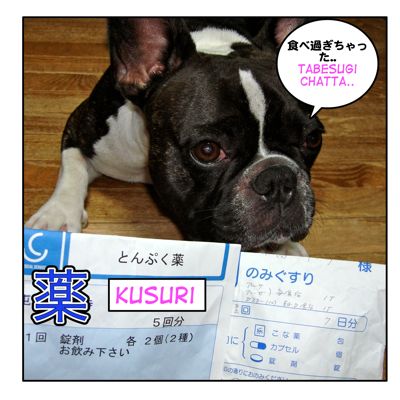
「食べ過ぎちゃった…」
=Tabesugichatta…
=I ate too much…
Yep! I ate too much last night, and I have a stomachache today.
So today’s word is 薬 = kusuri = medicine
薬 =くすり/やく = kusuri/yaku
* 薬を飲む
= kusuri wo nomu
= to take medicine
(The verb 飲む( = nomu) means “to drink” but we also use it to take medicine.
(Note! You cannot literally say “take” medicine (薬を取る ( = kusuri wo toru) in Japanese. It sounds strange.)
In Japan, we can buy over-the-counter medicine like pain killers, and cold medicine at a 薬局 ( = yakkyoku) , pharmacy.
For the more seriously sick, we go to the doctor or hospital and either get medicine there directly or get a 処方箋 ( = shohousen) =prescription and go to 処方箋薬局 ( = yakkyoku) pharmacy where they deal with prescription medicine.
Basically there are two kinds of medicines.
•外用薬 ( = gaiyouyaku) external medicine
🔸 Basic medicines
•塗り薬 = nuri gusuri = topical cream
•湿布薬 = shippuyaku = compress, pack, anti-inflammatory analgesic plaster
•消毒薬 = shoudokuyaku = antiseptic substance
•目薬 = megusuri = eye-drop
•内服薬 = naifukuyaku = medicine for internal use
We also call it as
•のみぐすり = 飲み薬 = nomigusuri = oral medicine
 • 粉薬 = こな薬 = powder medicine
How to count: 包 = hou, pou
•カプセル = kapuseru = capsule
How to count: 個 = ko

•錠剤 = jouzai = pills
How to count: 錠 = jou
🔸 Basic medicines
•風邪薬 = kazegusuri = cold medicine
•胃腸薬 = ichouyaku = digestive medicine
•頭痛薬 = zutsuuyaku = headache medication
•痛み止め = itamidome = pain killer
•下痢止め薬 = geridomeyaku = anti-diarrhea medication
•便秘薬 = benpiyaku = laxative product
•ビタミン剤 = bitaminzai = vitamins
•とんぷく薬 = 頓服薬 = tonpukuyaku
= medicines for internal use which you take when it is necessary like painkillers.
Besides とんぷく薬 ( = tonpukuyaku) , we are supposed to take medicine regularly.
Almost all the medicine has these notes outside of the box or envelope.
Ex.1日3回 = ichinichi sankai = three times a day
Ex.1日2回 = ichinichi nikai = twice a day
Ex. 毎食後 = maishokugo = after each meal
Ex. 朝•昼•ねる前•( )時間毎に
=asa/hiru/nerrumae/ ( ) jikan goto ni
=in the morning/at noon/before going to bed/ every ( ) hours
Ex. 食後•食前•食間 = shokugo/shokuzen/shokkan = after meal/before meal/during the meal
Ex. 各2個(2種)おのみ下さい。= Kaku niko (nishu) onomi kudasai = Please take two for each medicine. (two kinds (of medicines)
 From Maggie Sensei
みなさんも食べ過ぎには気をつけて下さいね。
=Minasan mo tabesugi niwa kiwotukete kudasaine.
=You should be careful not to eat too much either!
***
Will you be my Patron?
I appreciate your support! サポートありがとう!
12 Comments
失礼しますが、ちょっと質問があります。「気合い薬」は何か知ってますか?抗鬱薬みたいなことですか?彼女はその薬を飲むから少し心配してます。その絵文字を使いましたから、飲むのがタブレット化カプセルだと思います。💊
「気合い薬」はないので、多分、彼女さんは、本当の薬のことではなく「気合いをいれなくてはいけない = I have to psyche myself up」というmetaphorの意味で使ったと思います。
その人によって気合いを入れるものは違うので、例えばお酒を飲んで気合いをいれる人もいるし、音楽を聞いたり、ライブに行くことが「気合い薬」になる人もいますね。
ああ、わかりました。少し安心してましたけど、彼女に聞くことがちょっと恥ずかしいと思いました。ありがとうございます!
あとから笑い話になるといいですね。☺️
How would you say, I buy medicine at the drugstore
You say
薬局で薬を買います。
= やっきょくでくすりをかいます。
= yakkyoku de kusuri wo kaimasu.
Thank you… the google translator says: Kanojo wa itsumo kanojo no kusuri o torimasu for she always takes her medicine. I guess that is not correct. :grin: I am glad I check here first and now know the correct way to say take you medicine. Thanks you site is wonderful. I have learned a lot from your lessons. boucingheart! :uparrow:
@Janice
That is why we can not depend on google translator yet.
Hi maggie sensei… first of all thank you very much for making this wonderful lessons… Ive been learning a lot lately and having fun most specially UNDERSTANDING the lesson so easily… I have a request though, could you kindly make a lesson about inside the hospital. The form they use and questionaires and so fort… thank you and more power…
@Paul
Hi Paul,
Thank you for visiting this site. I am very happy to hear you enjoy studying Japanese.
As for your request, I thought about making a lesson on that theme before but since there are so many medical terms and they are tough, I was reluctant to make one. But I will add it on the request list.
Meanwhile please check this 風邪 lesson where I explained how to express your symptoms.
Thanks so much, i was seeking this…
@Aidolu
You’re welcome! Thank you for visiting this site! !ochame!