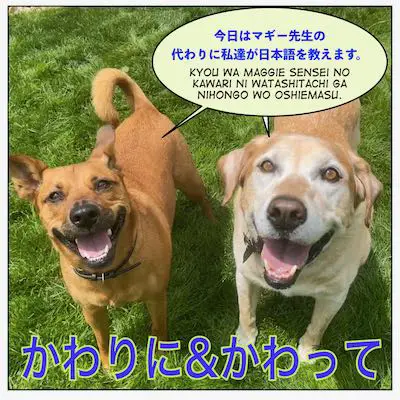
「今日はマギー先生の代わりに私達が日本語を教えます。」
= きょうはマギーせんせいのかわりにわたしたちがにほんごをおしえます。
= Kyou wa Maggie Sensei no kawari ni watashitachi ga nihongo wo oshiemasu.
= Today we will teach you Japanese instead of Maggie-sensei.
Hi everyone! We are your guest teachers today, Louie and Ellie.
We are going to study how to use 代わりに ( = かわりに = kawari ni) and 代わって ( = かわって = kawatte).
First, there are a few different kanji for かわる = kawaru, so let’s look at the differences.
I will explain them one by one, but first I’ll start with 変わる = かわる = kawaru, which is the most commonly used of the four.
🔸変わる = かわる = kawaru (the state / condition) changes / to be transformed
(transitive form: 変える = かえる= kaeru = to change something/to transform something)
It is the most commonly used kanji.
Ex. 環境が変わる
= かんきょうがかわる
= kankyou ga kawaru
= the environment changes
Ex. 天気がすぐに変わる
= てんきがすぐにかわる
= tenki ga sugu ni kawaru
= the weather changes quickly
Ex. 気が変わった。
= きがかわった。
= ki ga kawatta.
= I changed my mind.
Ex. 髪型が変わる
= かみがたがかわる
= kamigata ga kawaru
= one’s hairstyle changes
→transitive form: You change something
Ex. 髪型を変える
= かみがたをかえる
= kamigata wo kaeru
= to change one’s hairstyle
Ex. 話題を変える
= わだいをかえる
= wadai wo kaeru
= to change the topic
🔸替わる = かわる = kawaru = to be switched/to be replaced with something new/ when something is replaced with another
(transitive form: 替える = かえる = kaeru = to switch / replace something)
Ex. 月が替わるとまた新しいメニューになります。
= つきがかわるとまたあたらしいメニューになります。
= Tsuki ga kawaru to mata atarashii menyuu ni narimasu.
= When the month changes, we have a new menu again.
Ex. 日替わり定食
= ひがわりていしょく
= higawari teishoku
= daily special / daily set meal
Ex. このホテルは毎日、シーツを替えて(or 取り替えて)くれない。
= このホテルはまいにち、シーツをかえて(or とりかえて)くれない。
= Kono hoteru wa mainichi, shiitsu wo kaete (or torikaete ) kurenai.
= This hotel doesn’t change the sheets every day.
Ex. 1万円札を千円札10枚に両替する
= いちまんえんさつをせんえんさつじゅうまいにりょうがえする
= Ichimanen satsu wo sen-en satsu juumai ni ryougae suru.
= to exchange a 10,000-yen bill for ten 1,000-yen bills
🔸 換わる = かわる = kawaru = to be exchanged / to be switched / to be swapped
When one thing is exchanged or swapped with another of the same value―money, points, tickets, products, etc.
(transitive form: 換える = かえる = kaeru = to exchange / to swap something)
Ex. 不用品がいいお金に換わることもあるから捨てない方がいいよ。
= ふようひんがいいおかねにかわることもあるからすてないほうがいいよ。
= Fuyouhin ga ii okane ni kawaru koto mo aru kara sutenai hou ga ii yo.
= Sometimes unwanted items can be exchanged for good money, so it’s better not to throw them away.
Note: 不用品 = ふようひん = fuyouhin
→ This word refer to items that cannot be used typically because they are broken, damaged, or otherwise unusable for their original intended purpose.
Ex. 日本円をユーロに換える
= にほんえんを ユーロにかえる
= Nihon-en wo yuuro ni kaeru
= to exchange Japanese yen for euros
Note: 両替( = りょうがえ = ryougae) is used when exchanging items of the same value, such as changing bills or coins.
換える( = かえる = kaeru) is used when the currency unit itself changes, such as yen¥→ euro €.
Ex. 上野駅で銀座線に乗り換えてください。
= うえのえきでぎんざせんにのりかえてください。
= Uenoeki de Ginza-sen ni norikaete kudasai.
= Please transfer (change trains) to the Ginza Line at Ueno Station.
🔸代わる = かわる = kawaru = to substitute for ~ / to take over someone’s place
When someone acts on behalf of someone else or takes their role.
(transitive form: 代える = かえる = kaeru = to substitute / to change someone’s role or position)
Ex. A: 「疲れたら運転代るからね。」(casual)
= A: つかれたらうんてんかわるからね。
= A: Tsukaretara unten kawaru kara ne.
= A: I’ll take over the driving if you get tired.
B: 「ありがとう。次のサービスエリアで代わってくれる?」
= B: ありがとう。つぎのサービスエリアでかわってくれる?
= B: Arigatou. Tsugi no saabisu-eria de kawatte kureru?
= B: Thanks. Can we switch at the next service area?
Ex. 明日のバイトのシフト代わってくれない? (casual)
= あしたのバイトのシフトかわってくれない?
= Ashita no baito no shifuto kawatte kurenai?
= Could you switch shifts with me for tomorrow’s part-time job?
******
OK, now let’s get into the theme of this lesson: How to use 代わりに & 代わって = かわりに & かわって = kawari ni & Kawatte
⭐️How to form:
🔹〔noun (something/someone) + の = no* 〕 + 代わりに ( = かわりに = kawari ni ) + sentence = instead of ~ / to be substituted for
Ex. 今朝は、パンの代わりにご飯を食べた。
= けさは、パンのかわりにごはんをたべた。
= Kesa wa, pan no kawari ni gohan wo tabeta.
= This morning, I ate rice instead of bread.
Ex. 牛乳の代わりにアーモンドミルクでシチューを作ってみた。
= ぎゅうにゅうのかわりにアーモンドミルクでシチューをつくってみた。
= Gyuunyuu no kawari ni aamondo miruku de shichuu wo tsukutte mita.
= I tried making the stew with almond milk instead of regular milk.
Ex. レンタカーが故障したのですぐに代わりの車を手配してもらった。
= レンタカーがこしょうしたのですぐにかわりのくるまをてはいしてもらった。
= The rental car broke down, so they arranged a replacement car for me right away.
Ex. 和風スパゲッティーの店でフォークの代わりに箸が出てきた。
= わふうスパゲッティーのみせでフォークのかわりにはしがでてきた。
= Wafuu supagettii no mise de fooku no kawari ni hashi ga dete kita.
= At the Japanese-style spaghetti restaurant, they gave up chopsticks instead of forks.
Ex. 仕事であなたの代わりはいっぱいいるかもしれないが、自分の人生に代わりはいない。
= しごとであなたのかわりはいっぱいいるかもしれないが、じぶんのじんせいにかわりはいない。
= Shigoto de anata no kawari wa ippai iru kamo shirenai ga, jibun no jinsei ni kawari wa inai.
= There may be many people who can replace you at work, but nobody can replace you in your own life.
Ex. 今日はビールの代わりにノンアルビールにしておくよ。(casual)
= きょうはビールのかわりにノンアルビールにしておくよ。
= Kyou wa biiru no kawari ni non-aru-biiru ni shite oku yo.
= I’ll go with non-alcoholic beer instead of regular beer today.
Note: * 〔The noun (something / someone) + の ( = no) 〕 can be omitted to avoid repetition when the meaning is clear from context.
Ex. (Maggie) オックスフォード大学は難しいので*代わりにドッグスフォード大学に行くことにした。🐶
= (Maggie) オックスフォードだいがくはむずかしいのでかわりに*ドッグスフォードだいがくにいくことにした。
= (Maggie) Okkusufoodo daigaku wa muzukashii node kawari ni Doggusufoodo daigaku ni iku koto ni shita.
= (Maggie) Oxford University is too difficult, so I decided to go to Dogsford University instead.
*(Omitting オックスフォード大学の = オックスフォードだいがくの = Okkusufoodo daigaku no)
Ex. せっかくコンサートのチケットを入手したのにその日仕事で行けなくなっちゃった。代わりに行ってくれない?
= せっかくコンサートのチケットをにゅうしゅしたのにそのひしごとでいけなくなっちゃった。かわりに* いってくれない?
= Sekkaku konnsaato no chiketto wo nyushu shita no ni sono hi shigoto de ikenakunatcchatta. Kawari ni itte kurenai?
= I finally got a concert ticket, but I can’t go that day because of work. Could you go instead?
*(Omitting: 私の = わたしの = watashi no)
🐶 From the picture above:
今日はマギー先生の代わりに私達が日本語を教えます。
= きょうはマギーせんせいのかわりにわたしたちがにほんごをおしえます。
= Kyou wa Maggie Sensei no kawari ni watashitachi ga nihongo wo oshiemaseu.
= Today we will teach you Japanese instead of Maggie-sensei.
🔹 〔noun + に 〕代わって = かわって = kawatte
= instead of ~ / to be substituted / on behalf of ~ / in place of ~/ filling in for ~
You can rephrase the sentence above using に代わって = にかわって = ni kawatte:
→今日はマギー先生に代わって私達が日本語を教えます。
= きょうはマギーせんせいにかわってわたしたちがにほんごをおしえます。
= Kyou wa Maggie Sensei ni kawatte watashi ga nihongo wo oshiemasu.
= Today we will teach you Japanese instead of Maggie-sensei.
Ex. 多くの学校で、紙の教科書に代わってデジタルの教科書が使われ始めている。
= おおくのがっこうで、かみのきょうかしょにかわってデジタルのきょうかしょがつかわれはじめている。
= Ooku no gakkou de, kami no kyoukasho ni kawatte dejitaru no kyoukasho ga tsukawarehajimete iru.
= In many schools, digital textbooks are starting to be used instead of paper textbooks.
Ex. 10年後には人間に代わって全ての仕事をAIがするかもしれない。
= じゅうねんごには にんげんにかわってすべてのしごとをAI がするかもしれない。
= Juunengo ni wa ningen ni kawattte subete no shigoto wo AI ga suru kamo shirenai.
= In ten years, AI might do all the jobs instead of humans.
🔹verb (casual form) + 代わりに( = かわりに = kawari ni )+ sentence: In place of doing something do something instead / do something in return for it / offer something as a trade-off
Ex. 京都に行く代わりに奈良に行くことになった。
= きょうとにいくかわりにならにいくことになった。
= Kyouto ni iku kawari ni Nara ni iku koto ni natta.
= Instead of going to Kyoto, we ended up going to Nara.
Ex. クリスマスに休みを取る代わりに正月は仕事をしなくてはいけない。
= クリスマスにやすみをとるかわりにしょうがつはしごとをしなくてはいけない。
= Kurisumasu ni yasumi wo toru kawari ni shougatsu wa shigoto wo shinakute wa ikenai.
= Since I’m taking time off at Christmas, I have to work during New Year’s.
Ex. 来年から新卒を雇う代わりに経験のあるシニア世代を雇ったらどうだろう。
= らいねんからしんそつをやとうかわりにけいけんのあるシニアせだいをやとったらどうだろう。
= Rainen kara shinsotsu wo yatou kawari ni keiken no aru shinia sedai wo yatottara doudarou.
= How about hiring experienced senior workers instead of hiring new graduates starting next year?
Ex. 財布にお金がなかったので現金で買う代わりにポイントで支払った。
= さいふにおかねがなかったのでげんきんでかうかわりにポイントでしはらった。
= Saifu ni okane ga nakatta node genkin de kau kawari ni pointo de shiharatta.
= I didn’t have any money in my wallet, so instead of paying with cash, I paid with reward points.
Ex. 友達にうちまで車で送ってくれた代わりに、近い内に好きなものをご馳走する約束をした。
= ともだちにうちまでくるまでおくってくれたかわりに、ちかいうちにすきなものをごちそうするやくそくをした。
= Tomodachi ni uchimade kurumade okutte kureta kawari ni, chikai uchi ni sukina mono wo gochisou suru yakusoku wo shita.
= I promised my friend that I would treat him to anything he likes in return for giving me a ride home.
Ex. 今日は雨が降って試合が中止になった代わりに体育館で練習をすることになった。
= きょうはあめがふってしあいがちゅうしになったかわりにたいいくかんでれんしゅうをすることになった。
= Kyou wa amega futte shiai ga chuushi ni natta kawari ni taiikukan de renshuu wo suru koto ni natta.
= It rained and the game was canceled, so we ended up practicing in the gym instead
Ex. 給料が上がった代わりに仕事が多くなった。
= きゅうりょうがあがったかわりにしごとがおおくなった。
= Kyuuryou ga agatta kawari ni shigoto ga ooku natta.
= My salary increased, but in return, they increased my work.
🔹その代わり(に) ( = そのかわり(に) = sono kawari (ni) ) + sentence :
You first mention one action or situation, and “その代わり(に) = そのかわり(に)= sono kawari (ni) ” introduces what is done in return, what happens instead, what is received / given, or what is offered as a condition in exchange for doing something.
Ex. 引越しを手伝ってくれたらその代わりにこの冷蔵庫をあげるよ。
= ひっこしをてつだってくれたらそのかわりにこのれいぞうこをあげるよ。
= Hikkoshi wo tetsudatte kuretara sono kawari ni kono reizouko wo ageru yo.
= If you help me move, I’ll give you this refrigerator in return.
Ex. 私が夕飯を作るからその代わりに後片付けしてね。(female speech)
= わたしがゆうはんをつくるからそのかわりにあとかたづけしてね。
= Watashi ga yuuhan wo tsukuru kara sono kawari ni atokatazuke shite ne.
= I’ll cook dinner, so you take care of the clean-up, okay?
Ex. 夏は忙しくてどこにも行けなかった。その代わりこの冬は1週間休暇を取って海
外に行きたい。
= なつはいそがしくてどこにもいけなかった。そのかわりこのふゆはいっしゅうか
んきゅうかをとってかいがいにいきたい。
= Natsu wa isogashikute dokonimo ikenakatta. Sono kawari kono fuyu wa
isshuukan kyuuka wo totte kaigai ni ikitai.
= I was too busy to go anywhere this summer. To compensate for that, I want to take a week off this winter and travel abroad.
🔹adjective + 代わりに ( = かわりに = kawari ni)
= Although ~ / but on the other hand ~ / but in exchange ~
→ Used to express a contrast between two qualities (Ex. one positive and one negative).
Ex. 自家製のパンは、美味しい代わりに手間がかかる。
= じかせいのパンは、おいしいかわりにてまがかかる。
= Jikasei no pan wa, oishii kawari ni tema ga kakaru.
= Homemade bread is delicious, but it takes a lot of work.
Note: You can rephrase 代わりに ( = かわりに = kawari ni)with が ( = ga) (formal) / けれども ( = keredomo) / (casual) けど ( = kedo)
美味しい代わりに ( = おいしいかわりに = oishii kawari ni)
→ 美味しいが ( = おいしいが = oishii ga) / 美味しいけれども ( = おいしいけれども = oishii keredomo ) / (casual) 美味しいけど ( = おいしいけど = oishii kedo)
~代わりに ( = かわりに = kawari ni ) expresses the contrast more clearly or strongly than が ( = ga) / けれども ( = keredomo) / (casual) けど ( = kedo).
Ex. 都心のマンションは便利な代わりに家賃がびっくりするほど高い。
= としんのマンションはべんりなかわりにやちんがびっくりするほどたかい。
= Toshin no manshon wa benrina kawari ni yachi ga bikkuri suru hodo takai.
= An apartment in the city center is convenient, but the rent is surprisingly high.
Note: 便利な代わりに ( = べんりなかわりに = benrina kawari ni )
→便利だが ( = べんりだが = benri daga)/ 便利だけれども ( = べんりだけれども = benri dakeredomo ) / (casual) 便利だけど ( = べんりだけど = benri dakedo )
Ex. 床暖房はストーブよりも暖かい代わりに電気代がかかる。
= ゆかだんぼうはストーブよりもあたたかいかわりにでんきだいがかかる。
= Yukadanbou wa sutoobu yori mo atatakai kawari ni dekidai ga kakaru.
= Floor heating is warmer than a space heater, but it costs more in electricity.
Note: 暖かい代わりに( = あたたかいかわりに = atatakai kawari ni)
→ 暖かいが(= あたたかいが = atatakai ga ) / 暖かいけれども ( = あたたかいけれども = atatakai keredomo ) / (casual) 暖かいけど( = あたたかいけど = atatakai kedo)
Ex. この車は速くてかっこいい代わりに燃費が悪い。
= このくるまははやくてかっこいいかわりにねんぴがわるい。
= Kono kuruma wa hayakute kakkoii kawari ni nepi ga warui.
= This car is fast and cool, but the downside is that it has poor gas mileage.
Note: かっこいい代わりに( = かっこいいかわりに = kakkoii kawari ni)
→ かっこいいが = kakkoii ga / かっこいいけれども = kakkoii keredomo / (casual) かっこいいけど = kakkoii kedo
⭐️Special expression:
🔸代わる代わる = かわるがわる = kawarugawaru = alternately / in turn
Ex. 荷物が重かったので姉と代わる代わる持って郵便局まで運んだ。
= にもつがおもかったのであねとかわるがわるもってゆうびんきょくまではこんだ。
= Nimotsu ga omokatta node ane to kawaru gawaru motte yuubinkyoku made hakonda.
= The package was heavy, so my big sister and I took turns carrying it to the post office.
Note: You can rephrase this with 交替しながら = こうたいしながら = koutai shinagara = taking turns
Ex. その子は、お父さんとお母さんの顔を代わる代わる*見つめた。
= そのこは、おとうさんとおかあさんのかおをかわるがわるみつめた。
= Sono ko wa, tousan to okaasan no kao wo kawarugawaru mitsumeta.
= The child stared back and forth at his father’s and mother’s faces.
Note: You can rephrase this with 交互に = こうごに = one by one, alternately, in turns
🔸(その)代わりと言ってはなんですが = (その)かわりといってはなんですが = (Sono) kawari to itte wa nan desu ga:
= If I may offer an alternative / Allow me to propose an alternative/ Let me offer something instead (when politely offering an alternative or suggestion)
(Calling a restaurant)
Ex. 先日は、急にキャンセルをしてすみません。その代わりと言ってはなんですが来週、10名で予約を入れ直させてください。
= せんじつは、きゅうにキャンセルをしてすみません。そのかわりといってはなんでが、らいしゅう、じゅうめいでよやくをいれなおさせてください。
= Senjitsu wa, kyuu ni kyanseru wo shite sumimasen. Sono kawari to itte wa nan desu ga raishuu, juumei de yoyaku wo irenaosasete kudasai.
= I’m sorry for the sudden cancellation the other day. If I may offer an alternative, please allow me to reschedule a reservation for 10 people next week.
(A hotel receptionist is talking with a customer)
Ex. 生憎、その日は、海の見えるお部屋は全て満室となっております。代わりと言ってはなんですが、山側の広いお部屋ならご用意できますが…
= あいにく、そのひは、うみのみえるおへやはすべてまんしつとなっております。かわりといってはなんですが、やまがわのひろいおへやならごよういできますが…
= Ainiku, sono hi wa, umi no mieru oheya wa subete manshitsu to natte orimasu. Kawari to itte wa nan desu ga, yamagawa no hiroi oheya nara goyoui dekimasu ga…
= Unfortunately, all the rooms with a sea view are fully booked that day. If I may offer an alternative, we can prepare a spacious room on the mountain side…
*****
 マギー先生より = マギーせんせいより = Maggie Sensei yori = From Maggie Sensei
Louie先生、Ellie先生、今日は、私の代わりにレッスンをしてくれてありがとう❤️
= Louieせんせい、Ellieせんせい、きょうは、わたしのかわりにレッスンをしてくれてありがとう。
= Louie Sensei, Ellie Sensei, kyou wa, watashi no kawari ni ressun wo shite kurete arigatou.
= Louie-Sensei, Ellie-Sensei, thank you for teaching the lesson in my place today.
****
My Patrons can access the audio file
Audio Files for this lesson →Click here
PDF file without ads (One with romaji & One without romaji) →Click here
I appreciate your support! サポートありがとう! !
My supporters can access tons of audio files, PDF files, and special lessons on my Patreon page.
❤️ありがとう x 2: Mini lessons, PDF files with audio for all the lessons here from 2018
❤️ありがとう x 5 In addition to the previous benefit + Daily Japanese
Check the index of Daily Japanese Series →Index
❤️ありがとう x 10 In addition to the previous benefit + PDF file of all my Twitter lessons for a month (average 10 ~ 18 pages) with an audio file. Please check the details here

One-time support ↓ ありがとう!