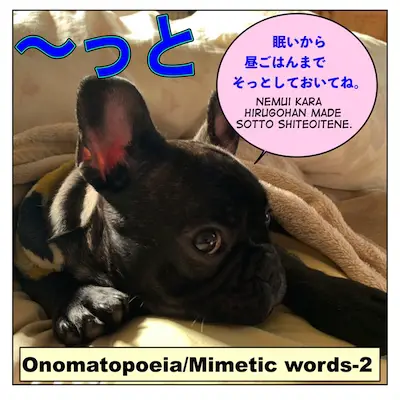
「眠いから昼ごはんまでそっとしておいてね。」
= ねむいからひるごはんまでそっとしておいてね。
= Nemui kara hirugohan made sotto shite oitene.
= I’m sleepy so leave me alone until lunch, OK?
Hi everyone! I’m Torajiro. I’m back to teach you Japanese.
It’s been a while since Maggie last made an onomatopoeia lesson.
In that lesson we focused on the ones with repetitive sounds like いらいら (= ira ira ) →いら x 2 (= ira x 2) = to be irritated
In this sequel lesson, let me introduce you to single word (non-repetitive) onomatopoeia followed by っと ( = tto).
→いらっと = iratto = to get irritated/to get annoyed
Note: Before we begin, let’s review these grammar terms first:
🔸擬音語 = ぎおんご = giongo = onomatopoeia → Words that imitate actual sounds.
🔸擬態語 = ぎたいご = gitaigo = mimetic words → Words that describe movements, actions, or states
Writing rule: Technically, you are supposed to write 擬音語 (ぎおんご = onomatopoeia) in katakana
Ex. ピッと鳴る
= ピッとなる
= Pitto naru
= to make a short beep
and 擬態語 (ぎたいご = gitaigo = mimetic words) in hiragana.
Ex. いらっとする
= Iratto suru
= to get irritated
But actually we use katakana for a lot for mimetic words -especially in casual writing, like in manga:
イラっとする = iratto suru
Sometimes you type small “ッ = tsu” in katakana as well.
→イラッ! = Irah!
→イラッとする = Iratto suru
In this lesson, I will present the mimetic words in hiragana and the onomatopoeia in katakana when it is obviously a sound.
⭐️How to form:
You use ~っと ( = tto) as an adverb to modify a verb.
➡️ 〜っと ( = tto) + verb
The most common verbs used with っと( = tto) are, する, なる, くる ( = suru, naru, kuru)
* 〜っとする ( = tto suru)
Ex. いらっとする = iratto suru = to get irritated
(describing the state or reaction of getting irritated)
* 〜っとなる ( = ~ tto naru )
Ex. いらっとなる = iratto naru = to become irritated (It focuses on the change of your feelings)
* 〜っとくる = ~ tto kuru
Ex. いらっとくる = iratto kuru = to suddenly feel irritated / to get irritated
(when the emotion suddenly hits you or comes over you
You can modify a noun
➡️ ~っと ( = tto) + verb (plain form / past tense, etc. ) + noun
Ex. いらっとすること
= iratto suru koto
= something that irritates you (general statement)
Ex. いらっとしたこと
= iratto shita koto
= something that irritated you (past experience)
There are too many of these so I won’t be able to cover all of them but hopefully I can show you the most common ones.
I will classify all these onomatopoeia and mimetic words as follows:
Index:
🌸 (⬅︎Since it is a long lesson, I put the flower marks here and there to jump back here.)
1) Emotions / Feelings/ Physical Sensations
3) Sudden Changes / Transformations
4) Movements / Manner of action
5) Atmosphere / Weather/ Environment
Note: Some words have multiple uses, so I will mark them with *
When you see *, check the other ways the word can be used.
1) Emotions / Feelings/ Physical Sensations
* いらっと = iratto = annoyed / irritated
Ex. 彼の声を聞いただけでいらっとくる。
= かれのこえをきいただけでいらっとくる。
= Kare no koe wo kiita dakede iratto kuru.
= I get irritated just by hearing his voice.
📝 いらっとする vs いらいらする ( = iratto suru vs iraira suru)
What are the differences between いらっとする ( = iratto suru) and いらいらする ( = iraira suru) ?
The subtle difference is that いらっとする ( = iratto suru) refers to a sudden, momentary irritation, while いらいらする ( = iraira suru) describes a longer-lasting, ongoing feeling of irritation.
You can say the same thing with どきっとする ( = dokitto suru) and どきどきする ( = dokidoki suru)
どきっとする ( = dokitto suru) refers to a sudden, brief moment when your heart skips a beat.
while どきどきする ( = dokidoki suru) describes a continuous or repeated feeling when your heart keeps pounding.
* かっと= katto = suddenly angry / lose temper suddenly
Ex. 些細なことでかっとなりそうになったらまず深呼吸をしてみましょう。
= ささいなことでかっとなりそうになったらまずしんこきゅうをしてみましょう。
= Sasai na koto de katto narisou ni nattara mazu shinkokyuu wo shite mimashou.
= If you feel like suddenly losing your temper over a trivial thing, try taking a deep breath first.
* ぎょっと = gyotto = to be startled / shocked / taken aback
Ex. 新聞の見出しを見てぎょっとした。
= しんぶんのみだしをみてぎょっとした。
= Shinbun no midashi wo mite gyotto shita.
= I was startled when I saw the newspaper headline.
* ぐっと* = gutto = to suppress one’s feelings / to be emotionally moved
Ex. 卒業の日に両親から花束をもらってぐっときた。
= そつぎょうのひにりょうしんからはなたばをもらってぐっときた。
= Sotsugyouno hi ni ryoushin kara hanataba wo moratte gutto kita.
= I was deeply moved when I received a bouquet from my parents on graduation day.
Ex. 上司に何を言われてもぐっと我慢していたがもう限界だ。明日から新しい仕事を探す!
= じょうしになにをいわれてもぐっとがまんしていたがもうげんかいだ。あしたからあたらしいしごとをさがす!
= Joushi ni nani wo iwaretemo gutto gaman shiteita ga mou genkai da. Ashita kara atarashii shigoto wo sagasu!
= No matter what my boss said, I put up with it, but I’ve had enough. I will start looking for a new job starting tomorrow!
→Another usage: Check 2) Attitude / Manner
* じわっと = jiwatto = slowly sinks into one’s heart or emotions / gradually hits emotionally
Ex. 子供の頃の写真を見ているとじわっとくる。
= こどものころのしゃしんをみているとじわっとくる。
= Kodomo no koro no shashin wo mite iru to jiwatto kuru.
= Looking at childhood photos kind of hits me emotionally.
* すっと* = sutto = to feel relieved / lightened
Ex. 友達に言いたいことを言って胸がすっとした。
= ともだちにいいたいことをいってむねがすっとした。
= Tomodachi ni iitai koto wo itte mune ga sutto shita.
= I felt relieved after telling my friend what I wanted to say.
→Another usage: Check 6) Texture/ Taste
* すかっと = sukatto = to feel relieved / refreshed
Ex. こんな暑い日は、何かすかっとしたものを*飲みたい。
= こんなあついひは、なにかすかっとしたものをのみたい。
= Konna atsuihi wa, nanika sukatto shita mono wo nomitai.
= I want to drink something refreshing on a hot day like this.
Note: *You can also say 〜ものがのみたい = mono ga nomitai.
Ex. 久しぶりに運動をして気分がすかっとした。
= ひさしぶりにうんどうをしてきぶんがすかっとした。
= Hisashiburi ni undou wo shite kibun ga sukatto shita.
= I exercised for the first time in a while, and I feel completely refreshed.
* すきっと = sukitto = refreshed / clear / neat (mind, mood, air, or a tidy space)
Ex. いらないものを捨てて部屋の中がすきっとした。
= いらないものをすててへやのなかがすきっとした。
= Iranai mono wo sutete heya no naka ga sukitto shita.
= I threw out unnecessary things, and the room looks neater.
* ずきっと = zukito = a sharp throbbing pain / a sharp, momentary pain
Ex. 一瞬、頭がずきっとしたが休んだらすぐに治った。
= いっしゅん、あたまがずきっとしたがやすんだらすぐになおった。
= Isshun, atama ga zukitto shita ga yasundara sugu ni naotta.
= I felt a sharp pain in my head for a moment, but it went away after I rested.
* ぞくっと = zokutto = shiver / thrill / spine-chilling feeling
Ex. 背筋がぞくっとなる怪談話
= せすじがぞくっとなるかいだんばなし
= Sesusji ga zokutto naru kaidan banashi
= A ghost story that gives you chills down your spine.
* ぞっと = zotto = shudder / horror / chill
Ex. いつもの散歩道に熊が出たと聞いてぞっとした。
= いつものさんぽみちにくまがでたときいてぞっとした。
= Itsumo no sanpo michi ni kuma ga deta to kiite zotto shita.
= I got chills when I heard a bear had appeared on my usual walking path.
* ちくっと = chikutto = a sharp prick / sting
Ex. (医者(or 看護師)が患者に注射をする時 )
= (いしゃ (or かんごし)がかんじゃにちゅうしゃをするとき )
= ( Isha (or kangoshi) ga kanja ni chuusha wo suru toki)
= (When a doctor (or a nurse) gives an injection to a patient)
↓
「ちょっとちくっとしますよ。」
= Chotto chikutto shimasu yo.
= It’ll sting a little, OK?
* どきっと = dokitto = startled / shocked / heart skips a beat
Ex. 友達に好きな人を言い当てられてどきっとした。
= ともだちにすきなひとをいいあてられてどきっとした。
= Tomodachi ni sukina hito wo iiaterarete dokitto shita.
= I was startled when my friend guessed who I like.
* はっと = hatto = to realize/notice something suddenly
Ex. 仕事に夢中になりはっと気がついたらもう終電の時間だった。
= しごとにむちゅうになりはっときがついたらもうしゅうでんのじかんだった。
= Shigoto ni muchuu ni naru hatto ki ga tsuitara mou shuuden no jikan datta.
= I was so absorbed in work that I suddenly realized it was already time for the last train.
* ひやっと *= hiyatto = startled / a sudden fright / brief scare
Ex. 狭い路地から自転車が急に飛び出してきてひやっとした。
= せまいろじからじてんしゃがきゅうにとびだしてきてひやっとした。
= Semai roji kara jitensha ga kyuu ni tobidashite kite hiyatto shita.
= A bike suddenly came out of a narrow alley, and it startled me.
→Another usage: Check 5) Atmosphere / Weather/ Environment
* ほっと = hotto = to be relieved
Ex. 息子が海外から無事に帰国してほっとしました。
= むすこがかいがいからぶじにきこくしてほっとしました。
= Musuko ga kaigai kara buji ni kikoku shite hotto shimashita.
= I was relieved that my son returned safely from abroad.
* むかっと = mukatto = to feel a sudden flash of anger or irritation / to feel suddenly sick
Ex. 職場でむかっとしたら、まずその場を離れて深呼吸をした方がいい。
= しょくばでむかっとしたら、まずそのばをはなれてしんこきゅうをしたほうが
い。
= Shokuga de mukatto shitara, mazu sonoba wo hanarete shinkokyuu wo
shita hou ga ii.
= If you suddenly get annoyed at work, it’s best to step away for a moment
and take a deep breath.
* むすっと = musutto = to be sulky, grumpy
Ex. その店のオーナーはいつもむすっとしているように見えるが実はとても優しい
人だ。
= そのみせのオーナーはいつもむすっとしているようにみえるがじつはとてもやさ
いひとだ。
= Sono mise no oonaa wa itsumo musutto shite iru you ni mieru ga jitsu wa
totemo yasashii hito da.
= The owner of the shop always looks grumpy, but in fact, he’s a very kind
person.
* むっと * = mutto = to get annoyed /offended
Ex. 髪型が変わったことにすぐに気が付かなかったから彼女は少しむっとしていたようだ。
= かみがたがかわったことにすぐにきがつかなかったからかのじょはすこしむっとしていたようだ。
= Kamigata ga kawatta koto ni sugu ni kigatsukanakatta kara kanojo wa sukoshi mutto shite ita you da.
= She seemed a little annoyed because I didn’t notice her new hairstyle right away.
→Another usage: Check 5)Atmosphere / Weather/ Environment
* もやっと = moyatto = vague discomfort / fuzzy feeling
Ex. 友達に言われたことを思い出すたびに、なにかもやっとする。
= ともだちにいわれたことをおもいだすたびに、なにかもやっとする。
= Tomodachi ni iwareta kotowo omoidasu tabi ni, nanika moyatto suru.
= Every time I think about what my friend said (*), it somehow bothers me.
( it leaves me with a vague, uneasy feeling that I can’t explain.)
Note: literal translation: what I was told by my friend
🌸 ←Go back to the Index
* さらっと* = saratto = smoothly, casually
Ex. 難しい単語がさらっと出てくるようになった。
= むずかしいたんごがさらっとでてくるようになった。
= Muzukashii tango ga saratto dete kuru you ni natta.
= I’ve become able to use difficult words effortlessly
→Another usage; Check 6) Texture of food
* しゃきっと = shakitto = sharp / alert / brisk (attitude, posture, texture)
Ex. スーツを着たら気分までしゃっきっとした。
= スーツをきたらきぶんまでしゃっきっとした。
= Suutsu wo kitara kibun made shakitto shita.
= When I put on the suit, I felt more refreshed and energized.
Ex. コーヒーを飲んだら頭がしゃきっとした。
= コーヒーをのんだらあたまがしゃきっとした。
= Koohii wo nondara atama ga shakitto shita.
= After drinking coffee, my mind became sharp and alert.
* ずけっと = zuketto = bluntly / brazenly (attitude or remark)
Ex. 彼女は相手が上司であろうとずけっとものがいえる。
= かのじょはあいてがじょうしであろうとずけっとものがいえる。
= Kanojo wa aite ga joushi de arou to zuketto mono ga ieru.
= She can speak her mind bluntly, even if that person is her boss.
* びしっと = bisshitto = sharply / neatly / firmly (speech, appearance, attitude)
Ex. 先生、うちの子にもっと勉強するようにびしっと言ってください。
= せんせい、うちのこにもっとべんきょうするようにびしっといってください。
= Sensei, uchi no ko ni motto benkyou suru you ni bishitto ittekudasai.
= (To the teacher) Please tell my child firmly to study more.
3) Sudden Changes / Transformations
* がらっと = karatto = completely / change style, situation completely / drastically
Ex. 髪を短くしたらがらっと雰囲気が変わった。
= かみをみじかくしたらがらっとふんいきがかわった。
= Kami wo mijikaku shitara garatto fun’iki ga kawatta.
= I got my hair cut short, and it completely changed my look.
* ころっと* = korotto = Changing one’s attitude or opinion completely / suddenly / easily (used when something changes or happens quickly and unexpectedly)
Ex. 彼は人によって態度をころっと変えるから信用できない。
= かれはひとによってたいどをころっとかえるからしんようできない。
= Kare wa hito ni yotte taido wo korotto kaeru kara shinyou dekinai.
= He changes his attitude completely depending on the person, so he can’t be trusted.
Ex. 祖父は日頃から病で苦しむよりもころっと逝きたいと言っている。
= そふはひごろからやまいでくるしむよりもころっといきたいといっている。
= Sofu wa higoro kara yamai de kurushimu yori mo korotto ikitai to itte iru.
= My grandfather often says he would rather pass away suddenly than suffer from illness.
Ex. 彼の嘘にころっと騙された。
= かれのうそにころっとだまされた。
= Kare no uso ni korotto damasareta.
= I was easily fooled by his lie.
→Another usage: Check 4) Movements / Manner of action
🌸 ←Go back to the Index
4) Movements / Manner of action
* ぐっと / ぐいっと = gutto/guitto = to gulp down
Ex. 喉が渇いていたのでビールを一気にぐっと飲み干した。
= のどがかわいていたのでビールをいっきにぐっとのみほした。
= Nodo ga kawaite ita no de biiru wo ikki ni gutto nomihoshita.
= I was thirsty, so I gulped down the beer.
* ぐるっと = gurutto = all around / in a circle / all the way around
Ex. 湖の周りをぐるっと散歩した。
= みずうみのまわりをぐるっとさんぽした。
= Mizuumi no mawari wo gurutto sanpo shita.
= I took a walk all the way around the lake.
* ころっと* = korotto = roll / fall over easily
Ex. 猫は布団の上でころっと横になった。
= ねこはふとんのうえでころっとよこになった。
= Neko wa futon no ue de korotto yoko ni natta.
= The cat rolled over and lay down on the futon.
→Another usage: Check 3) Sudden Changes / Transformations
* さっと = satto = quickly / in a flash
Ex. さっとお風呂に入ってテレビを観よう。
= さっとおふろにはいってテレビをみよう。
= Satto ofuro ni haitte terebi wo miyou.
= I’ll take a quick bath and watch TV.
* さらっと *= saratto = smoothly / lightly / casually/nonchalantly
Ex. 嫌なことを言われてもさらっと受け流せばいい。
= いやなことをいわれてもさらっとうけながせばいい。
= Iyana koto wo iwarete mo saratto ukenagaseba ii.
= Even if someone says something unpleasant, you should just brush it off / let it slide.
→Another usage: Check 6) Texture / Taste
* じっと (じーっと) = jitto (jiitto) staying still / staring
Ex. 早く授業が終わらないかじっと時計ばかり見ていた。
= はやくじゅぎょうがおわらないかじっととけいばかりみていた。
= Hayaku jugyou ga owaranai ka jitto tokeibakari mite ita.
= I kept staring at the clock, wishing the class would end soon.
(Talking to her child)
Ex. 髪の毛を切ってあげるから少しの間、じっとしていてね。
= かみのけをきってあげるからすこしのあいだ、じっとしていてね。
= Kaminoke wo kitte ageru kara sukoshi no aida, jitto shite itene.
= I’m going to cut your hair, so stay still for a little while, OK?
* すっと * = sutto = quickly / smoothly / gracefully
Ex. 彼女はすっと立ち上がってどこかに行ってしまった。
= かのじょはすっとたちあがってどこかにいってしまった。
= Kanojo wa sutto tachiagatte dokoka ni itte shimatta.
= She got up quietly and went off somewhere.
→Another usage: Check 6) Texture/ Taste
* そっと = sotto = gently / quietly
Ex. まだ子猫だからそっと触ってね。
= まだこねこだからそっとさわってね。
= Mada koneko dakara sotto sawatte ne.
= It’s still a kitten, so touch it gently.
Ex. 一人になりたいからそっとしておいて。
= ひとりになりたいからそっとしておいて。
= Hitori ni naritai kara sotto shite oite.
= I want to be alone, so please leave me alone.
* ぎゅっと */ ぎゅうっと = gyutto/gyuutto = tightly / firmly (hug, hold, squeeze)
Ex. 娘は熊のぬいぐるみをぎゅっと抱きしめて寝ていた。
= むすめはくまのぬいぐるみをぎゅっとだきしめてねていた。
= Musume wa kuma no nuigurumi wo gyutto dakishimete nete ita.
= My daughter was sleeping while hugging her teddy bear tightly.
→Another usage: Check 10) State/Condition
* くらっと = kuratto = feel dizzy / lightheaded
Ex. 急に立ち上がるとたまにくらっと目眩がする。
= きゅうにたちあがるとたまにくらっとめまいがする。
= Kyuu ni tachiagaru to tamani kuratto memai ga suru.
= If I stand up suddenly, I sometimes get a dizzy spell.
* ぐらっと = guratto = wobble / stagger / suddenly shake
Ex. 地震で建物がぐらっとしたので慌ててテーブルの下に潜った。
= じしんでたてものがぐらっとしたのであわててテーブルのしたにもぐった。
= Jishin de tatemono ga guratto shita node awatete teeburu no shita ni mogutta.
= The building shook suddenly in the earthquake, so I panicked and ducked under the table.
* くるっと = kurutto = spin around / turn quickly
Ex. 僕の顔を見ると、彼女はくるっと向きを変えて向こうに行ってしまった。
= ぼくのかおをみると、かのじょはくるっとむきをかえてむこうにいってしまった。
= Boku no kao wo miru to, kanojo wa kurutto muki wo kaete mukou ni itte shimatta.
= When she saw my face, she quickly turned around and went the other way.
* ぱっと *= patto = sudden / instantly / in a flash/ at a glance
Ex. 子犬を見たら彼女の顔がぱっと明るくなった。
= こいぬをみたらかのじょのかおがぱっとあかるくなった。
= Koinu wo mitara kanojo no kao ga patto akaru ku natta.
= When she saw the puppy, her face suddenly lit up.
Ex. ぱっと見てすぐに偽物の財布だとわかった。
= ぱっとみてすぐににせもののさいふだとわかった。
= Patto mite sugu ni nisemono no saifu dato wakatta.
= I could tell at a glance that the wallet was fake.
→Another usage in the negative form ぱっとしない = patto shinai : Check 10) State / Condition
* ぱーっと = paatto = lavishly / energetically / lively
Ex. 試験が終わったらぱーっとどこかに飲みに行こうか?
= しけんがおわったらぱーっとどこかにのみにいこうか?
= Shiken ga owattara paatto dokoka ni nomi ni ikou ka?
= After the exam is over, why don’t we go out for a drink to celebrate and have fun?
Ex. ボーナスが出たらぱーっと温泉旅行にでも行こうかな。
= ボーナスがでたらぱーっとおんせんりょこうにでもいこうかな。
= boonasu ga detara paatto onsen ryokou ni demo ikou kana
= If I get my bonus, maybe I’ll splurge and go on a hot spring trip.
* むくっと = mukutto = suddenly getting up / rising abruptly (usually from lying down or sitting)
Ex. ソファで寝ていた犬はむくっと起き上がって水を飲みにいった。
= ソファでねていたいぬはむくっとおきあがってみずをのみにいった。
= Sofa de neteita inu wa mukutto okiagatte mizu wo nomi ni itta.
= The dog that had been sleeping on the sofa woke up with a start and went to drink some water.
🌸 ←Go back to the Index
5) Atmosphere / Weather/ Environment
* むしっと = mushitto = humid / muggy (general weather or air)
Ex. 日本の夏はむしっとしていてエアコンなしでは過ごせない。
= にほんのなつはむしっとしていてエアコンなしではすごせない。
= Nihhon no natsu wa mushitto shite ite eakon nashi de wa sugosenai.
= The summer in Japan is humid and muggy, and you can’t get by without air conditioning.
* むっと * = mutto = stuffy / stifling / muggy
Ex. この部屋は窓がなく換気が悪いのでむっとする。
= このへやはまどがなくかんきがわるいのでむっとする。
= Kono heya wa mado ga naku kanki ga warui no de mutto suru.
= This room has no windows and poor ventilation, so it feels stuffy.
→Another usage: Check 1) Emotion / Feelings / Physical Sensations
* じめっと = jimetto = damp / clammy / sticky (unpleasantly humid or moist)
Ex. 乾燥機の調子が悪く洗濯物がじめっとしている。
= かんそうきのちょうしがわるくせんたくものがじめっとしている。
= Kansouki no choushi ga waruku sentakumono ga jimetto shite iru.
= The laundry feels damp because the dryer isn’t working properly.
* からっと = karatto = dry and crisp / lightly fried / clear weather
Ex. 今日はからっとした暑さで過ごしやすい。
= きょうはからっとしたあつさですごしやすい。
= Kyou wa karatto shita atsuza de sugoshiyasui.
= It’s hot today, but it’s dry, so it feels comfortable.
* ざわっと = zawatto = rustle / uneasy stir among people / buzz (of people)
Ex. 先生がこの中で100点を取った人が一人だけいますといったらクラスがざわっとした。
= せんせいがこのなかで ひゃくてんをとったひとがひとりだけいますといったらクラスがざわっとした。
= Sensei ga kono naka de hyakuten wo totta hito ga hitori dake imasu to ittara kurasu ga zawatto shita.
= When the teacher said, “There is only one person here who got a perfect score,” the class buzzed with excitement.
* ひやっと * = hiyatto = cool
Ex. 10月に入って朝晩ひやっとする。
= じゅうがつにはいってあさばんひやっとする。
= Juugatsu ni haitte asaban hiyatto suru.
= Since October started, it feels chilly in the mornings and evenings.
→Another usage: Check 1) Emotions / Feelings/ Physical Sensations
🌸 ←Go back to the Index
* かりっと = karitto = crispy / crunchy
Ex. このおせんべいはかりっとしていておいしい。
= Kono osenbei wa karitto shiteite oishii.
= This rice cracker is crispy and delicious.
* さらっと = saratto = smooth and light in texture (not thick, sticky, or heavy)
Ex. このラーメンのスープはさらっとしている。
= Kono raamen no suupu wa saratto shite iru.
= The soup of this ramen is light and not greasy.
→Another usage: Check 2) Attitude/Manner
* ざらっと = zaratto = feels coarse to the touch/ rough/ gritty/grainy
Ex. テーブルがざらっとしているけど誰か砂糖をこぼしたのかな。
= テーブルがざらっとしているけどだれかさとうをこぼしたのかな。
= Teeburu ga zaratto shiteiru kedo dare ka satou wo koboshita no kana.
= The table feels gritty – I wonder if someone spilled sugar on it.
* すっと * = sutto = refreshing
Ex. ミントティーを飲むと口の中がすっとする。
= ミントティーをのむとくちのなかがすっとする。
= Mintotii wo nomu to kuchi no naka ga sutto suru.
= Drinking mint tea gives a refreshing feeling in the mouth.
→Another usage: Check 1) Emotions / Feelings / Physical Sensation
* つるっと = tsurutto = smooth and slippery (slides easily without friction)
Ex. 温泉に入ったから肌がつるっとしている。
= おんせんにはいったからはだがつるっとしている。
= Onsen ni haittakara hada ga tsurutto shiteiru.
= After soaking in the hot spring, my skin feels smooth and silky.
Ex. 濡れた歩道でつるっと滑って転んだ。
= ぬれたほどうでつるっとすべってころんだ。
= Nureta hodou de tsurutto subette koronda.
= My foot slipped on the wet sidewalk, and I fell.
* しゃきっと *= shakitto = crisp / firm / refreshing texture
Ex. レタスは50度のお湯につけるとしゃきっとする。
= レタスはごじゅうどのおゆにつけるとしゃきっとする。
= Retasu wa gojuudo no oyu ni tsukeru to shakitto suru.
= If you soak lettuce in 50-degree hot water, it becomes crisp.
→Another usage : Check 2) Attitude/Manner
* じゅわっと = juwatto = juicy / full of liquid
Ex. ハンバーグを切るとじゅわっと肉汁が溢れ出てきた。
= ハンバーグをきるとじゅわっとにくじゅうがあふれでてきた。
= Hanbaagu wo kiru to juwatto nikujuu ga afuredetekita.
= When I cut into the hamburger steak, the meat juices gushed out.
* ふわっと = fuwatto = lightly / softly
Ex. ふわっとしたパンケーキを作りたかったら卵をよく泡立ててください。
= ふわっとしたパンケーキをつくりたかったらたまごをよくあわだててください。
= Fuwatto shita pankeeki wo tsukuritakattara tamago wo yoku awadatete
kudasai.
= If you want to make fluffy pancakes, beat the eggs well.
Ex. ラップをふわっとかけて電子レンジで2分温めます。
= ラップをふわっとかけてでんしレンジでにふんあたためます。
= Rappu wo fuwatto kakete denshirenji de nifun atatamemasu .
= Loosely cover with plastic wrap and heat in the microwave for 2 minutes.
* ほくっと = hokutto = soft and fluffy
Ex. このおいもはほくっとしている。
= Kono oimo wa hokutto shite iru.
= This potato is soft and fluffy.
* とろっと = torotto = melty
Ex. ピザのチーズがとろっと溶けたらオーブンから取り出してください。
= ピザのチーズがとろっととけたらオーブンからとりだしてください。
= Piza no chiizu ga torotto toketara oobun kara toridashite kudasai.
= When the cheese on the pizza melts, take it out of the oven.
* どろっと = dorotto = thick / gooey /oozy
Ex. オムレツの上にデミグラスソースがどろっとかかっている。
= Omuretsu no ue ni demigurasusoosu ga dorotto kakatte iru.
= Thick demi-glace sauce is poured over the omelet.
* ぴりっと = piritto = sharp / spicy / tingling / tense sensation
Ex. このパスタは唐辛子がぴりっと効いている。
= このパスタはとうがらしがぴりっときいている。
= Kono pasuta wa tougarashi ga piritto kiite iru.
= This pasta has a spicy kick from the chili pepper.
* ぷりっと = puritto = springy / plump / firm It’s often used to describe the plump texture of shrimp.
Ex. このエビ、ぷりっとして美味しいね。
= このエビ、ぷりっとしておいしいね。
= Kono ebi, puritto shite oishii ne.
= This shrimp is plump and tasty, isn’t it?
🌸 ←Go back to the Index
* きらっと = kiratto = sparkle / gleam ✨
Ex. 彼女の薬指には婚約指輪がきらっと光っていた。
= かのじょのくすりゆびにはこんやくゆびわがきらっとひかっていた。
= Kanojo no kusuriyubi niwa kon’yaku yubiwa ga kiratto hikatte ita.
= An engagement ring was sparkling on her ring finger.
* ぴかっと = pikatto = flash / shine brightly
Ex. このセンサーライトは暗がりで人が近づくとぴかっと光る。
= このセンサーライトはくらがりでひとがちかづくとぴかっとひかる。
= Kono sensaaraito wa kuragari de hito ga chikazuku to pikatto hikaru.
= This sensor light flashes brightly in the dark when someone approaches.
* にこっと = nikotto = smile brightly ☺️
Ex. 赤ちゃんがにこっと笑ってくれた。
= あかちゃんがにこっとわらってくれた。
= Akachan ga nikotto waratte kureta.
= The baby gave me a sweet little smile.
* にやっと = niyatto = smirk / sly grin 😏
Ex. 彼は、「勝負はこれからだ。」と言ってにやっと笑った。
= かれは、「しょうぶはこれからだ。」といってにやっとわらった。
= Kare wa, “Shoubu wa kore kara da.” to itte niyatto waratta.
= He said, “The game isn’t over yet,” and smirked.
* にっと = nitto = grin showing teeth
Ex. 間違えたときはにっと笑ってごまかす。
= まちがえたときはにっとわらってごまかす。
= Machigaeta toki wa nitto waratte gomakasu.
= When I make a mistake, I grin to cover it up.
*くすっと = kusutto = to giggle quietly / chuckle softly
Ex. 電車の中で友達とふざけていたら女子高生にくすっと笑われた。
= でんしゃのなかでともだちとふざけていたらじょしこうせいにくすっとわらわれた。
= Densha no naka de tomodachi to fuzakete itara joshikousei ni kusutto
warawareta.
= I was joking around with my friend on the train, and a high school girl
chuckled quietly at us.
🌸 ←Go back to the Index
* すらっと = suratto = tall and slender / slim and graceful
Ex. 彼は背がすらっとしている。
= かれはせがすらっとしている。
= Kare wa se ga suratto shite iru.
= He has a tall and slender figure.
* ぷくっと = pukutto = slightly puffed up / plump / swollen in a cute or round way
Ex. 赤ちゃんのほっぺたはぷくっとしていてかわいい。
= あかちゃんのほっぺたはぷくっとしていてかわいい。
= Akachan no hoppeta wa pukutto shiteite kawaii.
= A baby’s cheeks are puffed up and so cute.
* ぽちゃっと = pochatto = chubby
Ex. 高校生の時はもっとぽちゃっとしていたが、大学に入ってかなり痩せた。
= こうこうせいのときはもっとぽちゃっとしていたが、だいがくにはいってかなりやせた。
= Koukousei no toki wa motto pochatto shite ita ga, daigaku ni haitte kanari yaseta.
= I was chubbier in high school, but I lost quite a bit of weight after starting university.
🌸 ←Go back to the Index
* ぎゅっと* = gyutto = packet / tightly / full of ~
Ex. このお弁当には、母の愛情がぎゅっと込められている。
= このおべんとうには、ははのあいじょうがぎゅっとこめられている。
= Kono obentou niwa, haha no aijou ga gyutto
= This lunchbox is tightly packed with my mother’s love. (It’s filled with her affection.)
→Another usage: Check 4) Movements / Manner of action
* ずしっと = zushitto = heavy / weighty / heavily / a heavy impact or feeling
Ex. その荷物はずしっと重たかった。
= そのにもつはずしっとおもたかった。
= Sono nimotsu wa zushitto omotakatta.
= That luggage felt really heavy.
Ex. 先生の言葉はずしっと心に響いた。
= せんせいのことばはずしっとこころにひびいた。
= Sensei no kotoba wa zushitto kokoro ni hibiita.
= The teacher’s words struck me deeply.
* ずらっと = zuratto = in a row / lined up / all together
Ex. 店の前には、高級車がずらっと並んでいた。
= みせのまえには、こうきゅうしゃがずらっとならんでいた。
= Mise no mae niwa, koukyuusha ga zuratto narande ita.
= Luxury cars were lined up in front of the restaurant / store.
Ex. 彼は、集めたフィギュアを全部テーブルの上にずらっと並べて見せてくれた。
= かれは、あつめたフィギュアをぜんぶテーブルのうえにずらっとならべてみせてくれた。
= Kare wa, atsumeta figyua wo zenbu teeburu no ue ni zuratto narabete misete kureta.
= He showed me all the figures he had collected, lining them up on the table.
* ぱっとしない* = patto shinai (It is used in the negative form, しない = shinai ) = unimpressive / not stand out / looks lame
Ex. 今月出た新商品なんかパッとしないね。
= こんげつでたしんしょうひんなんかぱっとしないね
= Kongetsu deta shinshouhin nanka patto shinaine.
= The new product released this month isn’t very impressive. / The new product doesn’t really stand out.
Ex. この業界も最近ぱっとしないね。
= このぎょうかいもさいきんぱっとしないね。
= Kono gyoukai mo saikin patto shinaine.
= This industry hasn’t been doing very well lately either, huh?
→Another usage of ぱっと = patto Check 4) Movements / Manner of action
🌸 ←Go back to the Index
* ぴっと/ピッと = pitto = to make a short beep
Ex. この火災報知器は電池がなくなる前にピッという音がします。
= このかさいほうちきはでんちがなくなるまえにピッというおとがします。
= Kono kasaihouchiki wa denchi ga nakunaru mae ni pitto iu oto ga shimasu.
= This fire alarm makes a “beep” sound before the battery runs out.
* ぴーっと/ピーっと = piiitto = beep (long, continuous sound)
Ex. ピーっという音が3回鳴ったらカードを抜いてください。
= ピーっというおとがさんかいなったらカードをぬいてください。
= Piitto iu oto ga sankai nattara kaado wo nuite kudasai.
= When you hear the “beep” sound three times, please remove your card.
* ぐーっと(ぐうっと) / グーっと = guutto = growling / rumbling sound
Ex. 授業中にお腹がグーっと鳴って恥ずかしかった。
= じゅぎょうちゅうにおなかがグーっとなってはずかしかった。
= Jugyouchuu ni onakaga guutto natte hazukashikatta.
= My stomach growled loudly during class, and I felt embarrassed.
* ぺっと /ペッと = petto = spitting sound or action
Ex. その男の子は苦い薬を口からペッと吐き出した。
= そのおとこのこはにがいくすりをくちからペッとはきだした。
= Sono otokonoko wa nigai kusuri wo kuchi kara petto hakidashita.
= The boy spat the bitter medicine out of his mouth.
🌸 ←Go back to the Index
****
マギー先生より = マギーせんせいより = Maggie Sensei yori = From Maggie Sensei
寅次郎先生ありがとう🩷
= とらじろうせんせいありがとう
= Thank you Torajiro-Sensei.
きっと、昼ごはんまでじっと寝ていられないでしょ。早く起きて一緒に遊ぼ!
= きっと、ひるごはんまでじっとねていられないでしょ。はやくおきていっしょにあそぼ!
= Kitto, hirugohan made jitto neteirarenai desho. Hayaku okite issho ni asobo!
= I know you can’t just stay in bed until lunch. Get up now and let’s play!
****
My Patrons can access the audio file
Audio Files for this lesson →Click here
PDF file without ads (One with romaji & One without romaji) →Click here
Special Quiz from this lesson →Click here
The answers for the quiz →Click here
I appreciate your support! サポートありがとう! !
My supporters can access tons of audio files, PDF files, and special lessons on my Patreon page.
❤️ありがとう x 2: Mini lessons, PDF files with audio for all the lessons here from 2018
❤️ありがとう x 5 In addition to the previous benefit + Daily Japanese
Check the index of Daily Japanese Series →Index
❤️ありがとう x 10 In addition to the previous benefit + PDF file of all my Twitter lessons for a month (average 10 ~ 18 pages) with an audio file. Please check the details here
One-time support ↓ ありがとう!