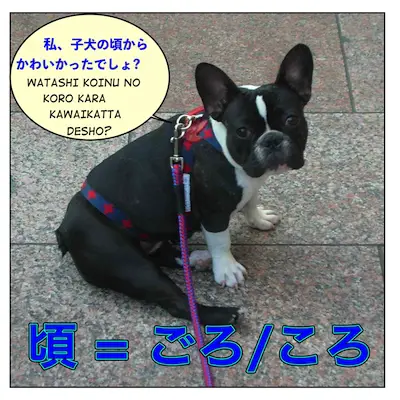
「私、子犬の頃からかわいかったでしょ?」
= わたし、こいぬのころからかわいかったでしょ?
= Watashi, koinu no koro kara kawaikatta desho?
= I’ve been cute since I was a puppy, right?
Hi everyone!
Let’s study how to use 頃 = ころ/ごろ ( = koro/goro) today.
It is one of the many time-related expressions.
I covered it a little in my Time Related Japanese lesson. You can review it here.
⬇️
時の日本語 = ときのにほんご = Toki no Nihongo = Time Related Japanese
In this lesson, we’ll focus specifically on how to use 頃 (ころ/ごろ) ( = koro/goro).
You may often see it as translated to “when”, but 頃 (ころ/ごろ) ( = koro/goro) is an approximate time expression that means:
→around/about a certain period of time.
When it is used with the verb’s masu-stem form, it means
→the right/best time (to do something)
I will show you how to used them in the example sentences later.
There are also some specific expressions, so I will cover them in this lesson.
⭐️How to form:
Note: The way you read the kanji 頃, ころ or ごろ( = koro or goro), changes depending on the following structures. And sometimes, you’ll see it is written in hiragana instead of kanji especially when it is used with a noun (time related word).
🔸noun (time related word) + 頃( = ごろ = goro )
Ex. 昼頃 = ひるごろ = hirugoro = around noon
Ex. いつ頃 = いつごろ = itsugoro = (around/about) when
🔸 noun + の + 頃 ( = ころ = koro ) / (past tense) noun + だった ( = datta) + 頃 ( = ころ = koro )
Ex. 子供の頃
= こどものころ
= kodomo no koro
= When I was a child / Around the time I was a child
Ex. 子供だった頃
= こどもだったころ
= kodomodatta koro
= when I was a child / around the time I was a child
🔸 i-adjective ~い ( = i) /( past tense) かった ( = katta) + 頃 ( = ころ = koro)
Ex. 安い頃
= やすいころ
= yasui koro
= the time when it is cheap
Ex. 安かった頃
= やすかったころ
= yasukatta koro
= the time when it was cheap
🔸na-adjective ~な ( = na) /(past tense) ~だった ( = datta) + 頃 ( = ころ = koro)
Ex. 元気な頃
= げんきなころ
= genkina koro
= the time when (someone) is healthy / active/ energetic
Ex. 元気だった頃
= げんきだったころ
= genkidatta koro = the time when (someone) was healthy / active/ energetic
🔸 demonstrative adjective + 頃 ( = ころ = koro)
Ex. あの頃 = あのころ = anokoro = around that time / back then
🔸 verb (present/past ) + 頃 ( = ころ = koro )
Ex. 着く頃
= つくころ
= tsuku koro
= around the time (someone) arrives
Ex. 着いた頃
= ついたころ
= tsuita koro
= around the time (someone) arrived
🔸 verb masu-stem + 頃 ( = ごろ = goro )
Ex. 食べ頃
= たべごろ
= tabegoro
= around the right time to eat / ripe (for eating)
📝 頃 ( = ころ/ごろ = koro/goro ) vs に ( = ni)
While you use に to indicates a specific time, you use 頃 ( = ころ/ごろ = koro/goro) to express approximate time.
For example, when you ask for a specific time, you use に ( = ni) :
* 毎朝、何時に起きますか?
= まいあさ、なんじにおきますか?
= Maiasa, nanji ni okimasu ka?
= What time do you get up every morning?
→ 7時に起きます。🕖
= しちじにおきます。
= Shichiji ni okimasu.
= I get up at 7 o’clock.
When you emphasize the time implying “by that time”, you say には ( = niwa)
→7時には起きます。
= しちじにはおきます。
= Shichiji niwa okimasu.
= I get up by 7 o’clock.
When you ask someone around what time, you use ごろ ( = goro) :
* 毎朝、何時ごろ起きますか?
= まいあさ、なんじごろおきますか?
= Maiasa, nanjigoro okimasu ka?
= Around what time do you get up every morning?
→ 7時ごろ起きます。
= しちじごろおきます。
= Shichiji goro okimasu.
= I get up around 7 o’clock. (7 ish)
You can use 頃 (ごろ = goro) without a particle, but you can also add に ( = ni) or には( = niwa) .
Using に ( = ni) makes the expression a bit more precise.
→ 7時ごろに起きます。
= しちじごろにおきます。
= Shichiji goro ni okimasu.
= I get up around 7 o’clock.
→ 7時ごろには起きます。
= しちじごろにはおきます。
= Shichiji goro niwa okimasu.
= I (at least) get up by around 7 o’clock. / I’m usually up around 7 o’clock.
Now, let me show you how to use them with some example sentences.
🔸noun (time related word) + 頃( = ごろ = goro)
Ex. A: 荷物は何時ごろ届きますか?
= にもつは なんじごろ とどきますか?
= Nimotsu wa, nanjigoro todokimasu ka
= About what time will the package arrive?
B: 3時ごろにお届けいたします。
= さんじごろにおとどけいたします。
= Sanjigoro ni otodoke itashimasu.
= We’ll deliver it around 3 o’clock.
Ex. A: 今日、何時ごろ帰る? (casual)
= きょう、なんじごろかえる?
= Kyou, nanjigoro kaeru?
= About what time are you going home today?
B: うん、8時ごろかな。
= うん、はちじごろかな。
= Un, hachiji goro kana.
= Hmm, around 8 o’clock, I guess.
📝 頃 ( = ごろ/ころ = goro/koro ) vs 位 ( = ぐらい/くらい= gurai/kurai )
位 (くらい / ぐらい = kurai/gurai ) is also used to indicate approximate time.
→ 今日、何時ぐらいに帰る?
= きょう、なんじぐらいにかえる?
= Kyou nanjigurai ni kaeru ?
= About what time are you going home today?
→ うん、8時ぐらいかな。
= うん、はちじぐらいかな。
= Un, hachijigurai kana.
= Hmm, around 8 o’clock, I guess.
For the examples above, you could say there’s not much difference, and they are often interchangeable.
However, in general, 位 (くらい / ぐらい = kurai/gurai ) is slightly more conversational and indicates a broader
range of time.
Also, while you can use 位 (くらい / ぐらい = kurai/gurai ) to describe size, the number of people, amounts, or quantities, you use 頃 (ごろ / ころ = goro/koro) specifically for time expressions.
So you can 位 (くらい / ぐらい= kurai/gurai )
⭕️ 30人ぐらい = さんじゅうにんぐらい = sanjuunin gurai = about 30 people
But you can’t say
❌ 30人頃 = さんじゅうにんごろ = sanjuunin goro
And while you can use 位 (くらい / ぐらい= kurai/guari ) with time length
⭕️1時間ぐらい = いちじかんぐらい = ichijikan gurai = about one hour (amount of time)
but you can’t say
❌1時間頃 = いちじかんごろ = ichijikan goro
You can combine 位 ( = ぐらい/くらい = gurai/kkurai )with 頃 ( = ころ = koro )
noun + ぐらい ( = gurai) + の ( = no) + 頃 (ころ = koro) = around the time when ~
Ex. 小学生ぐらいの頃
= しょうがくせいぐらいのころ
= shougakusei gurai no koro
= around the time I was an elementary school student
Learn more about 位 ( = くらい/ぐらい = kurai/gura) in this lesson.
→How to use 位 = くらい/ぐらい = kurai/gurai
Ex. A: 次の会議はいつ頃になりますでしょうか?
= つぎのかいぎはいつごろになりますでしょうか?
= Tsugi no kaigi wa itsugoro ni narimasu deshouka?
= When is the next meeting likely to be?
B: 来月の中頃になります。
= らいげつのなかごろになります。
= Raigetsu no nakagoro ni narimasu.
= It will be around the middle of next month.
Ex. 今年の3月ごろ、岡山に引っ越します。
= ことしのさんがつごろ、おかやまにひっこします。
= Kotoshi no sangatsu goro, Okayama ni hikkoshimasu.
= I will move to Okayama around March of this year.
Ex. 天気予報によると、明日の昼頃まで雨が降るらしい。
= てんきよほうによると、あしたのひるごろまであめがふるらしい。
= Tenkiyouhou ni yoru to, ashita no hirugoro made ame ga furu rashii.
= According to the weather forecast, it will rain until around noon tomorrow.
Ex. 台風は、明け方頃に、関東地方に接近するでしょう。
= たいふうは、あけがたごろに、かんとうちほうにせっきんするでしょう。
= Taifuu wa, akegatagoro ni, Kantou chihou ni sekkin suru deshou.
= The typhoon will probably approach the Kanto region around dawn.
🔸noun + の ( = no) + 頃 ( = ころ = koro ) / (past tense) noun + だった( = datta) * + 頃 ( = ころ = koro)
📝 Even when talking about the past, you can usually just use noun + の ( = no) + 頃 (ころ = koro ) without adding だった ( = datta) .
Using noun + だった頃 ( = だったころ = datta koro )emphasizes the past state, but it is usually optional. Using noun の頃 (ころ = koro) is shorter, simpler, and more common in casual speech.
The same rules apply to adjectives in the past tense.
Ex. 中学3年ぐらいの頃、初めてハワイに行った。
= ちゅうがくさんねんぐらいのころ、はじめてハワイにいった。
= Chuugaku sannen gurai no koro, hajimete Hawai ni itta.
= Around my third year of junior high school, I went to Hawaii for the first
time.
Ex. 5歳の頃からずっとバレエを続けている。
= ごさいのころからずっとバレエをつづけている。
= Gosai no koro kara zutto baree wo tsuzukete iru.
= I have been practicing ballet ever since I was five years old.
Ex. 加藤さんには新人の頃からお世話になっている。
= かとうさんにはしんじんのころからおせわになっている。
= Katou san niwa shinjin no koro kara osewa ni natteiru.
= Kato-san has been taking care of me since I was a newcomer/ever since I started at the company.
Ex. 最後に彼に会ったのは夏の終わり頃だったと思います。
= さいごにかれにあったのはなつのおわりごろだったとおもいます。
= Saigo ni kare ni atta nowa natsuno owarigoro datta to omoimasu.
= I think the last time I saw him was around the end of summer.
Ex. 祖母は私がまだ赤ちゃんだった頃の写真を財布に入れている。
= そぼはわたしがまだあかちゃんだったころのしゃしんをさいふにいれている。
= Sobo wa watashiga mada akachandatta koro no shashin wo saifu ni irete iru.
= My grandmother keeps a photo of me from when I was still a baby in her wallet.
Ex. まだ研修生だった頃、よくその店に行っていた。
= まだけんしゅうせいだったころ、よくそのみせにいっていた。
= Mada kenshuusei datta koro, yoku sono mise ni itteita.
= When I was still a trainee, I used to go to that restaurant.
🔸 i-adjective ~い ( = i) /( past tense) かった ( = katta) + 頃 ( = ころ = koro)
Ex. 若い頃は徹夜で友達と飲みに行ったものだ。
= わかいころはてつやでともだちとのみにいったものだ。
= Wakai koro wa tetsuya de tomodachi to nomini itta monoda.
= When I was young, I used to go out for drinks all night with my friends.
📝There is also a more literary expression, 若かりし頃= わかかりしころ= wakakarishi koro , which means “in one’s younger days” or “back when I was young.”
It’s often used in written or poetic Japanese rather than in daily conversation.
Ex. 円がもっと強かった頃は、毎年海外旅行をしていた。
= えんがもっとつよかったころは、まいとしかいがいりょこうをしていた。
= En ga motto tsuyokatta koro wa, maitoshi kaigairyokou wo shiteita.
= Back when the yen was stronger, I used to travel abroad every year.
Ex. 幼い頃、うちの周りは全て畑だった。
= おさないころ、うちのまわりはすべてはたけだった。
= Osanai koro, uchi no mawari wa subete hatake datta.
= When I was little, all around our house were fields.
Ex. 妹が小さかった頃* は、よく喧嘩をしていたが今では大の仲良しだ。
= いもうとがちいさかったころは、よくけんかをしていたがいまではだいのなかよしだ。
= Imouto ga chiisakatta koro wa, yoku kenka wo shiteita ga imadewa dai no nakayoshi da.
= When my younger sister was little, we used to fight a lot, but now we’re really close.
* around that period/around the time when she was little
Note: Using 時 ( = とき = toki ) instead of 頃 ( = ころ = koro )in this sentence.
→ 妹が小さかった時(or 小さい時)*は、よく喧嘩をしていたが今では大の仲良しだ。
= いもうとがちいさかったとき (or ちいさいとき)は、よくけんかをしていたがいまではだいのなかよしだ。
= Imouto ga chiisakatta toki (or chiisai toki) wa, yoku kenka wo shiteita ga imade wa dai no nakayoshida.
= When my younger sister was little, we used to fight a lot, but now we’re really close.
* at the time when she was little (more specific than 頃 = ころ = koro)
I’ll give you another example:
Ex. 大学3年生の頃*、友達と富士山に登った。
= だいがくさんねんせいのころ、ともだちとふじさんにのぼった。
= Daigaku sannensei no koro, tomdoachi to Fujisan ni nobotta.
= Around my third year (junior year) of university, I climbed Mt. Fuji with my friends.
* around the time I was a third-year student / during that period
Rephrasing this sentence with 時 ( = とき = toki) :
→大学3年生の時*、友達と富士山に登った。
= だいがくさんねんせいのとき、ともだちとふじさんにのぼった。
= Daigaku sannennsei no toki, tomodachi to Fujisan ni nobotta.
= When I was in my third year (junior year) of university, I climbed Mt. Fuji with my friends.
* At the time when I was a third-year student (more specific than 頃 =ころ).
Summary:
📝 時 ( = とき = toki ) vs 頃 ( = ころ = koro )
The nuance difference:
頃 ( = ころ = koro ) emphasizes an approximate period.
時 ( = とき = toki ) emphasizes a specific point in time.
Related Lesson
🔸na-adjective ~な ( = na) / (past tense) だった ( = datta) + 頃 ( = ころ = koro)
Ex. 父がもっと元気だった頃、一緒に山登りに行ったりキャンプをしたりした。
= ちちがもっとげんきだったころ、いっしょにやまのぼりにいったりキャンプをしたりした。
= Chichi ga motto genkidatta koro, issho ni yamanobori ni ittari kyanpu wo shitari shita.
= When my father was healthier, we used to go mountain climbing and camping together.
Ex. 2020年と言えば、世の中がコロナで一番大変な頃でしたね。
= にせんにじゅうねんといえば、よのなかがコロナでいちばんたいへんなころでしたね。
= Nisennijuunen to ieba, yononaka ga koro nade ichiban taihenna koro deshitane.
= Speaking of 2020, that was when the world was having the hardest time with COVID, wasn’t it?
Ex. 仕事がもっと暇だった頃は、毎日定時に帰れた。
= しごとがもっとひまだったころは、まいにちていじにかえれた。
= Shigoto ga motto himadatta koro wa, mainichi teiji ni kaereta.
= Back when work was lighter, I used to leave work on time.
🔸 demonstrative adjective + 頃 ( = ころ = koro)
* あの頃 = あのころ = ano koro = back then: Used when remembering or referring to a certain period of time in your past.
Ex. あの頃は、本当に辛かった。引っ越したばかりで周りに家族も友達も誰もいなか
た。
= あのころは、ほんとうにつらかった。ひっこしたばかりでまわりにかぞくともだ
もだれもいなかった。
= Ano koro wa, hontou ni tsurakatta. Hikkoshita bakari de mawari ni kazoku mo
tomodachi mo daremo inakatta.
= Those days were really tough. I had just moved, and I didn’t have any family
or friends around me.
* その頃 = そのころ= sono koro = at that time, those days
Ex. その頃、母は毎日私を車で学校まで送り迎えしてくれた。
= そのころ、はははまいにちわたしをくるまでがっこうまでおくりむかえしてくれた。
= Sono koro, haha wa mainichi watashi wo kurumade gakkou made okurimukae shite kureta.
= Around that time, my mother used to drive me to and from school every day.
You also use その頃 = そのころ to talk about something that was happening at the same time as another event, showing that the two things occurred simultaneously.
Ex. 私が東京に出てきたその頃、彼は地元の会社で働き始めていた。
= わたしがとうきょうにでてきたそのころ、かれはじもとのかいしゃではたらきはじめていた。
= Watashi ga Toukyou ni detekita sono koro, kare wa jimoto no kaisha de hatarakihajimete ita.
= Around the time I moved to Tokyo, he had started working at a company in his hometown.
* この頃 can be read either このころ ( = konokoro) or このごろ ( = konogoro) , and they have different meanings:
→このころ = kono koro → around that time / back then
Ex. (Looking at an old picture)
このころは何をしてもうまくいかなかったんだ。
= このころはなにをしてもうまくいかなかったんだ。
= Kono koro wa nani wo shitemo umaku ikanakattanda.
= Around that time, nothing I did seemed to go well.
📝 Even though it’s about the past, you use この = kono (“this”) because
you are looking at the picture and the memory feels close to you.
→このごろ = konogoro → recently / these days = 最近 = さいきん = saikin = recently
Ex. このごろ、よく眠れない。
= このごろ、よくねむれない。
= Konogoro, yoku nemurenai.
= I can’t sleep well these days.
Ex. 自分にも非があったのではと反省する今日この頃です。
= じぶんにもひがあったのではとはんせいするときょうこのごろです。
= Jibun ni mo hi ga atta nodewa to hansei suru kyou kono goro desu.
= Lately, I’ve been reflecting and thinking that I might have been at fault too.
📝 今日この頃 = きょうこのごろ ( = kyou konogoro ) is an idiomatic expression meaning “these days” or “lately.”
🔸 verb (present/past ) + 頃 ( = ころ = koro )
Ex.桜が咲く頃には日本に行きたい。
= さくらがさくころにはにほんにいきたい。
= Sakura ga saku koro niwa Nihon ni ikitai.
= I want to go to Japan around the time the cherry blossoms bloom.
Ex. 落ち着いた頃、また連絡します。
= おちついたころ、またれんらくします。
= Ochitsuita koro, mata renraku shimasu.
= I’ll contact you again once things have settled down.
Ex.日本に住んでいたころが一番幸せでした。
= にほんにすんでいたころがいちばんしあわせでした。
= Nihon ni sunde ita koro ga ichiban shiawase deshita.
= The time I lived in Japan was the happiest.
Ex. 会社に入った頃はよく上司にご馳走してもらった。
= かいしゃに はいったころは よく じょうしに ごちそうしてもらった。
= Kaisha ni haitta koro wa yoku joushi ni gochisou shite moratta.
= When I first joined the company, my boss often treated me to meals.
Ex. 彼と付き合い始めた頃は猫をかぶっていた。
= かれとつきあいはじめたころはねこをかぶっていた。
= Kare to tsukiai hajimeta koro wa neko wo kabutteita.
= When I first started dating him, I was pretending to be nicer than I really
am.
📝 猫をかぶる = ねこをかぶる = neko wo kaburu (= wearing/putting on a cat) is an animal idiom meaning to pretend to be innocent, quiet, or nice while hiding one’s true personality or feelings.
Ex. 家に帰る頃には雨も止んでいるだろう。
= いえにかえるころにはあめもやんでいるだろう。
= Ie ni kaeru koro niwa ame mo yande iru darou.
= By the time I get home, the rain will probably have stopped.
Ex. お父さんの飛行機、もうそろそろ成田空港に着いた頃じゃない?
= おとうさんのひこうき、もうそろそろなりたくうこうについたころじゃない?
= Otousan no hikouki, mou sorosoro Narita kuukou ni tsuita koro janai?
= Isn’t it about time Dad’s plane arrived at Narita Airport?
Ex. 授業が終わった頃に迎えに行くよ。
= じゅぎょうがおわったころにむかえにいくよ。
= Jugyou ga owatat koro mukae ni iku yo.
= I’ll come pick you up around the time your class ends.
🔸 verb masu-stem + 頃 ( = ごろ = goro )
It expresses the idea of the best time or ideal time to do something.
There aren’t many, but I will introduce the most common ones.
* 食べ頃 = たべごろ = tabegoro = good for eating/ ripe enough to eat (talking about fruits)
Ex. メロンを買ってきたけど食べ頃は明後日だから、まだ食べないでね。
= メロンをかってきたけどたべごろはあさってだから、まだたべないでね。
= Meron wo katte kita kedo tabegoro wa asatte dakara, mada tabenai de ne.
= I bought a melon, but the best time to eat is the day after tomorrow, so don’t eat it yet.
Ex. このワインはよく熟成されていて今が飲み頃です。
= このワインはよくじゅくせいされていていまがのみごろです。
= Kono wain wa yoku jukusai sareteite ima ga nomigoro desu.
= This wine has aged well, and now is the best time to drink it.
* 見頃 = みごろ = migoro = the best time to see / at its peak (Ex. flowers in full bloom, autumn leaves, scenic views, etc.)
Ex. この地方の桜の見頃は4月上旬です。
= このちほうのさくらのみごろはしがつじょうじゅんです。
= Kono chihou no sakura no migoro wa shigatsu joujun desu.
= The best time to see cherry blossoms in this region is the beginning of April.
🔸 Specific Expressions with 頃 = ころ/ごろ ( = koro /goro)
* 近頃 = ちかごろ = chikagoro = these days / recently
Ex. 近頃、この辺も物騒になってきたから戸締りをちゃんとした方がいいよ。
= ちかごろ、このへんもぶっそうになってきたからとじまりをちゃんとしたほうがいいよ。
= Chikagoro, konohen mo bussou ni natte kita kara tojimari wo chanto shita hou ga iiyo.
= These days, this area has become unsafe, so you should make sure to lock your doors properly.
* 今頃 = いまごろ = imagoro = around this time / about this time
Ex. 今頃、みんなはコンサートで楽しんでいるんだろうな。私だけ行けないなんて本当に残念。
= いまごろ、みんなはコンサートででたのしんでいるんだろうな。わたしだけいけないなんてほんとうにざんねん。
= Imagoro, minna wa konnsaato dde tanoshinde irundarou na. Watashi dake ikenai nante hontou ni zannen.
= I guess everyone is enjoying the concert now. It’s a shame that I’m the only one who can’t go.
Ex. 来年の今頃は、きっと京都にいると思います。
= らいねんのいまごろは、きっときょうとにいるとおもいます。
= Rainen no imagoro wa, kitto Kyouto ni iru to omoimasu.
= I’m sure I’ll be in Kyoto this time next year.
Ex. 去年の今頃は試験勉強をしていた。
= きょねんのいまごろはしけんべんきょうをしていた。
= Kyonen no imagoro wa shikenbenkyou wo shiteita.
= I was studying for exams around this time last year.
* 日頃 = ひごろ = higoro = usually / in daily life / on a regular basis
Ex. 日頃から運動をしている。
= ひごろからうんどうをしている。
= Higoro kara undou wo shiteiru.
= I make a habit of exercising.
Ex. 日頃から大変お世話になっております。(formal/business)
= ひごろからたいへんおせわになっております。
= Higoro kara taihen osewa ni natteorimasu.
= I appreciate your continuous support. /Thank you for your ongoing support.
* 手頃 = てごろ = tegoro = reasonable / affordable / convenient/ (talking about the size) handy/ just right size / suitable
Ex. 手頃な大きさのスーツケースを探している。
= てごろなおおきさのスーツケースをさがしている。
= Tegorona ookisa no suutsukeesu wo sagashite iru.
= I’m looking for a suitcase that is just the right size.
Ex. この炊飯器は手頃な値段で買える。
= このすいはんきはてごろなねだんでかえる。
= Kono suihanki wa tegoro na nedan de kaeru.
= You can buy this rice cooker at a reasonable price.
📝There is a word for
手頃な値段 / 価格 = てごろなねだん/かかく = tegoro na nedan/kakaku
= reasonable / affordable price
which is
→ 値頃 = ねごろ = negoro = the right / appropriate price/ bargain
Ex. 値頃感のある株
= ねごろかんのあるかぶ
= Negorokan no aru kabu.
= a stock that feels reasonably priced / a stock that seems like a good deal
* 年頃 = としごろ = toshigoro = the age (when someone is at a certain stage, usually adolescence / marriageable age)
Ex. 同じ年頃の子供達がいるので気持ちはよくわかります。
= おなじとしごろのこどもたちがいるのできもちはよくわかります。
= Onaji toshigoro no kodomotachi ga iru node kimochi wa yoku wakarimasu.
= I understand how you feel because I have children of the same age.
Ex. 息子は今、難しい年頃でどうやって接していいかわからない。
= むすこはいま、むずかしいとしごろでどうやってせっしていいかわからない。
= Musuko wa ima, muzukashii toshigoro de douyatte sesshite ii ka wakaranai.
= My son is at a difficult age right now, and I don’t know how to deal with him.
Ex. 彼も女の子といるとかっこうつけがる年頃なんだよ。
= かれもおんなのこといるとかっこうつけがるとしごろなんだよ。
= Kare mo onnanoko to iru to kakkou tsuketagaru toshigoro nandayo.
= He’s at the age where he tries to act cool when he’s with girls.
* 一頃 = ひところ = hitokoro = a certain period of time / once / back in the day / at one time
Ex. 彼は一頃の元気がない。
= かれはひところのげんきがない。
= Kare wa hitokoro no genki ga nai.
= He’s not as energetic as he used to be.
(or: He doesn’t have the energy he once had.)
* 頃合い = ころあい = koroai = the right time / the proper moment
Ex. 頃合いを見て上司に話してみます。
= ころあいをみてじょうしにはなしてみます。
= Koroai wo mite joushi ni hanashite mimasu.
= I’ll wait for the right moment and then talk to my boss.
Ex. 仕事が一段落ついたいい頃合いに友達から電話がかかってきた。
= しごとがいちだんらくついたいいころあいにともだちからでんわがかかってきた。
= Shigoto ga ichidanraku tsuita ii koroai ni tomodachi kara denwa ga kakatte kita.
= Just as I finished a big chunk of work, my friend called at the perfect time.
*******
 マギー先生より = マギーせんせいより = = Maggie Sensei yori From Maggie Sensei
この写真を撮った頃、このサイトを始めたんですよ。☺️
= このしゃしんをとったころ、このサイトをはじめたんですよ。
= Kono shashin wo totta koro, kono saito wo hajimetan desu yo.
= Around the time this photo was taken, I started this website.
****
My Patrons can access the audio file
Audio Files for this lesson →Click here
PDF file without ads (One with romaji & One without romaji) →Click here
I appreciate your support! サポートありがとう! !
My supporters can access tons of audio files, PDF files, and special lessons on my Patreon page.
❤️ありがとう x 2: Mini lessons, PDF files with audio for all the lessons here from 2018
❤️ありがとう x 5 In addition to the previous benefit + Daily Japanese
Check the index of Daily Japanese Series →Index
❤️ありがとう x 10 In addition to the previous benefit + PDF file of all my Twitter lessons for a month (average 10 ~ 18 pages) with an audio file. Please check the details here

One-time support ↓ ありがとう!