
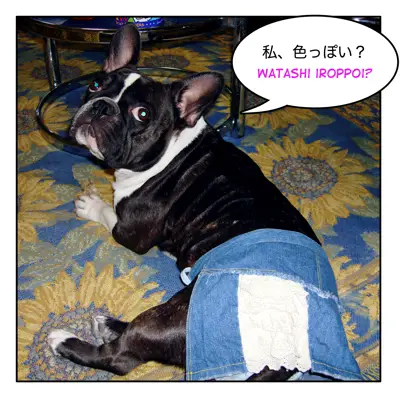
🐶「私、色っぽい?」
= Watashi, iroppoi?
= Am I sexy?
Today we are focusing on “poi”.
Look at the picture for today. 色っぽい ( = iroppoi) means “sexy“.
Ex. マギーは色っぽいです。
= Maggie wa iroppoi desu.
= Maggie is sexy.
Let’s compare the following sentences.
•(1)「今日は熱があります。」
= Kyou wa netsu ga arimasu.
= I have a fever.
•(2)「今日は熱っぽいです。 」
= Kyou wa netsuppoi desu.
= I have a slight fever today. I am feverish today.
っぽい (=~ppoi) means “~ish” or “~ like“. Just add it to nouns and make them to adjective forms to say something similar to that.
For example, if you want to say someone or some dog looks like Tom Cruise or Maggie, you can say:
* 彼はトムクルーズっぽい。
=Kare wa Tomu Kuru—zu ppoi.
= He is Tom Cruise-ish.
* あの犬はマギーっぽい。
= Ano inu wa Magi— ppoi.
= That dog is Maggie-like.
Even if Maggie does something that is LIKE something she would do you can say:
* そこに骨を隠すのはマギーっぽい。
= Soko ni hone wo kakusu no wa Magiippoi.
= Hiding the bone there is so like Maggie.
Here are some more examples:
⬇️
Ex.ゴミ箱 ( = gomibako)
→ゴミ箱っぽい( = gomibakoppoi) Trash can-like
•「あそこにゴミ箱っぽいものがあります。」
= Asoko ni gomibakoppoi mono ga arimasu.
= There is something which looks like a trash can.
Ex. 嘘 ( = uso) lie, fake
→嘘っぽい
= usoppoi
= fake-ish, not trustable, not convincing
•この映画は嘘っぽい。
= kono eiga wa usoppoi.
= This movie is a hoax.
Ex. 男 ( = otoko) a man
→ 男っぽい ( = otokoppoi) manly, masculine
Ex. 油 ( = abura) oil
→ 油っぽい
= ( aburappoi) oily
• 油っぽい食べ物
= aburappoi tabemono
= greasy food
Ex. オタク ( = otaku) geeky
→オタクっぽい ( = otakuppoi) geeky, dorky, nerdish
Ex. バカ(馬鹿)( = baka) fool
→ バカ(馬鹿)っぽい ( = bakappoi) foolish/ someone who looks stupid, something which looks ridiculous
Ex. 埃 ( = hokori) dust
→ 埃っぽい ( = hokorippoi) dusty
Very common with colors:
• 赤っぽい ( = akappoi) reddish
Ex. 赤っぽい色の車を探しています。
•青っぽい ( = aoppoi) bluish
•黄色っぽい ( = kiiroppoi) yellowish
•黒っぽい ( = kuroppoi) blackish
•白っぽい ( = shiroppoi) whitish
•緑っぽい ( = midorippoi ) greenish
•ピンクっぽい ( = pinkuppoi) pinkish
Ex. 子供 ( = kodomo) a child/children
→子供っぽい ( = kodomoppoi) childish.
📝 Note: 子供っぽい ( = kodomoppoi) is sometimes used for adults who are childish considering their age.
Ex. 彼はいい歳をしているのに子供っぽい。
= Kare wa ii toshi wo shite iru noni kodomoppoi.
= He is childish for his age.
(いい歳 ( = iitoshi) : negative: be supposed to be grown-up but…)
🔸 The difference between 「子供っぽい」 ( = kodomoppoi) and 「子供らしい」( = kodomo rashii)
🔸「っぽい」(=ppoi) and 「〜らしい」(~rashii) are interchangeable but sometimes they give a totally different nuance.
Usually 「子供っぽい」( = kodomo ppoi) can be used for adults but 「子供らしい」( = kodomo rashii) only can be used for kids.
「子供らしい」( = kodomo rashii) The subject has to be a kid. And it requires some qualities like being lively, active, innocent, cute, loving, and more positive compare to 「子供っぽい」( = kodomoppoi). Childlike.
•彼は本当に子供らしい
= kare wa hontou ni kodomo rashii
= (“He” has to be a real child and this sentence implies that he is energetic, active, innocent or cute, etc.)
•子供らしい服 ( = kodomorashii fuku ) = adequate clothes for kids
•子供っぽい服 ( = kodomoppoi fuku ) = childish clothes
*大人 ( = otona) →大人っぽい ( = otonappoi) mature
Ex. 彼女は大人っぽくみえるけれどもまだ子供だ。
= Kanojyo wa otonappoku mieru keredomo mada kodomo da.
= She looks mature but is still a child.
Ex. 大人らしい ( = otona rashii) grown-up
大人らしい態度 ( = otona rashii taido ) grown-up (mature) attitude
Also, みたいな means “like ~ “
1) 昨日、ビクターらしい人を見たよ。
= Kinou bikutaa rashii hito wo mitayo.
2) 昨日、ビクターみたいな人を見たよ。
= Kinou bikutaa mitai na hito wo mita yo.
3) 昨日、ビクターっぽい人を見たよ。
= Kinou bikutaappoi hito wo mitayo.
1) has more possibility that the person who this person saw was actually Victor.
2) means someone who looks like Victor.
3) means someone who looks like Victor or someone who has some similarities to Victor.
Also, you add 「っぽい」( = ~ppoi) after some (not all of them) 動詞の連用形 ( = doushi no renyoukei ), verbs with a nominal ending.
Ex. 怒る ( = okoru) to get angry → 怒り( = okori)
→怒りっぽい( = okorippoi) get angry easily
• 彼は怒りっぽい。( = kare wa okorippoi.) He gets angry easily.
• 彼は最近怒りっぽくなった。
= Kare wa saikin okorippoku natta.
= He’s been ill-tempered lately.
(→See below“how to make an adverb-form” )
Ex. 飽きる ( = akiru) to get tired of sth. /s.b.
→ 飽き ( = aki)
→ 飽きっぽい ( = akippoi) quick to get tired of sth./s.b.
Ex. 忘れる ( = wasureru) to forget
→ 忘れ ( = wasure)
→ 忘れっぽい ( = wasureppoi) quick to forget, tend to forget
Or sometimes you add it with some 形容詞 ( = keiyoushi) adjective.
安い ( = yasui) cheap
→ 安っぽい (=yasuppoi) cheapy
Ex. 安っぽい靴 ( = yasuppoi kutsu ) cheapie shoes.
Note: We don’t say 「高っぽい」( = takappoi) But as I always say, languages are changing.
:i: We see/hear many young people use “ppoi” in a wrong way but it has become modern Japanese.
Ex.「可愛っぽい」(=kawaippoi) which grammatically incorrect instead of saying 可愛らしい ( = kawairashii) or 可愛い ( = kawaii) cute, but they use it anyway.
Also, it adds some milder nuance.
Ex.「 綺麗っぽい」 ( = kireippoi) kind of beautiful.
← 綺麗な ( = kireina)
Ex. 「彼ら、これからカラオケに行くっぽいよ。」
= Karera, era korekara karaoke ni ikuppoi yo
= Looks like they are going to Karaoke now.
← 行くみたいだよ。( = ikumitai dayo.)
🔸There is a good example for this new trend. See this video and figure out what this actress ( = Kii-san) said.
Did you get it? I think she overused っぽい ( = ppoi) there.
:u:
• キイさん ( = Kii-san) :
「家にいるっぽい表情で出来たかなみたいな..」.
= Ie ni iruppoi hyoujyou de dekitakana mitaina..
= “I think I could do it like ..with a face expression as if I were at home.”
•キイさん( = Kii-san) :
「ああ、なんか女の子っぽい、はい。」
= Aa, nanka onnanokoppoi, hai.
= “Yeah, it’s kinda girl-like, right.”
(You might think that “girly” is appropriate here, but “girly” is negative. In this sentence onnanokoppoi is not negative.)
•インタヴュアー ( = Interviewer) :
「前より大人っぽいカレンダーになったかな…」(Sound faded)
= Mae yori otonappoi karendaa ni nattakana…
= “I wonder if this calendar came out to be more mature than the previous one?”
•キイさん ( = Kii-san) :
「今より大人っぽい気がします。はい。」
= Ima yori otonappoi kiga shimasu. ~
= “I think I look more mature than now.”
How to make an adverb-form:
You can change っぽい ( = ppoi) to っぽく ( = ppoku) and it will act as an adverb.
For example,
いたずらっぽい ( = itazurappoi) = mischievous
 いたずらっぽく笑う ( = itazurappoku warau) to laugh mischievously
How to make a negative form:
〜っぽい(= ~ppoi)
→〜っぽくない ( = ~ppoku nai.) or 〜っぽくありません。( = ~ppoku arimasen.) more polite.
彼は学生っぽい ( = kare wa gakuseippoi) He looks like a student.
彼は学生っぽくない。( = Kare wa gakuseippoku nai)
彼は学生っぽくありません。 ( = Kare wa gakuseippoku arimasen.) more polite.
He doesn’t look like a student.
 Maggie先生より = Maggie sensei yori = From Maggie-sensei
私も最近、忘れっぽくなっちゃって。今日、ご飯まだ食べていないよね。
= Watashi mo saikin, wasureppoku nacchatte. Kyou gohan mada tabete inai yone.
= I’ve been forgetful lately. I have eaten today right?
***
Will you be my Patron?
I appreciate your support! サポートありがとう!
56 Comments
Sensei what is the difference between っぽいandかのように
Hello Manisha,
Aっぽい: someone/something/some situation has certain quality of A
Noun + っぽい = ~ ish/~ like
~ は大人っぽい /大人っぽい + noun
~ は子供っぽい /子供っぽい + noun
~ は春っぽい /春っぽい + noun
It expresses noun which has qualities/characteristic of 大人(adult) ・子供 (children) ・春 (spring)
“A + かのように(Noun/na-adj) であるかのように + verb” means “as if” / A behave like B but actually A is not B.
彼は、なんでも知っているかのように話していた。
He was talking as if he knew everything (But actually he didn’t)
彼女は、まるでお金持ちでるかのようにふるまっている。
= She behaves like a rich person (but she is not (rich))
彼は、わかったかのように
Oh no, there so many structures to learn…
This is so difficult for me to understand…
私はちょっと頭が悪いんだけど…
Maggie Sensei can you please help me?
I’ve learned that らしい can be translated as “It looks like” but in a way that someone told me about this and I’m just passing this information.
And I also learn that そう can mean “it looks/ it seems” but in a way that I look someting and take a conclusion about it.
Is it everything that I said right?
If it’s possible can you please give a brief explanation about the differences between らしい, そう, みたい and っぽい?
Hi Eliza
When you tell someone what you have heard.
この店はおいしいそうです。
この店はおいしいらしいです。
この店はおいしいみたいです。
X おいしいっぽい (Though some young people may say this, it is grammatically wrong.)
When you look at the food and looks delicious, you say
この料理はおいしそうです。
X らしい・みたい・ぽい
When you see something and assume what is going to happen
You say 雨が降りそうだ。based on what you have seen.
You say 雨が降るみたいだ・降るらしい based on what you heard from other people or read somewhere.
X You can’t use ぽい
The usage of ぽい is more limited. Many of the typical examples are in the lesson.
Hello Maggie sensei,
If somebody calls me 子供っぽい, then is it a negative comment or a positive comment?
Since “子供” may also bring a positive image (like cute, innocent) and also a negative image (often crying, often wagamama, vv)
Then If I’m called like that, I really want to understand which thing is implied here :)
Thanks Maggie sensei.
Hello,
Good question.
As I wrote in the lesson 子供っぽい means “childish” and it sounds negative.(one’s behavior is immature/Something, for example clothes, looks too cute)
For positive / neutral / negative usage, you can use ようだ
(まるで)子供のようだ・です
Ah, sensei,
While reviewing the ppoi grammar, I found 1 question I raised before but still Maggie sensei ignored me (crying …).
Please don’t ignore me this time :)
If I did something bad, please forgive me , hahahaha
————-
My next question is can we describe a person as animal-like (means this person is aggressive, easy-to-fight, etc) by あの人は動物っぽい.
Or, someone is dog-like (It’s just a question for the lesson,please forgive me if you dont feel comfortable with this example) by 犬っぽい。
I understand in colloquial language, it’s OK to use. But… Is it grammatically correct?
Thanks Maggie sensei.
I am so sorry that I didn’t answer your question. I didn’t meant to ignore you. ごめんね!
I remember I read your comment but I guess I was going to answer you later after fetching a ball or something.
Yes, you say/hear that 動物っぽい・犬っぽい in conversation.
Ex. 動物っぽい動き
Ex. 行動が犬っぽい
(However, 動物みたい・犬のようだ might be better when you speak with your real human Japanese teacher in your class.)
Thank you Maggie sensei (from my heart) :)
I’m just kidding. Don’t be serious.
Always love Maggie sensei :)
Love you,too! 🐶💝
Hello Maggie sensei and hello Monday,
Could you help me this point?
The color itself has many tones, like strong pink, normal pink, slight pink.
When っぽい goes with color like ピンクっぽい = pinkish, what is the tone of this pink? I guess it’s strong pink but is it correct?
If ピンクっぽい is strong pink then is there any suffix to make pink slight pink?
Thanks Maggie sensei and enjoy a new week !
Hello Frozenheart!
I wouldn’t say “strong” pink. It is rather slightly pink but it depends on what you describe and what comes after ピンクっぽい
For example ピンクっぽい赤、ピンクっぽい肌,etc.
I think the idea is the same as “pinkish” in English.
Maggie sensei,
Could you help me in this sentence?
When I want to say ” she is not the Sun, but She is Sun-like”, I use っぽい
彼女は太陽ではないですけど、太陽っぽい。
Then, my sensei put me 0 point on this sentence.
Why my sentence is not correct, Maggie sensei?
子供っぽい can mean “He is not children but he is children-like”.
That’s why I dont know why “彼女は太陽ではないですけど、太陽っぽい” is incorrect.
Hello,
First, you don’t need to say “she is not the sun” because it is too obvious.
A person can’t be 太陽っぽい. Instead you can use みたい
She is like the sun. (It implies she is a warm and bright person.) 彼女は太陽みたいな人だ。・お日様みたいな人だ。
Maggie sensei,
Thank you for helping me.
But… why is that sensei.
As my understanding, we can describe 1 大人 with children characteristic by 子供っぽい。Why we can not describe 1 person with Sun-like characteristic (warm and bright) by 太陽っぽい。
My sensei answers that 太陽 and 人 are not related.
But I still can not figure out what noun is not related to what noun. Like children and an adult are also not related, aren’t hey?
But , it there are some exception nouns, could you please teach me !
My next question is can we describe a person as animal-like (means this person is aggressive, easy-to-fight, etc) by あの人は動物っぽい.
Or, someone is dog-like (It’s just a question for the lesson,please forgive me if you dont feel comfortable with this example) by 犬っぽい。
Thank you Maggie sensei!
As many of English words with “ish” is coined words, you can create your own words with っぽい in colloquial Japanese. In that sense,
太陽っぽい人が好き
might be acceptable.
In fact, っぽい is one of the overused words among young Japanese people and they attach っぽい to anything.
Ex. 明日みんなで集まるっぽい。(It seems like/I heard that we all get together tomorrow.)
Ex. なんか違うっぽい。(It looks different somehow.)
But not in your Japanese class. 😉
If you just say あの人は太陽っぽい, it sounds confusing to other people. The image you get from the sun is hot or warm or bright but it is too vague.
Maggie sensei,
ありがとうございました!
助かります
Thanks as always :)))
どういたしまして!
Yes!!!!! This is what I was talking about on Twitter!!! You’re so awesome!! Lol is っぽい the only suffix that does this kind of modifying? Thanks again! いつもありがとう!
@Courtney
Yay! Problem solved!
We also use ~気味(gimi) / 、~がかった(=gakkatta)
Ex. 赤みがかった(akami gakatta) reddish
Ex. 風邪気味=kazegimi = I have a light cold.
Ex. 遅れ気味= latish (running late)
わーい!(笑)マギー先生がいなければ困ってしまいました!いつもありがとう!!!!!
@Courtney
:maggie-small: boucingheart! boucingheart!
Hello, Maggie sensei,
I hope you find my question.
I’m really confused how to use っぽい with verbs.
Because in your example sentences the ending is always different 行くっぽい (basic form) 怒りっぽい 忘れっぽい (i-form), so there isn’t a rule which form of verb to use? And is the meaning somehow changed by the form of verb in the end?
I hope you understand my question and thank you for your reply boucingheart!
@sabi
Hi sabi,
Actually the correct way of using ぽい with a verb is
verb
*忘れる→(masu form) 忘れます→delete ます and add っぽい→ 忘れっぽい
*怒る→(masu form) 怒ります→delete ます and add っぽい→ 怒りっぽい
*飽きる→(masu form)飽きます→delete ます and add っぽい→飽きっぽい
However, in colloquial usage, you just add っぽい after a dictionary form.
する+っぽい
した+っぽい
It is grammatically wrong. Only for conversation.
I got it!! Thank you so much for your kind explain !heartsippai! !heartsippai!
And, Maggie sensei, I tried to look on your website for some lesson about differences in usage of よう/みたい、そう、らしい and っぽい (or at least some of them )
Especially らしい is confusing with よう/みたい and そう.. well, back to topic, I couldn’t find any lesson about this, so can I ask if there is some? If not, it would be nice if you could do a lesson about this if you want to.
I believe this grammar may be confusing for more people.
Anyway, thank you for all the lessons you did until now, they are so helpful !formingheart3! !formingheart3!
I always go here for the help when I’m lost in classes, Magie sensei is the best one, thank you !JYANE! !JYANE!
@sabi
Good to hear you got it.
I made lessons on らしい、よう and そう but not みたい yet. Will make a lesson if I have a chance.
Thank you for your nice words! これからもがんばります!
ドジっぽいタイポを見つけました。
“otonapppoi karenndaa” “otonappoi karendaa”
:w:
@Zetsuboumanadeshi
Hahaha, it will be hard to read that way. Thank you!!!! I fixed them. ありがとう!
お久しぶり、マギー先生!元気?
学校はもう始まったから、日本語の勉強のために時間が少ない。でも暇があると、いつもマギー先生のサイトに行っている^^
ちょっと質問がある。
私も最近、忘れっぽくなっちゃって。—>Why is the ~て form being used here? And how do you know what tense it’s in, since it’s the last verb in the sentence?
@Marianne
お久しぶり、Marianne! はい、元気ですよ!Marianneも元気でしたか?
We often leave the sentence without finishing it on purpose.Sometimes to avoid direct expressions because Japanese people tend to make it sound suggestive.
This て means “and../ so…” The listeners/readers can read between the lines depending on the context.
→私も最近、忘れっぽくなっちゃって(困ってしまいます。)
Suggesting some reason in a subtle way
Ex. 今日、遅く起きちゃって..(I got up late today so…)
Ex. もう宿題終わったので…(I’ve already finished my homework so…)
Ex. 勉強が忙しくて….(I’ve been busy studying so…)
Note for you
I will help your comment just a little to make it sound more natural :)
*学校は→学校が
*日本語の勉強のために時間→日本語の勉強のための時間 Note ために+ verb / ための+noun
*時間が少ない→”時間が少なくなった or 少なくなりました。
*サイトに行っている go →サイトに来ている o 来ています。(since you are here, “come” is better in Japanese)
元気でしたよ^^
Now I understand. ありがとう、先生!訂正もありがとう.
@Marianne
どういたしまして♪
元気そうでよかった!!!
Hello maggie sensei:)
I wish you all success.
I have the following questions:
1. Is -ppoi ending for all ages? Children, teens or adults?
2. I know we can end sentences with “da” instead of “desu”
is it the casual form of “desu”?
Also, is it manly to use “da” at the end of the sentences or is it fine for girls to use it too?
Thanks in advance.
@kuroineko
Hello! kuroineko!
1. Depends. The words such as 安っぽい、色っぽい、子供っぽい etc are pretty common all thorough the ages.
But only certain teens use っぽい with verbs.
Ex. 〜したっぽい、やったっぽい etc.
2.だ is not a casual suffix.
1) For writing : You can chose either desu form or da form.
2) For conversation : It sounds rough even for men.
Ex. あそこに見えるのが私の家だ。(If it is in writing, it is totally safe but if you verbally say that it sounds very blunt.)
In order to soften up we often add よ to a noun
私の家だよ。
Hello maggie sensei!
Thank you for your answer and for the examples, but part of the second question has no answer
2. what is “食べていない” and why not “食べなかった”?
Thanks in advance.
@kuroineko
Oh sorry! I missed the question.
食べていない means “I haven’t eaten” and 食べなかった is “I didn’t eat”
今日は何も食べていない= I haven’t eaten anything today.
昨日は何も食べなかった= I didn’t eat anything yesterday.
Hi maggie sensei^^
I want to thank you for your efforts and support to all of us.
I have the following questions:
1. in this sentence “彼はいい歳をしているのに子供っぽい” what is “している” meaning?
2. “私も最近、忘れっぽくなっちゃって。今日、ご飯まだ食べていないよね” what is “も” here?
does it mean “also”?
also, what is “食べていない” and why not “食べた”?
3. (not related). What is “なんと”? and please give me example.
Thanks in advance. ほんとうにありがとうございます。
@kuroineko
Hello kuroineko-san!
1) It is the same as いい歳をして. It is a set phrase. “for one’s age”
2) It could be “also” but it’s an emphasizing in this case.
3) なんと = what, how
Ex. なんというお名前ですか?= What is your name?
Ex. これはなんという本ですか?= What is the name of the book?
Ex. 子供の頃、なんと呼ばれていましたか?= How did people call you when you were a child?
I don’t really understand っぽい
This grammar has two meaning ? tendency and similarity ?
It works with verbs and adjectives too ?
@titi
Hello titi.
Q : This grammar has two meaning ? tendency and similarity ?
Yes. It means “ish” or “~like”
Q It works with verbs and adjectives too ?
Yes, the words that you can use with っぽい are very limited. The one I listed are the common examples. (忘れっぽい、安っぽい.etc)
As I said, young people crate their own words using っぽい but I would say if you overuse it it sounds shallow.
I’m a little confused by 今より大人っぽい気がします。はい。 Does that mean that she looked more adult in the previous calendar than in the current calendar? Or compared to NOW in general?
@Cygnus
今より大人っぽい気がします。
means “I think I look more mature (in the previous calendar compared to now.)”
エーーー??!そして、”That’s so like Aki”って言ったら、it will sound like “飽きっぽい”?
ダメだね。。。
How would you say “I will never give up!”?
and how would you say “I give up!” for example, when you don’t get something or don’t think you can win a game?
@Aki
Hahaha!! Akiっぽい!=飽きっぽい!?
Hope you don’t get tired of my site!
to give up = あきらめる
Ex. I gave up! = あきらめた!
Ex. Don’t give up! = あきらめないで!
hahah never sensei!!! ぜったいにない!!
do you have a lesson on word 全然?I’ve heard it so much, but I m not quite sure I know all of its uses…
@Aki
I don’t have a particular lesson on 全然 but I mentioned it in my slang lesson.
全然 (or 全く= mattaku) is usually used in negative sentences. Ex. 全然、英語が話せません。= I don’t speak English at all.
But we use it in affirmative sentences to stress the meaning in modern Japanese.
Ex.これ、全然、イケてる! = This is really cool!
There’s a typo here:
“•緑っぽい (=moidorippoi ) greenish”
“moidorippoi” should read midorippoi.
By the way this is really extensive, very interesting and informative, in all, AWESOME! Thanks for this cool lesson!
Ido-san,
“Typo” wo mitsukete kurete arigatou! Sassoku naoshimashita! Thank you for finding the typo. I fixed it right away.
I am very happy to hear you liked the lesson! Please come back again!
Hey, Maggie Sensei,
One of the examples above was: “昨日、ビクターみたいな人を見たよ。” I was wondering if “昨日、ビクターの様な人を見たよ。” can also be used. Or would the latter be translated as that he/she seemed, as in actions, like Victor an’ not in that he/she actually looked physically like Victor. Or how about “昨日、ビクターの様に見える人を見たよ。” Would this be “grammatically correct” Japanese? Finally, what about ビクターっぽそう, would this be fine as well? As in he seemed Victor-ish.
Thank you, Maggie Sensei. These lessons are really useful! Your master’s videos are extremely helpful as well! Keep up the great work!
Hello pcktbolさん
わ〜難しい質問が一杯ありますね。少しずつ答えますね。(Waa muzukashii shitumon ga ippai arimasune. Sukoshi zutsu kotaemasu ne.)
*If you say
「彼はVictorみたいな人だ。」or
「彼はVictorの様な人だ。」
I would think that that person has a similar personality or behaves very similar to Victor. But it could be just a physical resemblance in some cases. It is hard to tell by just that sentence.
“昨日、ビクターみたいな人を見たよ。」or “昨日、ビクターの様な人を見たよ。 They mean almost the same thing. Both sentences use the verb “見た” so we can assume that person physically looked like Victor.
If you say 昨日、ビクターみたいな人に会ったよ。then we don’t know if that person physically looked like Victor or personality-wise similar to Victor (or acted like Victor).
*“昨日、ビクターの様に見える人を見たよ。
Um… Maybe it is grammatically correct but it doesn’t sound natural because you use a person and the verb “見る” .
Ex. 「一見、マギーの様に見える犬を見たよ。」(Ikken Maggie no you ni mieru inu wo mitayo.) 「could be possible
but I would say
「一見、マギーの様な(マギーみたいな)犬を見たよ。」(Ikken Maggie no youna (or maggie mitaina) inu wo mitayo. ) .(一見= Ikken = at a glance.)
様に見える (you ni mieru) itself may sound redundant but it is possible to use. 彼は勉強をしている様に見える。(kare wa benkyou wo shiteiru you ni mieru. ) He looks like he is studying.
As for your last question,
ビクターっぽそう : Sorry, but it is not natural especially after a person’s name.
〜そう is usually used with adjective ( 忙しそう、暑そう)& verb (雨がふりそう、彼がやりそうなこと。)
I would say
(subject) はビクターっぽい。
However, as I mentioned in the lesson, young people might say
これ、無理っぽそう。(Kore murippo sou.) This seems to be impossible. (Grammatically incorrect.)
pcktbolさんは日本語をよく知っていますね。がんばって下さいね。(pcktbol-san wa nihongo wo yoku shitte imasu ne. Ganbatte kudasaine.) :grin:
Wow.. another awesome lesson.. my Japanese is coming along slowly but surely.. thanks so much for your lessons.. they are very much appreciated them. I’ve started started learning Hiragana and I found this great site: http://www.umich.edu/~umichjlp/Hiraganapro/index.html I left a comment in youtube but it didn’t post. Hope that link helps someone who’s also learning hiragana
Markshmily-san
Thank YOU for your comment! The site looks very useful! きっと、みなさんのやくにたつとおもいます。Kitto minasan no yaku ni tatsu to omoimasu! (I bet it is very useful for everyone!)
ありがとう!
Is there anything different (like a vowel insertion) if the ppoi ending is attached to a word that ends in a consonant? For instance, if I want to say bishounen-like/bishounen-ish?
CuriouserNcuriouserさん
なるほど、いい質問ですよね。(naru hodo, ii shitumon desu yone. ) I see, it is a good question! 「ん」などの子音で終わっても語末は「っぽい」になります”N” nadono shiin de owatte mo gomatsu wa “ppoi” ni narimasu. chotto matte, ima, rei wo kangaeru kara.)。
だから「美少年っぽい」って言います。(Dakara “bishounen-ppoi” tte iimasu. ) Even if it ends with a consonant such as “n”, it ends with “ppoi” , so we say “bisshounen-ppoi”.
ちょっと待って、今、他の例を考えるから。(chotto matte, ima hoka no rei wo kangaeru kara.) Let me see, I will think of other examples..
Ex. うどん(udon) noodle :うどんっぽい (udon ppoi) noodlish.
新聞(shinbun = newspapaer) : 新聞っぽい(shinnbun ppoi) newspaper-like
マイケルジャクソン(maikeru jakuson) : マイケルジャクソンっぽい (maikeru jakuson-ppoi) Michael Jackson-like
How’s that?
Thank you very much Maggie sensei for all these usefull lessons ^__^ I really enjoyed browsing through your blog today and especially liked the last lessons (“ppoi”, “keigo”, “konkatsu”, and the “restaurant” one with the adorable Nina san). Thanks again for all this work, sensei.
Ganbatte ne ! :3
Hello, Laetitiaさん!
Your nice comment made my day. I really appreciate it. Arigato~~~!!!! Korekara mo ganbaru node ouen shitene.