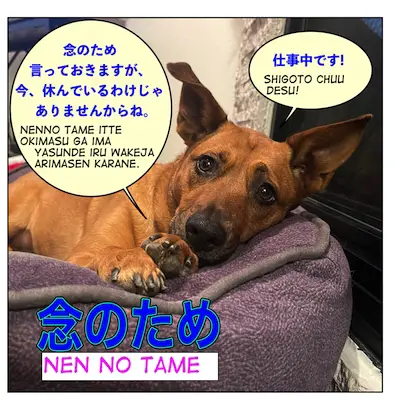
Ellie「念のため言っておきますが、 今、休んでいるわけじゃありませんからね。仕事中です! 」
= ねんのためいっておきますが、いま、やすんでいるわけではありませんからね。しごとちゅうです!
= Nen no tame itte okimasu ga, ima, yasunde iru wakedewa ariamsen kara ne. Shigoto chuu desu.
= Just to be clear, I’m not taking a break right now. I’m working!
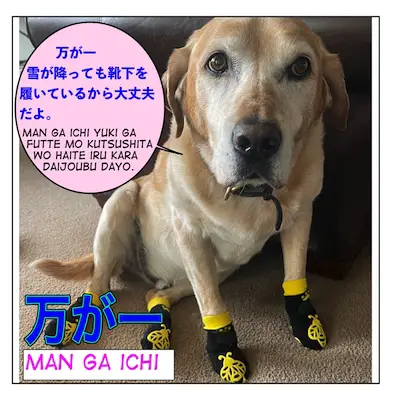
Louie: 「万が一、雪が降っても靴下を履いているから大丈夫だよ。」
= まんがいち、ゆきがふってもくつしたをはいているからだいじょうぶだよ。
= Man ga ichi, yuki ga futte mo kutsushita wo haite iru kara daijoubu dayo.
= Even if it snows, don’t worry! I’m wearing socks!
Hi everyone! We have these lovely guest teachers, Louie Sensei and Ellie Sensei today.
In today’s lesson, we’ll learn how to use 念のため(ねんのため = nen no tame)and 万が一(まんがいち = man ga ichi).
These expressions are both used to talk about preparing for something that might happen, but they are used in slightly different situations.
Let’s look at each one individually.
⭐️念のため = ねんのため = nen no tame = just in case (to do something as a precaution)
just to be sure
Note: The kanji of ため ( = tame) is 為
→念の為 = ねんのため = nen no tame
but in everyday writing, you usually see it in hiragana
→念のため = ねんのため = nen no tame
🔸How to use:
You use 念のため (ねんのため = nen no tame) when you do something that may not be strictly necessary, but you want to be prepared just in case, taking precautions or being safe.
You can also use 念のため (ねんのため = nen no tame) in the sense of “just to be sure” or “just to make sure” when you are double-checking or confirming something. I will teach you how to use it that way in this lesson as well.
🔸Sentence pattern:
念のため (ねんのため = nen no tame)+ do something(just in case/as a precaution)
Formal/ Business usage:
Ex. 念のため、本日の会議の資料を添付させていただきます。
= ねんのため、ほんじつのかいぎのしりょうをてんぷさせていただきます。
= Nen no tame, honjitsu no kaigi no shiryou wo tenpu sasete itadakimasu.
= I’m attaching today’s meeting documents, just in case.
Ex. 念のため、お電話番号をお伺いしてもよろしいでしょうか。
= ねんのため、おでんわばんごうをおうかがいしてもよろしいでしょうか。
= Nen no tame, odenwa bangou wo oukagai shite mo yoroshii de shou ka.
= May I have your phone number just in case?
Ex. 明日の出張の件で念のためご連絡を入れさせていただきます。
= あしたのしゅっちょうのけんでねんのためごれんらくをいれさせていただきます。
= Ashita no shucchou no ken de nen no tame gorenraku wo iresasete itadakimasu.
= I’m contacting you regarding tomorrow’s business trip, just in case.
Ex. 念のため、身分証明となるものをお持ちください。
= ねんのため、みぶんしょうめいとなるものをおもちください。
= Nen no tame, mibunshoumei to naru mono wo omochi kudasai.
= Please bring something that can be used as identification just in case.
Ex. 既にお聞きになっていると思いますが、念のため確認のメールを入れさせていただきます。
= すでにおききになっているとおもいますが、ねんのためかくにんのメールをいれさせていただきます。
= Sude ni okiki ni natte iru to omoimasu ga, nen no tame kakunin no meeru wo iresasete itadakimasu.
= I believe you may have already heard, but just in case, I will send a confirmation email.
Daily Conversation usage:
Ex. A: 「今日、雨降るかなあ…」
= きょう、あめふるかなあ…
= Kyou, ame furu kanaa.
= I wonder if it is going to rain today.
B: 「念のため、折り畳みの傘を持っていった方がいいよ。」
= ねんのため、おりたたみのかさをもっていったほうがいいよ。
= Nen no tame, oritatami no kasa wo motte itta hou ga ii yo.
= You should take a folding umbrella with you, just in case.
Ex. お客さん、10人来るけど料理これで足りるかな?念のため、もう少し用意しておこうかな。
= おきゃくさん、じゅうにんくるけどりょうりこれでたりるかな?ねんのため、もうすこしよういしておこうかな。
= Okyakusan, juunin kuru kedo ryouri kore de tariru kana? Nen no tame, mousukoshi youi shite okou kana.
= We’ll have 10 guests, but I wonder if this food will be enough. I guess I should prepare a little extra just in case.
At a clinic
受付:「お熱はありますか?」
= うけつけ:おねつはありますか?
= Uketsuke: Onetsu wa arimasu ka?
= Receptionist: Do you have a fever?
患者:「今朝、測ったときはありませんでした。」
= かんじゃ:けさ、はかったときはありませんでした。
= Kanja: Kesa, hakatta toki wa arimasen deshita.f
= Patient: I didn’t have a fever when I checked this morning.
受付:「念のため、もう一度測ってみましょうか。」
= うけつけ:ねんのため、もういちどはかってみましょうか。
= Uketsuke: Nen no tame, mou ichido hakatte mimashou ka.
= Receptionist: Let’s check it one more time, just in case.
Ex. 友達の誕生日プレゼントにTシャツを買いに来たが、サイズがわからなかったので、念のため大きめのサイズにした。
= ともだちのたんじょうびプレゼントにTシャツをかいにきたが、サイズがわからなかったので、ねんのためおおきめのサイズにした。
= Tomodachi no tanjoubi purezento ni T-shatsu wo kaini kita ga, saizu ga wakaranakatta node, nen no tame ookime no saizu ni shita.
= I went to buy a T-shirt as a birthday present for a friend, but I didn’t know the size, so I chose a larger size, just in case.
Ex. ネット予約がきちんと入っているか念のため、確認しておいた方がいい。
= ネットよやくがきちんとはいっているかねんのため、かくにんしておいたほうがいい。
= Netto yoyaku ga kichin to haitte iru ka nen no tame, kakunin shite oita hou ga ii.
= You should check that your online reservation went through, just in case.
🗒️ Another way to say “just to be safe / for the time being” is 一応 = いちおう = ichiou .
念のため大きめのサイズにした。
= ねんのためおおきめのサイズにした。
= Nen no tame ookime no saizu ni shita.
→一応大きめのサイズにした。
= いちおうおおきめのサイズにした。
= Ichiou ookime no saizu ni shita.
念のため確認しておいた方がいい。
= ねんのためかくにんしておいたほうがいい。
= Nen no tame kakunin shite oita hou ga ii.
→一応、確認しておいた方がいい。
= いちおうかくにんしておいたほうがいい。
= Ichiou, kakunin shite oita hou ga ii.
While 念のため ( ねんのため= nen no tame)sounds more careful and deliberate, 一応 (いちおう = ichiou)sounds more relaxed and informal, and is often used in everyday speech for light precautions — doing something that you may not really need, but just in case or for the time being.
Check my lesson on 一応 = いちおう = ichiou
Link: Click here
Ex. A: 「今度、映画でも一緒に観に行かない?」
= こんど、えいがでもいっしょにみにいかない?
= Kondo, eiga demo issho ni mi ni ikanai?
= Do you want to go see a movie together sometime?
B: 「いいよ。でも念のため言っておくけどこれはデートじゃないからね。」
= いいよ。でもねんのためいっておくけどこれはデートじゃないからね。
= Iiyo. Demo nen no tame itte oku kedo kore wa deeto ja nai kara ne.
= Sure. But just to be clear, this isn’t a date.
Note: The literal meaning of 念のため言っておく ( = ねんのためにいっておく = nen no tame itte oku) is “I’m saying this as a precaution.”
In casual conversation, 念のため(ねんのため = nen no tame) can be added after a sentence to clarify what you just said: just so you know / in case you’re wondering / just for your information
⬇️
Ex. その動画は既に削除されています。念のため。
= そのどうがはすでにさくじょされています。ねんのため。
= Sono douga wa sude ni sakujo sarete imasu. Nen no tame.
= That video has already been deleted, just so you know.
⭐️万が一 = まんがいち = man ga ichii
🔸How to use:
The literal meaning of 万が一(まんがいち = man ga ichi) is “one in ten thousand.”
It is used when the possibility of something happening is very low, and refers to thinking about or preparing for an unexpected situation that is often serious, negative, or risky.
Note: You can also say 万一( まんいち = man ichi).
They mean the same, but 万が一( まんがいち = man ga ichi) is more common in daily conversation and emphasizes that it is very unlikely to happen.
🔸Sentence pattern:
万が一(まんがいち = man ga ichi)/ 万一(まんいち = man ichi)+(something: event / accident, or a rare or serious situation)happens + what to do.
Ex. 万が一、飛行機が遅れるようなことがあったら、すぐに連絡してください。
= まんがいち、ひこうきがおくれるようなことがあったら、すぐにれんらくしてくだ
い。
= Man ga ichi, hikouki ga okureru youna koto ga attara, sugu ni renraku shite
kudasai.
= If the plane happens to be delayed (in the unlikely case), please contact me
immediately.
Note: So here 万が一(まんがいち = man ga ichi)refers to the possibility of a flight delay,
which is an unlikely but possible event. It is used to talk about what to do if
such an unexpected situation happen.
Ex. 多分、間に合うと思いますが、万が一、遅れるようなことがあれば、先に始めて
ださい。
= たぶん、まにあうとおもいますが、まんがいちおくれるようなことがあれば、さき
にはじめてください。
= Tabun, maniau to omoimasu ga, man ga ichi okureru youna koto ga areba,
saki ni hajimete kudasai.
= I think I’ll probably make it, but in the unlikely case that I happen to be late, please start without me.
Ex. 万が一この商品にご満足を頂けなかった場合は全額返金いたします。
= まんがいちこのしょうひんにごまんぞくをいただけなかったばあいはぜんがくへんきんいたします。
= Man ga ichi kono shouhin ni gomanzoku wo itadakenakatta baai wa zentaku henkin itashimasu.
= In the unlikely event that you are not satisfied with this product, we will give you a full refund.
Ex. コンサートで万が一気分が悪くなった場合は、近くの係員にお声がけください。
= コンサートでまんがいちきぶんがわるくなったばあいは、ちかくのかかりいんにおこえがけください。
= Konsaato de man ga ichi kibun ga waruku natta baai wa, chikaku no kakariin ni okoegake kudasai.
= If you feel unwell at the concert (in the unlikely event), please contact a nearby staff member.
Ex. 万が一この入試に落ちたら、来年同じ大学を受ける。
= まんがいちこのにゅうしにおちたら、らいねんおなじだいがくをうける。
= Man ga ichi kono nyuushi ni ochitara, rainen onaji daigaku wo ukeru.
= If I fail this entrance exam, I’ll apply to the same university again next year.
Note: The speaker thinks they will pass, but is talking about what they would do just in case.
Ex. 万が一、携帯を落としたら、遠隔操作でロックしてください。
= まんがいち、けいたいをおとしたら、えんかくそうさでロックしてください。
= Man ga ichi, keitai wo otoshitara, enkaku sousa de rokku shite kudasai.
= If you lose your phone (in the unlikely case), lock it remotely.
Ex. 万が一サイン会に誰も集まらなかったら、中止にします。
= まんがいちサインかいにだれもあつまらなかったら、ちゅうしにします。
= Man ga ichi sain-kai ni dare mo atsumaranakattara, chuushi ni shimasu.
= If no one shows up at the signing event (in the unlikely case), we will cancel it.
Ex. 万一、来年転勤することになれば、家族と離れて暮らさないといけなくなる。
= まんいち、らいねんてんきんすることになれば、かぞくとはなれてくらさないといけなくなる。
= Man ichi, rainen tenkin suru koto ni nareba, kazoku to hanarete kurasanai to ikenaku naru.
= In the unlikely event that I happened to be transferred next year, I will end up having to live apart from my family.
Ex. 海外旅行に行く時は万が一に備えて、保険に入っておいたほうがいい。
= かいがいりょこうにいくときはまんがいちにそなえて、ほけんにはいっておいたほうがいい。
= Kaigai ryokou ni iku toki wa man ga ichi ni sonaete, hoken ni haitte oita hou ga ii.
= When going on an overseas trip, you should get insurance to be prepared for any unlikely situation.
Ex. 父は万一に備えていつも貴重品を枕元に置いて寝る。
= ちちはまんいちにそなえていつもきちょうひんをまくらもとにおいてねる。
= Chichi wa man ichi ni sonaete itsumo kichouhin wo makuramoto ni oite neru.
= My father always keeps his valuables by his pillow when he sleeps, preparing for emergencies.
Ex. 人生、何があるかわからないから万一に備えてある程度の貯金はあった方がいい。
= じんせい、なにがあるかわからないからまんいちにそなえてあるていどのちょきんはあったほうがいい。
= Jinsei, nani ga aru ka wakaranai kara man ichi ni sonaete arutekido no chokin wa atta hou ga ii.
= Life is unpredictable, so you should have some savings to be prepared for emergencies.
Ex.各自治体は、万が一のために防災用品を常備している。
= かくじちたいは、まんがいちのために、ぼうさいようひんをじょうびしている。
= Kaku jichitai wa, man ga ichi no tame ni, bousai youhin wo joubi shite iru.
= Each local government keeps emergency supplies on hand in case of an emergency.
Lastly, let me introduce a few more ways to say ‘preparing for an emergency or an unexpected situation.
⭐️ もしもの場合 / もしもの時に備えて
= もしものばあい / もしもときにそなえて
= moshimo no baai / moshimo no toki ni sonaete
= to prepare for an emergency / just in case something unexpected happens
Ex. ホテルに泊まるときは、もしもの場合に備えていつも非常口を確認する。
= ホテルにとまるときは、もしものばあいにそなえていつもひじょうぐちをかくにんする。
= Hoteru ni tomaru toki wa, moshimo no baai ni sonaete itsumo hijouguchi wo kakunin suru.
= When I stay at a hotel, I always check the emergency exits just in case.
⭐️いざという時に備えて = いざというときにそなえて= iza to iu tok ni sonaete
⭐️ いざという時のために
= いざというときのために = iza to iu toki no tame ni
= to prepare for an emergency / just in case something unexpected happens / to prepare for a crucial or important moment / for when it really matters
Ex. このお金は、いざという時のために取っておこう。
= このおかねは、いざというときのためにとっておこう。
= Kono okane wa, iza to iu toki no tame ni totte okou.
= Let’s keep this money for when it really matters / for an emergency.
Ex. 政府はいざという時のために備蓄米を確保している。
= せいふはいざというときのためにびちくまいをかくほしている。
= Seifu wa iza to iu toki no tame ni bichikumai wo kakuho shite iru.
= The government secures stockpiled rice for emergency situations.
****
 マギー先生より = マギーせんせいより = From Maggie Sensei
Louie 先生、Ellie先生、また教えに来てくれてありがとう!
= Louiseせんせい、Ellieせんせい、またおしえにきてくれてありがとう!
= Louise Sensei, Ellie Sensei, mata oshie ni kite kurete arigatou!
= Thank you, Louie-sensei and Ellie-sensei, for coming to teach us again!
私は万が一おやつがないときに備えていつもソファーの下に非常食を隠していました。😉
= わたしはまんがいちおやつがないときにそなえていつもソファーのしたにひじょうしょくをかくしていました。
= Watashi wa man ga ichi oyatsu ga nai toki ni sonaete itsumo sofaa no shita ni hijoushoku wo kakushite imashita.
= I used to hide emergency snacks under the sofa, just in case there were no treats.😉
****
My Patrons can access the audio file
Audio Files for this lesson →Click here
PDF file without ads (One with romaji & One without romaji) →Click here
I appreciate your support! サポートありがとう! !
My supporters can access tons of audio files, PDF files, and special lessons on my Patreon page.
❤️ありがとう x 2: Mini lessons, PDF files with audio for all the lessons here from 2018
❤️ありがとう x 5 In addition to the previous benefit + Daily Japanese
Check the index of Daily Japanese Series →Index
❤️ありがとう x 10 In addition to the previous benefit + PDF file of all my Twitter lessons for a month (average 10 ~ 18 pages) with an audio file. Please check the details here

One-time support ↓ ありがとう!