
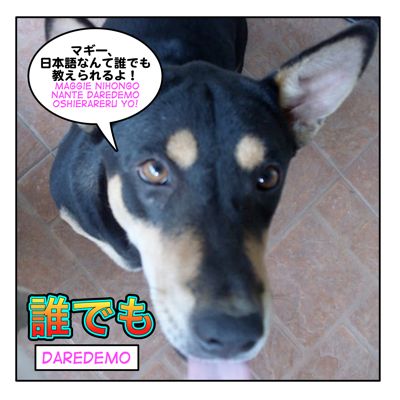
「マギー、日本語なんて誰でも教えられるよ。」
= Maggie, Nihongo nante daredemo oshierareru yo.
= Hey, Maggie, anybody can teach Japanese, you know.
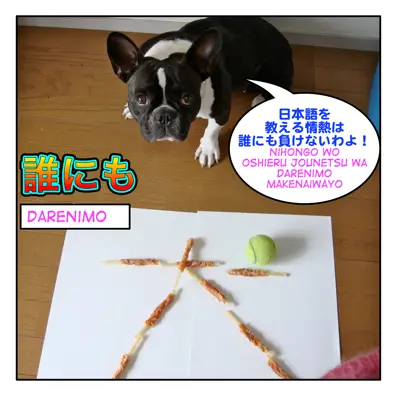
「日本語を教える情熱は誰にも負けないわよ!」
= Nihongo wo oshieru jōnetsu wa darenimo makenai wayo!
= Nobody can beat my passion for teaching Japanese!
みんな、元気?= Minna genki? = How are you, everyone?
This lesson is for one of my favorite Twitter followers アーナナーシュ who has always tried hard to do any quizzes or homework!
He asked me the difference between 誰でも ( = daredemo) & 誰にも ( = darenimo).
I will finally make a lesson to answer his question with his adorable doggie, Pepsi-Sensei!
Now let’s take a look at what Pepsi-sensei said in above picture.
!to right! 「マギー、日本語なんて誰でも教えられるよ。」
= Maggie, Nihongo nante daredemo oshierareru yo.
= Hey, Maggie, anybody can teach Japanese, you know.
Note : なんて= nante = a particle to belittle something/someone.(It is ”just Japanese!” kind of feeling.)
When you look this word up in the dictionary, it says both 誰でも ( = daredemo) and 誰にも ( = darenimo) are “anybody”.
No wonder it is confusing for Japanese learners, huh?
But the rules are very simple! :grin:
🔸 誰でも ( = daredemo) + affirmative sentence / no matter who it is
🔸 誰にも ( = darenimo)+ negative sentence, negative imperative sentence/ nobody
 Ex. 誰でもわかる
= daredemo wakaru
= Anybody can get/understand it.
Ex. 誰にもわからない
= darenimo wakaranai
= Nobody can get /understand it
Ex. 誰でもまねできる。
= Daredemo mane dekiru.
= Anybody can do (copy/imitate) that.
Ex. 誰にもまねできない。
= darenimo mane dekinai.
= Nobody can do (copy/imitate) that.
 When you say “anybody” does/can, you use 誰でも ( = daredemo)
Ex. 誰でも今日はただで入れます。
= Daredemo kyō wa tada de hairemasu.
= Anybody can enter free of charge today.
Ex. 女の子だったら誰でもケーキが好きなはずだ。
= onnanoko dattara daredemo keiki ga sukina hazuda.
= All girls should love cakes. (Literally: If (it) is a girl, anyone should like cakes.)
Note : The difference between 誰か ( = dareka) and 誰でも ( = daredemo )
Ex. 誰か手伝って!
= Daredaka tetsudatte!
= Can anyone help me?
Ex. 誰でもいいから手伝って!
= Daredemo ii kara tetsudatte!
= Anyone can help me? to right! (implying I don’t care who it is, help me!)
You use 誰にも ( = darenimo) with negative quotes or negative imperative sentences.
In the above picture, I said,
→ 「日本語を教える情熱は誰にも負けないわよ!」
= Nihongo wo oshieru jounetsu wa darenimo makenai wayo!
= Nobody can beat my passion for teaching Japanese!
(Note : わよ ( = wayo) ending is for female speech
誰にも負けない = darenimo makenai = won’t lose to anyone)
Ex. マギーの気持は誰にもわからない。
= Maggie no kimochi wa darenimo wakaranai.
= Nobody knows how Maggie feels.
Ex. こんな難しい問題は誰にも解けない。
= Konna muzukashii mondai wa darenimo tokenai.
= Nobody can solve such a difficult problem.
Ex. 「このことは、誰にも言わないでね。」
= Kono koto wa darenimo iwanaide ne.
= Don’t tell anybody about this.
Ex. 誰にも私の秘密は教えない。
= Darenimo watashi no himitsu wa oshienai.
= I won’t tell my secret to anybody.
Ex. 誰にも彼女の大変さはわからないと思う。
= Darenimo kanojo no taihensa wa wakarani to omō.
= I think nobody can understand her hardship.
 マギー先生より= Maggie Sensei yori = From Maggie Sensei
ペプシ先生ありがとう!= Pepushi Sensei arigatō! = Thank you, Pepsi-Sensei!
この日本語のレッスンは、ゆかりが手伝ってくれてるの。でも誰にも言わないでね。 🤫
= Kono nihongo no ressun wa yukari ga tetsudatte kurete iru no. Demo darenimo iwanai dene.
= Yukari helps me with these Japanese lessons but don’t tell anybody”!
***
Will you be my Patron?
I appreciate your support! サポートありがとう!
35 Comments
Hi Maggie!
Thank you so much for all of your articles, they are so helpful to me. I have a question along these lines.
For nan demo / na ni demo, can I assume:
– nan demo = affirmative sentence
– nan ni demo = negative sentence
I thought my assumption was correct until I cam across:
– I can become anything – watashi wa nan ni demo naremasu
This isn’t a negative sentence, but uses nan ni demo. Could you please help clarify?
Thank you!!
Hi Julia
As for なんでも・なんにでも ( = nan demo & nanni demo) , is different from 誰でも&誰にも
nan ni demo can be used in an affirmative sentence
(この接着剤はなんにでも使えます。= kono secchakuzai wa nan ni demo tsukaemasu.= This glue can be used for anything.)
But “何も” ( nani mo) is used in a negative sentence.
彼は何もわからない。
= Kare wa nani mo wakaranai.
= He doesn’t get anything.
おはようございます、マギー先生!
I think this question is somewhat related to this lesson, if I switch 誰 with any other noun, would the same rules still apply?
e.g.
1.大人にも難しいです。
2.大人でも難しいです。
The first one with にも was what I used when I wanted to say something is difficult even for adults, then I came across a sentence by a native Japanese speaker using でも (the second one), which I assume is the correct way of saying it. But I’m still confused, is the first one strictly wrong? What would be the correct way of using にも in this case?
こんばんは! altuser
The basic difference is
noun にも〜 = ~ for/to noun,too
noun でも 〜 = ~ even for ~
1.大人にも難しいです。
2.大人でも難しいです。
Though some people say 1) 大人にも難しい
2) 大人でも難しい is much more common
The nuance difference is
2) means “It is difficult even for adults.”
1) is “It is difficult for adults,too.”
***
I will show you other examples.
Let’s compare the following sentences.
→私にもできることがある。
There is something that I can do, too.
→私でもできることがある。
There is something that even I can do.
あ、わかりやすいです!説明してありがとうございます!
よかった〜😊
What about the difference between them in situations where 誰にも is used with non-negative verbs? e.g. What is the difference (if there is one? I feel like there isn’t really but grammatically I couldn’t explain why) between 誰にもできる and 誰でもできる or 誰にもわかる and 誰でもわかる?
@Erica
Hello Erica,
誰にも is usually used in a negative sentence but you can see it with non-negative verb form when it modify a noun.
誰にもわかる日本語 = 誰でもわかる日本語 (The same meaning)
誰にもできる仕事 = 誰でもできる仕事 (The same meaning)
今まで、このブログを知って、悔しいだよ!Maggie先生、質問があるんですが、
だれでも分かる=anybody can understand it
だれにも分からない=nobody can understand it
では、not everyone can understand it 日本語でなんと言いますか。
@rokuvo
Hi rokuvo!
not everyone can understand it =みんな(or すべての人)がわかるわけではない(です)
今まで、このブログを知って、悔しいだよ!
You mean “今までこのブログを知らなくて悔しいよ”?
How come people say なんでもないです and not なににもないです? 例えば:
友:「もうあなたのタイムカードを落としたよ」
私:「あ、そっか!めっちゃありがとう!」
友:「なんでもないです!」
Hi can I ask if 誰も=誰にも?
@mel
Hi, mel!
誰も and 誰にも :
They are not the same :
1)When に in 誰にも is an Indirect Object Marker, you can’t switch them.
Indirect Object Marker に:
Ex. Maggieにこれをあげます。= I will give this to Maggie
Ex. Maggieに秘密(ひみつ)を話(はな)す。 = to tell Maggie one’s secret.
→
Ex. これは誰にもあげません。= I won’t give this to anybody. (X これは誰もあげません。This means “Nobody will give this.)
Ex. 誰にも秘密を話しません。= I won’t tell my secret to anybody. (X 誰も秘密を話しません。This means “Nobody tells the secret.)
When 誰も is used as a subject,
Ex. Nobody knows = 誰も知らない= daremo shiranai, you can’t say 誰にも知らない= darenimo shiranai. This doesn’t make any sense.
1) When に in 誰にも is used as emphasizing of 誰も, you can switch them.
Nobody knows what I am thinking about.
a: 誰にも私の考えていることはわからない。>b : 誰も私の考えていることはわからない。
a) emphasizes “Nobody” more than b)
thanks alot maggie sensei!(:
i am now clearer about those two words. however can i ask from your example,
誰にもわからない
= darenimo wakaranai
= Nobody can get /understand it
does 誰にも知らない= darenimo shiranai.
=nobody can know it?
(or does it make no sense like what you said from the previous comment? sorry im a little confused here! gomenasai!)
once again thanks alot!(:
@mel
I assume you already know the difference of the meaning between 知る(= to know, to learn) and わかる (= to understand)
While わかる is an intransitive verb, 知る is a transitive verb and we have to use different particle for each verb.
*(object) がわかる (Note : Occasionally you can say ~をわかる)
*(object) を知る (We never say ~が知る)
We sometimes use に when we want to emphasize the subject.
私は〜がわかる =I understand ~
→subject + には Emphasizing the subject “I” →私には〜がわかる= (emphasizing the subject “I”) ( (Maybe you or other people don’t but ) I understand ~
→subject + にも Adding the nuance of “even” (Even I know ~or Also I know ) →私にも〜がわかる (Even I understand ~ )
Now the verb 知る can’t use with the particle に
*私は〜を知っている。= I know ~ →(negative form) 私は〜を知らない = I don’t know~
So you can’t say 私には〜を知っている or 私に〜を知らない
That is why you can’t say 誰にも知らない。We just say 誰も知らない = Nobody knows.
あっそっか!教えてくれてありがとうございました!有り難いことです。(i backtracked your lessons and found this phrase!^^)ごめんね、i only started learning japanese last year,だから、私の日本語は上手でわない。thankyou so much for your long and detailed explanation! i look forward to your future lessons!(:
@mel
どういたしまして。Hope you keep learning! がんばって!
(a little correction : 上手でわない→上手ではない。)
Thanks for your blog. I’ve just started reading it recently, but it has really helped make some things clear. It really helps since I live in Japan
@Ace I am happy to hear you found us! また来てね!
Maggie-sensei, is it correct to say 「日本語を教える情熱は誰でも勝つわよ!」 –> “When it comes to teach Japanese, I beat anyone!”?
@Mweggy
Hi, Mweggy!
“誰でも勝つわよ” means “Anyone will/would win”.
Ex. そんな試合、誰でも勝つよ。
= Sonna shiai daredemo katsuyo.
= Anybody would win such a game!
So if you want to say
“I beat anyone! ”
The direct translation is
私は誰にでも勝つ(わよ)!
= Wsatashi wa darenidemo katsu (wayo).
誰にでも = darenidemo
We put the particle に here because “to beat/ to win over someone” is ~に勝つ = ~ ni katsu
But in this case, it is more common to say “I won’t lose to anybody!” = 私は誰にも負けない。= Watashi wa darenimo makenai.
あ、なるほど!
ありがとうございます, マギー先生! Even though that was my first comment I always read your lessons, you’re such a great help! マギー先生の事尊重します!(*^o^*)
@Mweggy
どういたしまして!!またいつでもコメントいれて下さいね。
(尊重 You mean “to respect”= 尊敬= sonkei?) Anyway, thank you!!! Please come back!!
Yes I meant it as “respect”, I thought 尊重 was synonymous with 尊敬… and yes I’ll come back for sure! じゃね,マギー先生! (^-^)/
@Mweggy
It means “to respect” but 尊重 is usually used for one’s ideas, opinions, thoughts, positions, etc. not people.
あなたの意見(iken =opinion)/ 立場(tachiba= position)/考え (=kanngae= thoughts) を尊重します。
and it also means “to regard, esteem, value”, etc.
OK, will see you in some article comment section again!!
マギー先生最高!
あはは、ゆかり先生タイプしてくれているね^^
ありがとう、ゆかり先生!<3
@Aki
ありがと!アキ!
Shhh! 誰にも言わないでよ! 前足でタイプできないからね。 :)
Why do you say “Nihongo wo oshieru jounetsu wa darenimo makenai wayo” Instead of “Nihongo wo oshieru jounetsu wa darenimo katanai wayo” ?
@Jason
Because 勝たない(= katanai) means “not to win”
and 負けない(= makenai) means “nobody can beat me”
負ける(=makeru)= to lose→ negative form: 負けない(= makenai) = unbeaten, not to lose
勝つ (=katsu) = to beat/to win → negative form: 勝たない(=katanai) = not to win/ to lose
I think I understand. It’s like saying “it loses to no one” So darenimo means nobody in this context. I was thinking it should be ” it beats everyone”. Thanks for your help.
@Jason1982
どういたしまして!(^▽^)/
Thanks Maggie, Pepsi and Yukari sensei! Your passion in teaching Japanese inspires learners like me to do my best.
More powers to your blog!
@Amelie
Thank you for always having a great attitude towards learning Japanese!!
Thank you so much for writing this very informative lesson, Maggie-sensei! I’ve always been confused about when and how to use 「誰でも」and「誰にも」.
A friend recently introduced me to your website and I’m backtracking your lessons bit by bit! I’m self-studying Japanese and I have a long way to go but your lessons are very helpful, informative and very interesting too!
ありがとうございます!
@sonattan
Hello, sonattan!! Thank you for your first comment! I am glad to hear this lesson was helpful.
There are lots of lessons but they are random. Go through the index. Hope you can find some useful lessons for you.
Feel free to ask me any questions here.