
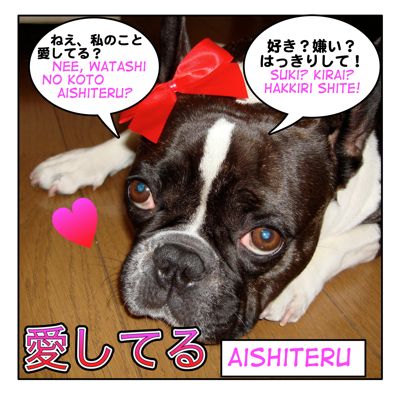
「ねえ、私のこと愛してる?」
= Nee watashi no koto aishiteru?
= Hey, do you love me?
「好き?嫌い?はっきりして!」
= Suki? Kirai? Hakkiri shite!
= Do you like me or not? Which is it?!
Today we will learn how to express LOVE ♥ :n: in Japanese.
Love in Japanese is 愛 = あい = ai.
•人間愛 ( = ningen ai) love towards for your fellow
•兄弟愛 ( = kyoudai ai) brotherly love
•愛のある生活 ( =Ai no aru seikatsu) Life with love
•愛情 ( = aijou) affection
The verb form is : 愛する ( = aisuru)
•愛する人 ( = aisuru hito) loved one, a person you love
“I love you!” in Japanese is,
•「私は、あなたを愛しています。」
= Watashi wa anata wo aishite imasu.
•「僕は君を愛しています。」
= Boku wa kimi wo aishite imasu. (male talk)
Or we often omit the subject and and object and just say,
•「愛しています。」( = Aishite imasu.)
↓ (more casual)
•「愛してる。」( = Aishiteru) Love you!
•「愛しているよ。」( = Aishite iru yo) This sounds a bit boyish.
•「愛してるよ。」( = Aishiteru yo.) This sounds a bit boyish.
「愛しています 。or 愛してる ( = Aishiteru or Aishiteru) 」( = Aishite imasu.) is a very heavy and special phrase.
We use 好き です ( = Suki desu) much more often than 愛しています( = Aishiteimasu) or 愛してる(=Aishiteru).
好き(=suki) means “to like“. And of course, 愛している ( = Aishitteiru) has a much deeper meaning but if you say 好きです ( = Suki desu.) sincerely, you will be able to accurately express your love in a way that is equal to the meaning of 愛しています。( = Aishite imasu.)
*あなたのことが好きです。
= Anata no koto ga suki desu.
 あなたのことが好き!
= Anata no koto ga suki!
This sounds a bit girlie.
*あなたが好きです。( = Anata ga suki desu.)
あなたが好き!( =”Anata ga suki!”)
This sounds a bit girlie
Note : They both mean “I like you. /I am fond of you.”→“I love you.” It is very common to add ~のこと ( =~no koto) after a pronoun to refer to that person.
のこと ( = no koto) means “things about” and it implies the (whole) existence of that person. It can emphasize that person. At the same time, it sometimes works to temper or lessen the feeling or power of that sentence — and yes this seems very contradictory, but I’m sure all languages have these subtle nuances. We use “こと” ( = koto) to make the sentence softer while
あなたが好きです。 ( = Anata ga sukidesu.) sound very straight.
Ex. 君が好き ( = Kimi ga suki)
君のことが好き
( = Kimi no koto ga suki.)
I like/love you. (male talk.)
Ex. あなたが信用できない。
( = Anata ga shinyou dekinai.)
あなたのことが信用できない。
= Anata no koto ga shinyou dekinai.
= I can’t trust you.
Ex. 彼、あの子が好きなんだって。
= Kare anoko ga sukinan datte.
彼、あの子のことが好きなんだって。
= Kare anoko no koto ga sukinan datte.
= They said he liked her. / I heard he liked her.
OK, now, if you like that person a lot, you can say ”大好き” ( = daisuki) or “めちゃめちゃ好き” ( = mechamecha suki)
*あなたが大好きです。( = Anata ga daisuki desu.)
あなたが大好き!( = Anata ga daisuki) sounds a bit girlie
*あなたのことがめちゃめちゃ好きです。( = Anata no koto ga mechamecha desu.)
あなたのことめちゃめちゃ好き!( = Anata no koto daisuki!) sounds a bit girlie.
Both mean “I like you a lot. /I am very fond of you.”→“I love you.”
As in English, this is not just for a romantic relationship. Kids and parents also say to each other “I love you”, using 好き ( = suki). They almost never use 愛してる ( = aishiteru) face to face.
*「ママのこと大好き!」
= Mama no koto daisuki!
= I love you, Mom! / I love my mom!
*「お父さん、私のこと好き?」
= Otousan, watashi no koto suki?
= Dad, do you like/love me?
I know it all depends on the couple but compared to Westerners, we don’t say 「愛しています 。(or 愛してる)」( = Aishite imasu / Aishiteru)) , “I love you!” face to face in daily life so much.
But don’t misunderstand. There is love in Japan! We are just more shy and just not good at expressing it verbally. Or we prefer expressing our love in more subtle ways. Some people think
言葉にすると軽くなる or 安っぽくなる
= Kotoba ni suru to karuku naru / yasuppoku naru.
= If you say something (so often/casually) it will become cheesy.
So when do we say “I love you!”?
★We say it when we tell someone “I love you!” for the first time, confessing our love.
*告白する ( = kokuhaku suru) to confess (one’s love)
*告白される ( = kokuhaku sareru) to be confessed. (Someone confesses their love to you.)
(Note : 告白する ( = kokuhaku suru) generally means to confess but it means to tell someone “I love you!” or how much you love that person for the first time because it is a big deal for us.)
Slang:
↓
*コクる ( = kokuru) to confess
*コクられる ( = kokurareru) to be confessed to (Someone confesses their love to you)
Ex. 彼に告白した。
( = Kare ni kokuhaku shita.)
I confessed (my love) to him.
Ex. 彼にコクられた。
( = Kare ni kokurareta)
I was confessed by him. →He confessed to me. Slang
↓ more shallow
口説く ( = kudoku) to come on to someone/ to hit on /make a pass at someone
*彼に口説かれた。
= Kare ni kudokareta
= He hit on me.
*彼女を口説いた。
= Kanojo wo kudoita.
= I made a pass at her.
*口説き文句
= kudoki monku
= a pick-up line / loving words
★Younger couples are not so shy about expressing their love.
*「好きだよ。」
= Sukidayo.
= I like/love you!
*「大好き!」
= Daisuki!
= I really like/love you!
*「愛してる!」
= Aishiteru!
= I love you!
They say it or text it to their sweethearts more casually.
★Also when we see our own feeling of love objectively and refer to it, we use the “L” word.
*彼を心から愛していました。
= Kare wo kokoro kara aishite imashita.
= I loved him from the bottom of my heart.
* 彼女を本当は好きではありませんでした。/愛していませんでした。
= Kanojo wo hontou wa suki de wa arimasen deshita./ Aishite imasen deshita.
= To be honest, I didn’t like/love her.
Note: In Japanese 彼 ( = kare) could be the personal pronoun“he” or “boyfriend” while 彼女 ( = kanojo) could be “she” or “girlfriend“
EX.「彼いるの?」( = Kare iruno?) = 彼氏/カレシいるの? ( = Kareshi iruno?)
= Do you have a boyfriend?
Ex.「僕には彼女がいます。」
= Boku niwa kanojo ga imasu.
= I have a girlfriend.
(Or 「私/僕には付き合っている人 がいます。」
= Watashi/Boku niwa tsukiatte iru hito ga imasu.
=I’m been seeing someone.)
* 彼 ( = kare) 彼氏/カレシ ( = kareshi) boyfriend
*彼女/カノ ジョ ( = kanojo) girlfriend
⇨Young people stress the ending sound.
→カレシ( = kareshi)
カ ノジョ( = kanojo)
while older generation say,
→カレシ( = kareshi)
カノジョ( = kanojo)
*元カレ( = moto kare) ex-boyfriend (colloquial)
*元カノ( = moto kano) ex-girlfriend (colloquial)
*ボーイフレン ド ( = bouifurendo) boyfriend
*ガールフレ ン ド ( = gaaru furendo) girlfriend
★Or when you accuse your sweetheart of becoming cold!
Ex. 私のこともう愛してないの?
= Watashi no koto mou aishite naino?
= You don’t love me anymore?
Ex. 僕のこと好きっていったのに嘘だったの?
= Boku no koto sukitte itta no ni uso datta no?
= Were you lying when you said you loved me?
************************
Let’s continue…
❤️<Other expressions to show your love>
• あなたがずっと好きでした。
= Anata ga zutto suki deshita.
= I’ve always loved you.
• あなたは私にとって大切な人です。
= Anata wa watashi ni totte taisetsu na hito desu.
= You are very special (to me.)
•大切 ( = taisetsu) literally means “important”.
• 君は僕にとって大切な人だ。
= Kimi wa boku ni totte taisetsu na hito da. (male talk.)
= You are very special.
Note: It will be more natural to use a person’s name instead of あなた ( = anata) / 君 ( =kimi) (Check my Is it OK to use あなた ( = anata) lesson.)
• あなたのことを大切に思っています。
= Anata no koto wo taisetsu ni omotte imasu.
= I care about you.
• 私にはあなたが必要です。
= Watashi ni wa anata ga hitsuyou desu.
= I need you.
• 僕にはあなたが必要なんだ。
= Boku ni wa anata ga hitsuyou nanda. (male talk.)
= I need you!
• 君(あなた)とずっと一緒にいたい。
= Kimi (Anata) to zutto issho ni itai.
= I want to be with you for good. ( boys use 君 ( = kimi) )
• あなたを幸せにしたい。
= Anata wo shiawase ni shitai
= I want to make you happy.
•ずっと側にいたい。
= Zutto soba ni itai.
= I want to be with you.
•側 ( = soba) literally means “next to” or “close to”.
• ずっと君を守ってあげたい。
= Zutto kimi wo mamotte agetai. (male talk.)
= I want to protect you forever.
They are all a bit corny and cliché.
If a third person hears these, they might say,
あっま〜〜い!( = Ammaaai!) , How sweeeet! ( →甘い = amai = sweet) Too sweet!
or
くさい ( or クサイ)セリフ( or 台詞)!( = kusai serifu) The original meaning of くさい = 臭い (= kusai) is stinky or smelly.
But we also use it when we hear something overly clichéd or corny. (セリフ/ 台詞 ( = serifu) : line)
But I personally love to hear them.♥
❤️<恋>( = koi) love, romantic love, fancy, romance
While 愛 ( = ai) is deeper and more general in that it includes love for people, animals, earth, and countries, etc. 恋 ( = koi) is just for romantic love. In my definition, 愛 ( = ai) is something unconditional but 恋 ( = koi) could be infatuation or ドキドキする ( = dokidoki suru.) something that makes your heartbeat. There is 永遠の愛 ( = eien no ai) eternal love but there isn’t a word 永遠の恋 ( = eien no koi)
*恋に落ちる ( = koi ni ochiru) to fall in love
Note: We never say 愛に落ちる ( = ai ni ochiru.)
*恋する ( = koisuru) adj. (to be)in love
*恋する二人 ( = koisuru futari) two people in love
*恋している ( = koishiteiru)/恋をしている ( = koi wo shiteiru.) to be in love
→「私(は)、~に恋(を)していま す。」
= Watashi (wa) ~ ni koi (wo) shiteimasu.)
= I am in love with (someone).
Ex. マギーは潤に恋している。
= Maggie wa Jun ni koishite iru.
= Maggie is in love with Jun.
Note: When we use 愛する ( = aisuru) here, we say,
Ex.マギーは潤を愛している。
= Maggie wa Jun wo aishite iru.
= Maggie loves Jun.
*恋人 ( = koibito) loved one, boyfriend, girlfriend
📝 Note: Careful not to say 愛人 ( = aijin). 愛人 ( = aijin) is someone — male or female — you are having an affair with, like a mistress, etc.
*恋人同士 ( = koibito doushi) a couple
Ex. 私達は恋人同士です。
= Watashitachi wa koibito doushi desu.
= We are a couple.
This sound more romantic than
私達は付き合っています。
= Watashitachi wa tsukiatte imasu.
= We are seeing each other.
•初恋 ( = hatsukoi) first love
Ex.あなたは私の初恋の人でした。
= Anata wa watashi no hatsukoi no hito deshita.
= You were my first love/crush.
•恋愛 ( = ren’ai) love, love affair, romance
Ex. あの二人は 恋愛関係にある。
= Ano futari wa ren’ai kankei ni aru.
= They are in love.
Ex.もうかなり 長い間恋愛から遠ざかっている。
= Mou kanari nagai aida ren’ai kara touzakatte iru.
= I haven’t had a relationship for a long time.
•恋話/恋ばな ( = koibana) (slang) romantic stories ←恋愛話 ( = ren’ai banashi)
•恋仲 ( = koinaka) to be in love, to be in a romantic relationship
(old fashioned)
Ex. 彼らは恋仲だ。
= Karera wa koinaka da.
= They have a romantic relationship.
(old fashioned)
•恋敵 ( = koigataki) rival in love (a bit old fashioned) = 恋のライバル ( = koi no raibaru)
Cultural Note :
Sometimes we change the titles of Western movies completely and replace them with some catchy Japanese titles.
There are many romantic movies that use the kanji 恋 ( = koi) in their titles.
Can you guess the original movie title from the Japanese titles?
♥恋するベーカリー ( = Koi suru beikarii) A bakery in love (←the literal meaning)
“It’s Complicated”
♥恋人たちの予感 ( = Koibito tachi no yokan) Expected to be lovers (←the literal meaning)
“When Harry Met Sally”
♥それでも恋するバルセロナ ( = Soredemo koisuru Barucelona) Still Barcelona is in love . (←the literal meaning)
“Vicky Christina Barcelona”
♥恋愛小説家 ( =Renai shousetsuka) Novelist of love (←the literal meaning)
“As Good As It Gets”
♥恋のから騒ぎ ( = Koi no karasawagi) Carried out for love (←the literal meaning)
“10 Things I Hate About You”
♥ニューヨークの恋人 ( = New York no koibito) Loves in N.Y. (←the literal meaning)
“Kate &Leopold”
and many more…
❤️<Other love-related words>
•一目惚れ ( = hitomebore) love at first sight
•惚れる ( = horeru) to be in love with someone, to fall in love with someone (male speech)
Ex. あの子に惚れた!
= Anoko ni horeta!
= I’m in love with her.
Ex.「惚れてしまうやろ〜!」
= Horete shimajuyarou!
= “(If you are so sweet to me) I will fall in love with you!/I can’t help falling in love with you.”
Osaka dialect. This phrase became popular last year when one comedy duo started to use it as their punch line.
•片思い (片想い)( = kata omoi) one-sided love, unrequited love
Ex.マギーは片思い(片想い)をしている。
= Maggie wa kataomoi wo shiteiru.
= Maggie has a crush on someone.
•両思い ( = ryou omoi) to be in love with each other
•熱々 ( = atsuatsu) lovey-dovey
•ラブラブ ( = raburabu) lovey-dovey
Ex.ラブラブだね!
= Raburabu dane.
= You guys are lovey-dovey!
•熱い仲 ( = atsui naka) in love
Ex. 彼らは熱い仲だ。
= Karera wa atsui naka da.
= They are in love
•仲良し ( = nakayoshi) or 仲がい い ( = naka ga ii) to be very close
(You can use it for friendship as well.)
<おまけ> ( = Omake) Bonus!
Are you in love now? Then here are some useful phrases to get closer to that person you like.
❤️ <The first step! >
In Japan, when we like someone, we often ask the person out subtly.
First of all, ask for their email or phone number.
Ex. メールアドレス(or メルアド)交換しない?
= Meiru adoresu(meruado) koukan shinai?
= Do you want to exchange email addresses?
Ex. 電話番号聞いてもいい?
= Denwa bangou kiitemo ii?
=Do you mind if I ask for your phone number?
Ex. 暇な時に連絡くれる?
= Hima na toki ni renraku kureru?
= Can you contact me when you are free?
↓
❤️ <誘う> ( = sasou) to ask someone out
Then ask them out. Check to see if they are interested in going out with you alone.
Ex. 今度一緒にどこかに遊びに行きませんか?/行かない?
= Kondo issho ni dokoka ni asobini ikimasen ka?/ikanai? ←more casual
= Do you want to go out with me sometime? / Do you wanna go out with me sometime?
Ex. 今度の日曜日空いてる?
= Kondo no nichiyoubi aiteru?
= Are you free next Sunday?
Ex. 今度映画でも観に行かない?
= Kondo eiga demo mini ikanai?
= Do you wanna go see a movie sometime?
Ex. ちょっと美味しい店があるんだけど今度一緒にいかない?
= Chotto oishii mise ga arundakedo kondo issho ni ikanai?
= I know a good restaurant. Do you wanna go there with me sometime?
↓ (more direct)
Ex. 今度、どこかに連れて行ってくれない?
= Kondo dokoka ni tsurete itte kurenai?
= Can you take me out sometime? (female talk.)
Ex. 今度どこかに一緒にデートしない?
= Kondo dokoka ni issho ni deeto shinai?
=Do you wanna go on a date sometime?
Ex. 今、付き合っている人はいますか?
= Ima tsukiatte iru hito wa imasu ka?
= Are you seeing anybody?
Ex. 二人でどこかに行かない?
= Futari de dokoka ni shokuji demo ikanai?
= Do you wanna go somewhere — just the two of us?
If someone asks you out, it is obvious that they like you!
And if you ask someone and they say ちょっと. . ( = chotto…) go check my ちょっとlesson, immediately!
↓
❤️<デート> ( = deito) date
•デートする ( = deito suru) to go on a date
•「今度、デートしない?」
= Kondo deito shinai?
= Do you wanna go out with me sometime?
•彼とデートする
= Kare to deito suru.
= to have a date with a boyfriend
•「日曜日はデートの約束があるの。」
= Nichiyoubi wa deito no yakusoku ga aruno. (female talk)
= I have a date with him this Sunday.
•初デートでドライブに行く。
= hatsu deito de doraibu ni iku
= to go on a drive on a first date.
•人気デートスポット
= Ninki deito supotto
= popular date spots
↓
❤️ <If your relationship gets steady..>
*交際する ( = kousai suru) to go out (formal)
When celebrities are spotted dating, they often have a special interview and do
交際宣言 ( = kousai sengen) an official announcement to tell people they are officially seeing each other.
*付き合う( = tsukiau) to go out with someone
→付き合っている ( = tsukiatteiru) seeing someone
Ex. 付き合っている人がいます。
= Tsukiatte iru hito ga imasu.
= I am seeing someone.
Ex.「私達、付き合ってるの。」
= Watashitachi tsukiatteruno.
= We are seeing each other. (female talk)
Ex. 「僕達、付き合っているんだ。」
= Bokutachi tsukiatte irunda
= We are seeing each other. (male talk)
Ex.付き合い始めたばかりだからどうなるかわかりません。
= Tsukiai hajimeta bakari dakara dounaru ka wakarimasen.
= I have just started to see someone so I don’t know what is going to happen in the future.
If you like someone very much and want to go out with them, you ask,
•「私(僕)とお付き合いして下さい。」
= Watashi/Boku to otsukiai shite kudasai.
= Please go out with me. (polite)
•「私(僕)と付き合って下さい。」
= Watashi/Boku to tsukiatte kudasai.
= Go out with me, please.
•「よかったら、私(僕)と付き合ってくれる?」
= Yokattara watashi/boku to tsukiatte kureru?
= If possible, will you go out with me?
*僕 ( = boku) is for men
↓
❤️<Getting more serious?>
Or are you more serious and thinking about marriage?
→まじめな(お)付き合い ( = Majime na (o)tsukiai) or
真剣な(お)付き合い ( = Shinken na (o)tsukiai)
serious relationship
If you are very committed, you can ask,
•「正式にお付き合いして下さい。」
= Seishiki ni tsukiatte kudasai.
= Please go out with me officially.
•「結婚を前提にお付き合いして下さい。」
= Kekkon wo zenntei ni otsukiai shite kudasai.
= I would like to have a relationship with you with the object eventually being marriage.
Now, good luck finding your sweetheart, everyone! :D
🐶 From the pic. above,
「ね え、私のこと愛してる?」
= Nee watashi no koto aishiteru?
= Hey, do you love me?
「好 き?嫌い?はっきりして!」
= Suki? Kirai? Hakkiri shite!
= Do you like me or not? Make yourself clear!
 マギー先生より ( = Maggie Sensei yori) From Maggie Sensei
日本語での愛の表現を覚えましたか?それでは、誰か練習で私に愛を告白してみて下さい。
= Nihongo deno ai no hyougen wo oboemashita ka? Soredewa dareka watashi ni ai wo kokuhaku shite mite kudasai.
= Did you learn how to express love in Japanese? So, who is going to confess their love to me in the comments?
***
Will you be my Patron?
I appreciate your support! サポートありがとう!
200 Comments
Hey Maggie,
Short question, my boyfriends name is Simon, when I want to say
„I‘m in love with Simon“
Do I say :
Watashi wa Saimon wo aishite iru.
Yes, you can say that.
There are a few ways to say that
“Watashi wa Saimon wo aishite iru. ” is good but you may see that more in written form.
In conversation you can just say
Saimon ga suki.
Saimon ni koishiteru.
Good to know, you really helped me out.
Thank you very much <3
You’re very welcome! :)
Maggie-Sensei, ohayou!
I have one more question regarding this subject: Well, the girl I love wrote me “aishiteru” on a photo of the two of us. (Also, she only used my first name without “San” or anything like it.) Now of course you can’t read her mind, but as far as I know, this is something serious, isn’t it? So she probably wouldn’t say something that strong if she doesn’t mean it, right? (She’s an all-Japanese girl, with me being her only Western contact.)
Ohayou, Ralph,
Yes, if she writes that quote, she is more serious than “suki/daisuki” and she has feelings for you. 💕
そうですか!ありがとうございます! This is great news for me! 😊
Also, thank you for all the knowledge!
どういたしまして💕
こんにちは、マギー先生,
I loved reading your website! It’s incredibly detailed and love the added touches for fonts and emoticons! ^_^
I have one question! My boyfriend of 5 years and I love to call each other “my love” how would we say that in Japanese? Is there such a word/phrase for it?
Example:
Me) Thank you for doing that for us!
BF) You’re welcome, my love!
Would it be “watashi no ai” or “watashi no koi”? Or what would it be? Thank you in advance! <3
Hi Psy
Thank you for visiting my site. I am glad to hear you like reading my site.
I am afraid to say you don’t use the terms of endearment such as “my love” / “babe/baby”/”sweetie” /”honey” in Japanese.
People might refer to one’s partner ハニー ( = honey) and ダーリン (darling) but they don’t say 私の愛・恋 ( = watasi no ai / koi).
You might see 私の愛しい人 (= watashi no itoshii hito) for my loved one in the literature but I doubt people use it verbally.
So if you want to express your love, I guess you say
ありがとう! or どういたしまして and add (name/ nickname)+ 大好き! / 好きだよ💕
なるほど! ありがとう ございます for taking time out of your day to assist me, マギー先生 and 天人! 感謝します! 🙏
How sad it sounds, but Maggie’s right.
I don’t know, if you know, that あなた might also be translated as “dear”.
According kotobank.jp =>2 妻が夫に対して、軽い敬意や親しみをこめていう。
However, I doubt that noways it’s commonly used among young people. Maybe in dramas, literature, etc…
ヨロシク
*nowadays
どういたしまして、Psy! 💕
Hi 天人!
I know… We have to create new words!
I might have mentioned in my あなた lesson but you might hear that usage in drama or animations but it is a bit old fashioned.
なるほど! ありがとう ございます for taking time out of your day to assist me, マギー先生 and 天人! 感謝します! 🙏
Maggie-sensei, thank you so much for this lesson!
Actually I want to ask the difference of grammar, but it’s about love expression so I hope it’s not really out of context.
Usually I found either 君が好き or 君を好きになった, but recently I found this sentence 超美少女が好きになったのは、超能力者。 I take it’s 超能力者 who fell in love with 超美少女 rather than the other but it might be because of the comma that I’m not really sure.
And when I searched for other examples, looks like (object) が好きになる is used but not as frequently as (object )が好き or (object)を好きになる, did I guess it right? But aren’t their meanings all the same ?
Hi Crims,
Good question.
Aが好きになったのは、B
The one who A fell in love with is B.
Aが好きになったのはB
The one who fell in love with A is B.
As you said, comma is a key to tell which one is which.
**
First ~が好き and ~が好きになる are different.
~が好き I like/love ~
~が好きになる I come to like ~
As for these two
~が好きになる
~を好きになる
I can’t tell which one we use more but が is a topic marker and を is an object marker. Therefore, while が emphasizes who you like and を is used when you state the fact you like someone.
Hope it helps.
Dear Maggie Sensei, konnichiwa!
I’m sorry for commenting on this rather old article, but there is something I would like to learn from you.
There is this Japanese girl I have deep feelings for. Ich know that she also likes me a lot, but I can’t figure out how much exactly. However, I am confident, so I want to propose my love to her. Should I say “(name) wo aishiteru yo”, or is it too heavy? If so, were I to use “(Name) ga daisuki da yo” instead? Doesn’t it make a difference if I left out the “ga” before her name (I’ve also read that several times)?
If “koibito”, by the way, is definitely related to a mutual feeling, this makes me even more confident – I’ve called her “watashi no koibito” several times, and she didn’t object that. However, maybe it’s only because I’m a gaijin …
Kind regards,
Ralph
(I’m sorry for “ich know” – it’s German autocorrect …^^)
@Ralph
Hi Ralph
It’s true. “Aishite imasu” is deeper than “daisuki dayo”. The middle one is “~ no koto ga suki desu.”
It may sound strange but “Boku wa ~ no koto ga suki desu.” sounds deeper than “daisuki”.
FYI “koibito” is fine but you use “kanojo” more often in Japanese. “Boku no kanojo ni natte kudasai.” = Please be my girlfriend.
Good luck!!
Sensei, thank you for the explanation. I have a question. In your post, koibito= loved one, boyfriend or girlfriend. so, if a woman say, “aitsu wa watashi no koibito” what does exactly she mean? Is she refer to “he is my boyfriend” or “he is my beloved”? The situation is, she doesn’t know exactly whether the guy loves her or not. But, sure she knows her own feeling, how deeply in love she is with him. And, they never officially going out. I am so confused. Please help me, sensei
@Coraline
恋人 is someone exclusive.
So they are supposed to be in love. (So they should have been going out and love each other deeply.)
友達<ボーイフレンド<恋人
I see, so you can’t say someone is your koibito just because you love her/him without knowing their feeling toward us?
@Coraline
Right. Unless he/she is your imaginary lover. (^_−)−☆
And Maggie-sensei, sorry for the bad grammar. English isn’t my first language. So you might be confused to understand what i meant. What i really wanted to ask is, can we use 恋人 to describe someone relationship other than lovers/boyfriend?
Because in a light novel i have been read, the main lead guy is called as the second lead female’s ‘yuujin and koibito’ by the narrator. But from the story, we can exactly tell that the main lead guy is in love with another woman.
Of course this second lead female is deeply in love with the main lead guy. So, can we interpret the ‘koibito’ that’s used by narrator as a beloved?
Sorry for being a bit annoying…
Oh no, i’m really bad with grammar. What i meant is “a light novel i have read’ not ‘i have been read’
Gomenasai Maggie-sensei
@Coraline
My answer is the same.
恋人= one’s loved one/boyfriend/girlfriend/significant other
nothing else.
yuujin no koibito means “my friend’s loved one”
I don’t know the story so I can’t give you more information but you may find some hidden facts while the story develops.
Maggie Sensei, arigatou gozaimasu!
Yes, in fact it really sounds strange that “suki” can be stronger than “daisuki” … Is there any explanation for that? Is it because of that “koto” expression … On the other hand, that could be used with “daisuki” as well, couldn’t it. So I really have no clue …
@Ralph
I guess it’s because ” 好き ( = suki)” already have a meaning of “I love you” besides “I like something”, you don’t need to add “dai”. Also we say “daisuki” too casually when you talk about food, games, things or some preferences, etc.
Of course, 大好き ( = daisuki) can sounds much stronger than 好き ( = suki) depends on how you deliver the speech.
Naruhodo Alright, sensei. Arigatou gozaimasu That’s so helpful!
@Risya
You’re very welcome! :)
Souka, arigatou gozaimasu (^_^)
@Coraline
Douitashimashite!
I see. I just want to know that whether it’s same as I love you or stay in love with you. I found the sentence when I was listening to Misato Aki’s song. The lyrics is “さよならの向こう側で、キミを大好きなまま”
@Riesya
The meaning of きみを大好きなまま is “stay (or keep) loving you”
The previous line of the song is
キミを待っている I will wait for you.
So キミを大好きなまま modifies that line.
I will wait for you loving you.
*キミを大好きなまま
@Riesya
Ah..まま the way it is right now/ keep doing something
But I am confused with your question. What do you want to know. 大好きなまま to do something keep loving you
You need a verb after that.
Oh no. I think I made a mistake with my writing haha sorry sensei. It’s supposed to be like this キミ大好きなまま.
Hi, Maggie-sensei. I want to ask a question. How about 君を大好きなママ? Is it same as I love you?
@Riesya
Hi Riesya
君を大好きなママ means “Mom who loves you” (Ex. 君を大好きなママより= From Mom who loves you.)
Is that what you meant?
Hi Maggie-sensei,
Thank you for the lesson! I just wanted to know, would it be more common to use (as a young girl toward her boyfriend in public) 「ねえ、私のこと大好き?」as opposed to 「ねえ、私のこと愛してる?」?
@Jenni
I would say 「私のこと好き?」instead of 大好き.
as well thank you for all the effort you put in your lessons they are a huge help!!
@おはぎ
My pleasure! ❤
Hi, Maggie-sensei, you’ve got quite detailed lessons here, thank you very much. I came across phrase “スキあい” in manga I’m reading now and I suspect that it has nothing to be with love (it has been used in child’s play). Am I right or not? What does it mean?
@Irina
Hi Irina,
Can you give me the whole sentence with スキあい?
I will figure that out.
Sorry, that’s it – the whole sentence Maybe the story can help? The highschool boy and girl are standing really close to each other face to face, the boy is going to say something but that girl’s little brother suddenly jumps on him shouting スキあい.
@Irina
I see.
Can you check if it is スキあり not スキあい.
If it is スキあり(隙あり) it totally makes sense.
It means “chink in one’s armor (armour)” which we say when we attack someone when you find their weak spot that shows and opening for attack.
Thank you very much, Maggie! It makes sense! Font is styled to look like handwriting, so for me last symbol looked totally like い! But now I see that 2nd stroke much longer (sigh).
@Irina
Great! Now problem solved! :)
So happy to see your website! You see, I was writing an anime fanfiction, and I’m trying to learn more japanese. What does this phrase mean in japanese: “Complete my heart/Complete this heart of mine” ?
@Margaux0615
Hi!
What does this phrase mean in japanese: “Complete my heart/Complete this heart of mine” ?
You mean how to say that line in Japanese?
There is no direct translation.
You could translate it literally but it sounds unnatural.
You could say You can fill my heart. あなたは私の心を満たしてくれます。
Thank you very much! boucingheart! !niconico!
@Margaux0615
You’re very welcome! :)
Maggie先生、こんにちは!
May I ask how strong is the word “恋人” ?
On my Twitter bio, I wrote “私の恋人→ XXX (It’s a Japanese Celebrity Name Here)”
A Japanese user who I followed then tweeted “XXXくんの恋人? . . . ”
Was it wrong for me to joke about it in my bio? (Cause it’s kinda common in western terms do so)
So is 恋人 a strong word? Cause I think she got offended T_T
Thanks!
@ナチ
こんにちは!
Oh don’t worry! She just reacted because she is jealous.
恋人 is an exclusive relationship.
She would still react if you change it to ~君の彼女(カノジョ)~’s girlfriend.
こんにちは、マギー先生!
I’m so glad to have found your site! It’s very informative and I have learned a lot from you. !heart3!
So say that someone you met online (but haven’t met in person) tells you “あなたのことが気になるよ”. To my understanding “気になる” could also mean “I like you” or “I’m curious/interested about/in you”. Is that right?
Then I want to ask this person, “Why are you interested in me?” Previously you went over the phrase “どうして私のことが好きなの?” but what are some other ways to ask this question without using the word “好き”? I think “好き” is too strong a word to use in this case.
Would any of these phrases work?
何故私のことが気になるの?
私のどかが気になるの?
私のことをどう思う?
What would sound more natural? I also don’t want to sound too direct or rude.
お返事お待ちしております。お願いいたします。
@Sofia
Hi Sofia,
I am glad that you found my site as well. :)
As you said the feeling of 好き is stronger than 気になる
So when someone says あなたのことが気になります and if you say “どうして私のことが好きなの?”, the person might feel pressured so you should avoid using the word 好き
And if you want to know the reason,
何故私のことが気になるの? →OK or どうして私のことが気になるの?
私のどかが気になるの? →私のどこが気になるの?
私のことをどう思う?→A bit straight forward but OK
Or if you feel happy, just tell him 私のことが気になると聞いて嬉しいです。without asking a question.
Hi! Thank you for all your hardwork! It helps me a lot!
Just one question: how can you say “let me be your boyfriend” in japanese? I’m looking forward to your answer~
@Saya
Hi Saya,
“let me be your boyfriend”
The literal translation is
あなたの彼に(なら)させて(ください)
僕をあなたの彼にしてください。
But it doesn’t sound natural.
In Japanese we would say
付き合わせてください。
Dear Maggie,
Thank you for teaching us so many useful phrases. I’m a French woman and currently learning Japanese. I often pick up sentences and/or explanations on your blog.
I was looking for some sentences to express how glad I am to have met a Japanese man who became my close friend. It’s not about a love relationship so the vocabulary of this lesson doesn’t fit.
We’re both a little over 40 and never met physically, we exchange e-mails to improve our language skills. I’m looking for sentences such as:I’m glad we got to know each other. I’m happy we can talk freely and understand each other, your friendship and trust are important to me….
I want to send him an handmade card to thank him because he always helps me with Japanese and he also comforted me at a difficult time in my life.
Could you eventually help? Maybe a topic with phrases about friendship would be a good idea
@Carine
Bonjour Carine! Thank you for visiting our site.
It seems like you found a nice Japanese friend.
First if you want to thank him for supporting you through difficult time and appreciate your friendship you can say something like
いつも日本語を教えてくれて有り難う。そしていつも支えてくれてありがとう。(Nama)のお陰で辛いことも乗り越えてくることができました。心から感謝しています。
=Itsumo nihongo wo oshiete kurete arigatou. Soshite itsumo sasaete kurete arigatou. (Name) no okage de tsurai kotomo norikoete kuru koto ga dekimashita. Kokoro kara kansha shiteimasu.
= Thank you for always teaching me Japanese. And thank you for your support. Thank to (name), I could overcome the hardship. Thank you from the bottom of my heart.
Hello Maggie Sensei! Ogenki desu ka? Thank you for your wonderful blog!
Like Corine, I am in my 40s and have a Japanese male friend of the same age with whom a correspond from time to time. In my case, we have met in person a few times in Japan and are close enough for public hugging, but it is not a romantic relationship.
He does not speak much English and I am only a beginner at Japanese so we do not write long notes and I always have to use a dictionary, but it is extremely helpful for me to practice reading Japanese characters and understand colloquial phrases (our correspondence is not formal). Sometimes a friend translates, but I would like to be able to express some forms of friendly affection on my own, as that seems more personal.
For instance, it would be nice to express that I miss his company (I am never sure if words such as “aitai” are suited to friendship) or how much I appreciate him as a person/apprecite his correspondence. Also he has some health issues, and I am often at a loss how to express concern and caring in a personal way without being formal. It would be super if you could do a lesson on expressing affection/caring on a friendship level one day!
@Em
Hello Em!
Thank you for visiting this site.
I think I got the similar request in past. Was it you? Well, everybody has different type of friendship so it would be hard to make a general friendship lesson but will keep it in mind.
Meanwhile,
it would be nice to express that I miss his company (I am never sure if words such as “aitai” are suited to friendship)
So you want to know some casual expression to tell him you miss him. 会いたい could be too direct. How about
また会えたらうれしいな。 = I will be happy if I get to see you again.(but it has a very light tone)
or how much I appreciate him as a person/apprecite his correspondence.
Your correspondence is by email or letters?
こうやってemail (or 手紙=letter)を書き合えることに感謝しています。
Also he has some health issues, and I am often at a loss how to express concern and caring in a personal way without being formal.
Just say 体に気をつけてね。/ 無理はしないでね。
Thank you Maggie-sensei!
No, it was not me. Perhaps there are many people who have non-romantic close friendships reading your blog! :-D I agree that it is difficult though, as there are many degrees of friendship.
Can you explain 無理はしないでね? Is it a way of saying “take care of yourself?” I love to read your explanations of the differences in saying things in Japanese, it’s very helpful to a beginner.
@EM
Ah, OK,
無理しないでね。/ 無理はしないでね。(a little stronger) means “Take care (not work too hard/try not to do too much )
Hi!
I just found your blog, and I am making a a gift for my dad, (he speaks japanese and thats why i want to write him in this language) so i would like to know, how do you write “I love you, dad!” in japanese? I saw “i love you, mom”, but i would like to know the dad version:)
thank you so much!
@Ginny
Hello Ginny
I love you, dad! in natural Japanese is
お父さん、大好き!
hey maggie, i know its kinda late but thank you for taking the time to make this blog.
I’ve recently gotten my heart broken by an ex who was japanese.. and i’d like to know how to tell him that i miss him dearly and im thinking about him, but want to make it really short, sweet but powerful. how would i go on about saying this?
The relationship barely started and tough circumstances ended it.. but we both knew we had strong feelings for eachother, to the point of considering marriage.. but im not so sure anymore about his feeling now..and so i want to ask him if he still does feel the same way, but im not sure how to put it. if you could help me id greatly appreciate it! thanks ~
@kitten
Hello kitten, thank you for visiting this site.
Hmmm it is a tough request because I don’t know his personality.
But let me give you a couple of example sentences so that you can use a part of them.
(私達が)会わなくなって~ ヶ月(〜年)経ちますね。
= It has been ~ months(~ year(s) since we decided not see each other anymore.
ふっきれたと思ったけれどもやはり(his name)のこと、忘れることができません。
= I thought I was over you but I can not forget about you.
まだ(his name) への(強い)気持ちが強く残っています。
= I still have a (strong) feeling for you.
(His name)は、まだ私に対する気持ちが残っているのかな?
= I wonder if you still have feelings for me…
If you want to make it sound more straightforward, you can tell him
まだ(his name) のことが好きです。
= I still love you.
(His name)が少しでもまだ私に何らかの気持ちがあれば嬉しいです。
= I would be very happy if you have some kind of feelings towards me.
How’s that?
Maggie sensei can I ask how do you translate Kimi no koto nante?
ありがとうございます!
@Joe
Hello Joe,
It seems like an unfinished sentence.
The pattern ~ のことなんて= ~ no koto nante is usually used in a negative context. And you emphasize what comes before なんて(=nante)
Ex. 君のことなんて知らない。= Kimi no koto nante shiranai. = I don’t know YOU!
If you want to learn more about the function of なんて=nante, go check this lesson.
How to use なんて
Ex. 君のことなんてきらいだ。= Kimi no koto nante kiraida. = I don’t like you.
Sensei~ shitsumon ga arimuasu~~
I have to make a Japanese poem for our class but there’s a phrase that I cannot translate. Could you help me?
How do you say: “I realize how much I love you and this rainy season” in Japanese?
Arigatou gozaimasu!
@lariza
Konnichiwa lariza!
realize or realized?
I can’t write a poem so you have to change the following sentence a little but how about
あなたのこと、そしてこの雨の季節をどれだけ愛しているか気がつく。
(If it is a past tense, “realized” 気がついた)
dear–Maggie,
¨Please–ekskuse–the–weird–writing–(been–typing–5–min–just–for–these–words—-10–mw–but–the–keyboard–got–soa;ked–
.Kould–U–please–eksplain–
BOKU–OKAASAN–NO–.KOTO–(3–dots–following)
domo–arigatoo–masuta–!
@ema
Wow. I had to decipher your writing. :)
僕、お母さんのこと…
= Boku okaasan no koto..
We often leave the sentence unfinished on purpose in Japanese.
So you have to read between the lines.
Usually when you leave the sentence like that it means “I like you.”
僕、お母さんのこと(が好きだ)…
= Boku okaasan no koto (ga sukida)
I love you, Mom.
But it depends on the context.
Good day Maggie sensei!
I’m a male and I’ve taken a liking to someone (a girl xD) and I want to tell her I like her.
I do not want it to be too direct because I don’t want to be too “sudden”. Another way to put it is, I’m trying to be subtle, but I also want to know if that is a bad thing? I’m thinking like this because I do not know how she feels about me. Hehe. >A<
I enjoy talking to her and I want to know more about her. I hope you can help me.
Thank you very much!
PS: I love your posts! :)
@Haru
Hi Haru,
So you want to know how to telling someone verbally in a subtle way.
As I wrote in this lesson, telling someone 好きです is very straight forward.
If you keep asking her out, she will get a hint.
Or if you always go out with her in a group, you can tell her
Ex. 今度、二人きりで会えないかなあ。
= Kondo futari kiri de aenai kanaa.
= Is it possible to go out just you and me?
You can give her compliments.
Ex. Aちゃんは本当にかわいいね。
= A chan wa hontou ni kawaiine.
= You are so cute, A-chan.
If you want to tell her your feelings in a subtle way,
Ex.最近、Aちゃんのことが気になってきたんだけど。
= Saikin A chan no koto ga kini natte kitanndakedo…
= I kind of think of you often lately.
Ex. Aちゃんは僕の理想のタイプなんだよね。
= A chan wa boku no riosu no taipu nan dayone.
= You are my ideal type, you know.
If you want to express you feelings a little more strong,
Ex.Aちゃんのことが好きになっちゃったかもしれない。
= A chan no koto ga suki ni nacchatta kamo shirenai.
= I kind of like you. (The direct translation is..I might be in love with you… )
See we have lots of vague ways to confess our love. :)
がんばって!
Uwaa, thank you for the very quick reply. I hope I wasn’t much of a bother! >__<
ありがとうございます!
がんばる!
Have a good day~ (*´∀`*)
Uwaa, thank you for the very quick reply. I hope I wasn’t much of a bother! >___<)
Ahhh sorry, I think I’m flooding the replies, my 2 previous replies didn’t completely post. ごめなさい m(_ _)m
So copying the contents of my previous replies and editing it:
Uwaa, thank you for the very quick reply. I hope I wasn’t much of a bother! XD
I’m doing my best in regards to the complimenting but there’s still the fear of feelings not going to be reciprocated but I’ll work hard!
Hmm, I forgot to include it in first post but if it’s someone you meet online or through SMS, will the approach be very different? I really am falling for her but I don’t know what to do aside from telling her my feelings.
ありがとうございます!
がんばる!
Have a good day~ (*´∀`*)
@Haru
We have received all your comments. :)
So you just know her on line?
Then, you can add a sentence like
LineでしかAちゃんのことを知らないけれどももうずっと知っている様な気がします。
= Line de shika A-chan no koto wo shiranai keredomo mou zutto shitte iru you na ki ga shimasu.
= I only know you on LINE but I feel like I have known you for a long time.
But if you haven’t seen her yet, then you should see her in person first and then tell her how you feel.
一度会ってもらえますか?
= Ichido atte moraemasu ka?
= Is it possible to see me in person once?
Good luck!
Hi Maggie sensei, I’m back to ask for additional help. XD
How should I say these things?
“I cannot stop thinking of you for a while now.” or “You’ve been on mind for quite a while now.”
“I wish / want to know more about you.” or “I wish to know you better.”
Would one say these things to the person they like? Thanks! :D
@Haru
Hi Haru,
I can help you but do you want to try translating the sentences first?
Thank you!
Do you mean I will try translating it? x3
@Haru
Yes. That way you can learn Japanese better.
I forgot about your previous reply, I found the other sentence there:
“Ex.最近、Aちゃんのことが気になってきたんだけど。
= Saikin A chan no koto ga kini natte kitanndakedo…
= I kind of think of you often lately.”
But I will try translating the other one:
Aちゃんのことをもっと知りたい。
A-chan no koto wo motto shiritai. (I want to know more about you.)
I hope I was able to translate it correctly.
Thank you!
@Haru
Perfect!! You got it!! :)
How do you say “I think I am in love with some one, what should I do?” in japanese?
@ハー
→誰かを好きになったみたい。どうしたらいい?
Dear Maggie Sensei,
Shitsumon ga arimasu.
Can “Aishiteru” use with Family member? Ex. If I want to Post in my mother’s facebook on haha no hi that…Okaasan, itsumademo aishiteru yo., is this phrase can be use to tell mom that I love her?
Or it’s suitable to say “Daisuki” with Family member b’coz I’ve searched in the internet that Aishiteru like a affair word, can’t use with mom or dad or any family members but some websites said that it’s ok to use with family member.
Could you please help to explain the different between “Aishiteru and Daisuki” when using with family member (Dad and Mom)
Many Thanks for your kind help in this matter.
@yuyu
Hello YuyYou
Daisuki is more common and sound lighter but I am sure your mother will be very happy to see your heartwarming message either way.
Japanese people are not good at expressing our love even towards our family or even our sweethearts.
But I am sure she knows you can express your love openly so that’s perfectly all right.
I think it is very lovely.
In Japan (of course it depends on the family but) grownups don’t express their love towards their parents, children saying “daisuki / Aishiteimasu” verbally in daily life.
But there is love equally in your country. Maybe we express our appreciation here and there, saying ありがとう/感謝しています
Your comment reminded me how important to express our love. ありがとう!
Ooh, interesting!
Sensei, can you tell me how to say “I have fallen in love with someone else” in Japanese? Both in a formal and informal way?
@Sharon
Hi Sharon!
“I have fallen in love with someone else”
The literal translation is 他の人を好きになりました。but I will teach you more natural Japanese here.
(casual) 他に好きな人ができちゃったの。(female) / 他に好きな人ができちゃったんだ。
(formal) 他に好きな人ができました。
Wow, sounds complex. So it’s not just 他に好きして or something like that? :O
Oh, sensei, I remember reading a blog post somewhere saying that the word for “love” doesn’t exist in ancient times in Japan? Is that true? I thought 愛 is an old word because it’s the same as Chinese. Or maybe it’s not used in ancient Japanese era?
Thank you.
What does “Zutto Aishiteru Yo” mean? Is it a heavy frase or casual? Please and thanks :)
@Kendra
ずっと愛してるよ (=Zutto aishiteruyo) means “I will love you forever.” and it is a phrase to tell someone so it is heavy.
maggie sensei,
Kimi no koto ga suki, is used as love/like
can you use this like in english after seeing a girl a couple of times to let a girl know you are interested in seeing her romantically?
or would it come off a little strong
thank you ver much
Well Michael, in my opinion you can safely use 君のことが好き(です).
And after next couple of times you can go to level 2 and say: 大好きです!
Maggie, would you agree with me?
@michael & 天人
Actually telling someone 好きです(=sukidesu) is very powerful. And if you say 〜のことが好きです。it is considered to be 告白 (confession of your love.)
So in that sense it is strong. But it depends on your relationship. If you want to tell her you really like her, you can say that.
If you are not that ready yet, you can deliver your feelings in a subtle way like.
Ex. ~ といると本当に楽しい。
Or all sorts of compliments will tell her you are interested in her.
Then when you are ready, you can tell her 好きです.
Just for your information, you may think 大好き is “to like/love someone so much” and it is strong but we (especially girls) often say that casually
Ex. あっ、マギーレッスン作ってくれたの?大好き!
= You made a lesson, Maggie? Love you!
Good luck! ❤
こんばんは sensei! how do you say ‘..because i know that you love me’ in nihongo?
Bonjour charlotte,
the answer is:
(私を)愛しているのは分かっているから。
Or more colloquial (私を)愛してるのって分かってるから。
You can also use 知っている instead of 分かっている.
How do you say “Hurry up and fall inlove with me” in japanese? thanks a lot for the reply :)
@Juno
In jokingly? How about 早く、急いで私に(or if you are a boy, 僕に)恋をして!
I want to know in joke and in being serious, and also in both genders :) and by the way can you translate into Romanji? thanks a lot.
@Juno
Hi Juno,
I am sorry but I don’t quite get what you want to know. Jokes in Japanese related to love?
what i mean is that i want to know how to say “hurry up and fall in with me” in both genders in a joke and serious way to say. and actually i cant understand your reply because its in kanji so can you reply me in romanji. thanks a lot again maggi sensei :)
@juno
OK, I will type it again with romaji.
早く、急いで私に恋をして(下さい)
= Hayaku isoi de watashi ni koi wo shite(kudasai)
(kudasai is more polite)
It is supposed to be “jokingly” because the original sentence doesn’t sound “serious”
how do you say “if you’re like this, i might fall for you” in japanese?
@Chiharu
Hello Chiharu!
これが好きだったらあなた(name)のことが好きになるかもしれない。
What kind of grammar would you use to say “I wish (something) was the case (though it’s not)”
I have only learned “I hope” and “(something) was supposed to be the case” so I don’t know how to express my wish for something that is impossible, or unlikely to happen.
(I hope that makes sense u.u)
@Jules
Hello Jules!
I wish ~ past tense + (だっ)たらいいのに/(だっ) らよかったのに
I wish Maggie was here. : マギーがここにいたらいいのに
I wish I had a nice car : いい車があったらいいのに
I wish I could speak Japanese fluently = 日本語がぺらぺらだったらいいのに。
I will make a short lesson on Facebook sometime.
kawaii maggie-sensei~ it’s peko-chin~~~
your mini lessons are very useful for daily conversation, i love it ♥
for this lesson, if i want to say “i can’t accept your feelings”..
then can i say it like this:
“anata no kimochi ga dekinai yo”?
and how if i want to say “i can only love taller guy”? >.<
@peko-chin
Hi peko-chin! Kawaii? Thank you!! !heart!
“I can’t accept your feelings!”
→あなたの(the person’s name+の)気持ちを受け入れられない・受け入れられません。(→more polite)
= Anatano (or the person’s name+ の) kimochi wo ukeirerarenai.・ukeireraremasen.(→more polite)
I can only love taller guys.
背の高い男性しか好きになれない。・好きになれません。(→more polite)
Se no takai dansei shika suki ni narenai.・suki ni naremasen. (→more polite)
I’m glad to hear you like my mini lessons!
Hi Maggie Sensei,
I have a question, How can I express these statements:
” I been thinking about him”
” I also feel the same way about that person”
” please don’t play with my feelings”
@DeeSweety
Hi SeeSweety!
” I been thinking about him”
彼のことをずっと考えています。= Kare no koto wo zutto kangaete imasu.
” I also feel the same way about that person”
私もあの人に同じ様な気持ちを持っています。= Watashi mo anohito ni onajiyouna kimochi wo motte imasu.
or
私もあの人に同じ様な気持ちを感じています。= Watashi mo anohito ni onajiyouna kimochi wo kanjite imasu.
” please don’t play with my feelings”
私の気持ちを持て遊ばないで下さい。= Watashi no kimochi wo moteasobanaide kudasai. (If you are a woman.)
(If you are a man, you say 僕(=boku) instead of 私(=watashi))
Hope this helps…. !happyface!
Heya Maggie-sensei, I have a question and I’m sure I’m right about this, but I wanted to run this by you, because I am not 100% sure I am. >.< and I studied myself for years off sites like yours and a couple other genuine sensei's and barely now I am taking free online course at YesJapan and another one via mobile call Human Japanese. But I am still very unsure of my knowledge.
I want to write 'I'm not in love'. I've heard the line said in my favorite BL anime,Sekai-ichi Hatsukoi. But it's different then what I want. There's is more of the freaking out I'm not in love – this is not love, kinda thing.
I get 私は恋をしてないです (I'm not in love) / 'Watashi wa koi o shi tenaidesu'
Watashi as in 'I, myself'
は (Wa) as in the particle that expresses the Listener knows who the speaker is referring to as well as stating you do not like or in this case the speaker is saying he isn't in love.
を (wo) would normally changed to Wa if you wanted to emphasize the fact. But he isn't trying to, because the truth he knows he's in love. Kind of like he's ashamed to admit but ashamed that he can't go out and just say he is, I guess. That's why you put をし meaning to be regrettable or disappointing in the fact.
てな it's used after a phrase right? To modify a noun and い used to express the thoughts and feelings??
I really hope I didn't do to bad and I really hope you can help. Thank you for taking the time to read this.
@Akemi Zyanya
Hi Akemi!
You got more or less except the way you separate the sentence.
私= I = subject
は= subject marker
恋= love = object
を=object marker
してない= shitenai a casual contraction of していない = not doing
です= auxiliary verb
恋をする=the literal translation is “to do love.” here. but it means “to be in love.”
↓
Present progressive form : 恋をしている
↓
the negative form = 恋をしていない
Hope this helps..
Arigatou sensei,
Oh, I see where I went wrong . . . -Sighs- Study is so much easier then putting everything together.
I’m sorry for messing that up and again thank you so very much for helping me, from the bottom of my heart, really. I’ve always wanted to learn but I has a horrible student as a kid.
@Akemi Zyanya
Douitashimashite! You’re very welcome! !happyface!
Whoa, this is awesome thanks a lot ^^
How do you say that you have a secret crush?
Thanks! :3
@Charles
Hi Charles!
OK, to have a secret crush= ひそかに心を寄せる= Hisoka ni kokoro wo yoseru
But in conversation
“You have a secret crush on him, right?” (female speech / between friends)
= (隠しているけれど)本当は彼のこと好きなんでしょ!
= (Kakushite iru keredo) Hontou wa kare no koto sukinandesho!
or
= (隠しているけれど)本当は彼に気があるんでしょ!
= (Kakushite iru keredo) Hontou wa kare ni ki ga arun desho!
= (隠しているけれど)本当は彼のこと好きなんだろ。(male speech/ Between friends)
= (Kakushite iru keredo) Hontou wa kare no koto suki nan daro.
= (隠しているけれど)本当は彼に気があるんだろ!
=(Kakushite iru keredo) Hontou wa kare ni ki ga arun daro!
Hello, I love your page. It took me insanley long to find something on “love”. When I reseached, the results were all confusing and didnt seem right (my instincs kicked in haha) I found a video which helped a little, but your page really broke it down!
I’m actually doing something for a friend and I wanted to know how do you say “I missed you and I love you” But I love you as a confession. In one sentence? Thanx =)
@Twix
Hi, Twix! I am very happy that you found our site following your instinct!
“I missed you and I love you.”
You can’t say that in one sentence. It will be two sentences but….
The most standard way to say is
あなた(name)が恋しいです。愛しています。
FYI There a couple of ways to say “I miss you” in Japanese.
あなた(name) が側にいないから寂しいです。
= Anataga soba ni inai kara samishii desu.
あなた(name)がいないと寂しいです。
= Anataga inai to samishii desu.
あなた(name)に会えなくて寂しいです。etc.
= Anatani aenakute samishii desu.
And I put あなた for the pronoun, “you” but you can use her/his name.
Hope this helps.
Thanx! or どうもありがとうございま.
This helped me a lot, after hours of searching.
@Twix
You’re very welcome, Twix!
Hope you visit us again and again! !happyface!
Hi, せんせい~
I have a question! I was reading a manga the other day where the man says: 俺の人生の愛 [at least I think so?? This is from memory!]
Is it something like ‘love of my life’? It was on a letter, so in English, it would look something like: “To the love of my life” (like a love letter or a Valentine’s Day card).
ありがとう! ^^
@Tacti
Hi Tacti!
俺の人生の愛 sounds a bit strange to address someone because it also means “love in my life” but it is possible to use as “love of my life”.
Check it again if you still have the manga to see if it says 俺の人生の愛 and let me know. !happyface!
Sensei, I have some questions for this lesson :)
1) 愛する人
“loved one, a person you love”
How do I say “a person that is loving” or “a person that loves”?
2) 恋人たちの予感
“Expected to be lovers”
How does one say “a premonition of lovers” as in “a premonition that belongs to the lovers”? Do I simply invert the order to “Yokan no koibitotachi”?
3) 恋のから騒ぎ
“Carried out for love”
a) Does this mean “that one loses one’s cool because of love” or that “for the sake of love one lose’s one’s cool”?
b) Could sensei give me another couple of examples that use this no + kara combination?
4) 惚れてしまうやろ〜!」
“(If you are so sweet to me) I will fall in love with you!/I can’t help falling in love with you.”
Sensei I looked up the word “yaro” and found it means “it seems”. Does this mean that the above sentence could be also translated to: “(If you are so sweet to me) it seems I can’t help falling in love with you.”?
5) Sensei some time ago I came across the expression “suki de iru”.
a) Does this expression mean “being in love”?
b) Is it possible to use this (i)stem + de pattern in other sentences like for example: “onaka ga suki de iru”?
6) 暇な時に連絡くれる?
“Can you contact me when you are free?”
How do I say: “Can I contact you some day you may be free?”, “Himana toki ni renraku ageru?”
7) Sensei, for a man, how quick does sensei think we should drop polite speech with a girl when we are getting to know her for:
a) friendship
b) trying to getting things closer to a possible relationship
8) 私(僕)と付き合って下さい。
“Go out with me, please.”
Just to make sure sensei, when we talk about going out in this context we are talking about getting to the beginning of a relationship of some kind, like something before being a couple. In other words, that there would be a mutual understanding that both parties are interested in each other. It doesn’t involve the literal meaning of going out somewhere, like to watch a movie or something, right?
9) 今回はあまり長くないから特別ね!
Now I am even studying the comment section sensei! XD And I used to think some of the lessons from Maggiesensei were long… XD It is all good study though so I am not complaining. :)
Does the above sentence mean “This time it isn’t that long so it is an exemption.”?
これどうやって使うの?
“How do you use this?”
Sensei I don’t recall seeing this “yatte tsukau” pattern before. I guess “yatte” is the -te form of “yaru”. Does this “yatte tsukau” pairing imply something we could translate to “make use” in English.
This has become a long comment. Sorry sensei for so many questions. :/
@NecroMadMat
Good, now you have been studying about “Love” !heart!
OK, let me answer your questions one by one.
1) 愛する人
→It works for both ways but you should clarify who loves who.
私の愛する人= A person who I love
NMMの愛する人 = A person who NMM loves
私を愛する人 = A person who loves me
NMMを愛する人 = A person who loves NMM
2) Actually 恋人たちの予感 can be translated “Expected to be lovers” or “Premonition of lovers.”
And usually the later translation is more common. Since this movie is about two people who we expect them to be a couple, I guess they put that title. 恋人たち(=同士)になる予感 is more accurate title.
3) 恋のから騒ぎ
“Carried awat for love”
a) Does this mean “that one loses one’s cool because of love” or that “for the sake of love one lose’s one’s cool”?
→Could be both.
b) Could sensei give me another couple of examples that use this no + kara combination?
This から is not a particle. It is from a word 空 = から= empty
空騒ぎ =から騒ぎ= to make a fuss about nothing
4) This Osaka dialect やろ is equivalent of でしょう/でしょ/ではありませんか and used when you make your point.
Something something, isn’t it?
↓
惚れてしまうでしょ!(惚れてしまうではありませんか。)
5)
a) have/has been loving someone
b) “onaka ga suki de iru” doesn’t work.
好き is actually na-adjective / an adverb
So it works as follows :
na-adjective plain form
元気な
delete な→元気
add で→元気で
add いる→元気でいる
6) あげる is used when you do some action for someone’s sake so you can only say
連絡”をして”あげる= himana toki ni renraku wo shite ageru
when you are talking to your big fan or someone who is crazy about you. :)
so 連絡してもいい? is better.
7)You can always observe how the person addresses you and how she changes the way she talks to you. If you feel it is getting closer, you can adjust to it. If you are talking to the same age people, being overly polite will put some distance between you two. On the contrary, if she is talking to you politely and you keep talking to her too casually, she might think you are shallow.
8) Yes that is right.
But some people say this phrase without knowing that person so well even if they have never dated before.
9) 今回はあまり長くないから特別ね!
Hahaha, you are an ideal student!
Yes, it means
Since it (the translation you asked me) is not that long this time, I will make an exception for you.
これどうやって使うの?
“How do you use this?”
Sensei I don’t recall seeing this “yatte tsukau” pattern before. I guess “yatte” is the -te form of “yaru”. Does this “yatte tsukau” pairing imply something we could translate to “make use” in English.
どうやって means “how”
どうやって払うの?= How do we pay?
どうやって勉強したらいいですか?= How should I study?
どうやって駅に行ったらいいかわからない。= I don’t know how to get to the station.
This has become a long comment. Sorry sensei for so many questions. :/
No problem! Hope I answered all your questions.
Oh yeah sensei, I am studying about love everyday, especially when I am studying with the big love sensei gives to her students. XD
1) 愛する人
Sensei I think I got it. But outside of the verb “suru”, when it comes to other verbs, would there be a more marked difference when one uses intransitive and transitive verbs to describe the action of a person?
Like for example, pardon me sensei if this doesn’t make sense, ok?
A) TRAN: watashi wo mitsukeru hito (the person that finds me)
B) INTRAN: mitsukaru hito (the person that is found)
I bet those sentence don’t make any sense but maybe sensei will understand. :)
2) Sensei, 恋人たち(同士)になる予感 is easier for me to understand. :D But I wanted to know how would I be able to say:
“Lover’s premonition”
3) 恋のから騒ぎ
Oh, I completely forgot about that “kara” meaning. ^^’ So the sentence could actually mean: “Love and it’s getting crazy for nothing”, right sensei? :)
4) 元気でいる
So this would mean: “have been fine/have been ok”?
5) Polite vs casual
A) So, is it expected for men to be the ones to drop polite first?
B) If I get this right, once I drop polite she would also drop polite and if she doesn’t it means I am being considered shallow.
C) Are there women that never drop polite in Japan?
6) Dou yatte tsukau: It didn’t occur to me to look for “dou yatte” together, now I found there is a definition for both words put together. ^^’
Thank you sensei, the other questions are clearer than a cleaned piece of glass. :)
@NecroMadMat
Hi NMM!
1)
→If you are talking about the difference between transitive verbs and intransitive verbs, yes, there are lots of verbs which have different meanings.
For example 開ける(akeru) and 開く(=hiraku/aku)
This could be your next lesson to study.
http://142.93.68.150/2012/01/31/%E3%81%8A%E9%96%8B%E3%81%8D-ohiraki-%E9%96%8B%E3%81%8F%EF%BC%9D%E3%81%B2%E3%82%89%E3%81%8F%E3%81%82%E3%81%8F-etc/
2) Ah I see your point. I guess we say
“Lovers’ premonition” = 恋人達の予感
3) 恋のから騒ぎ
Oh, I completely forgot about that “kara” meaning. ^^’ So the sentence could actually mean: “Love and it’s getting crazy for nothing”, right sensei?
→Ummm not quite “Love “and”” ~~”
から of から騒ぎ is 空=kara= empty and 空騒ぎ means “fuss” and the verb 空騒ぎする means “to make a fuss over something or carry away”
So 恋のから騒ぎ means “Carried away for love” or “Making a fuss over all the love relationships”
4) 元気でいる
So this would mean: “have been fine/have been ok”?
Yes!
5) Polite vs casual
A) So, is it expected for men to be the ones to drop polite first?
Not necessary. It could be a girl who drop the politeness first.
B) If I get this right, once I drop polite she would also drop polite and if she doesn’t it means I am being considered shallow.
If you talk to her casually and she keeps using polite form then it could be
she respects you or she wants to put the distance between you.
C) Are there women that never drop polite in Japan?
Possible but I doubt it…
Thank you very much sensei. :)
@NecroMadMat
どういたしまして!
Thank you for this lesson ^^
@DaVinciChan
Douitashimashite! Hope you come back here again and again !CHECKHEART!
Magggie-chan Konnichiwa O genki desu ka? hehe
kimo watashi sa or ich ggg… :/
@Yuki-chan
Hi Yuki-chan!! Sorry for the late response. I was on vacation now. Genki desuyo! Yukichan wa?
友達に告白されたんですが、なんるべく傷つけない様に断るにはどうすればいいですか?? 私、英語が苦手で。。(泣
*申し訳ないのですが、お友達のままでいたいです。
本当にごめんなさい。
英語でどうやって書くんですか??
お返事まってます!!☆
@SEri
お〜上手にお断りするのはどこに行っても難しいですね。
I’m sorry but I just want to stay friends.
ではどう?うまく伝わるといいね。 !ryouwink!
Please please please please please help me!
Maggie…I have this guy friend that told me to figure out what this phrase thingy means! I have searched and searched!
What does “anata niwa unzari shiteiru” mean in English?
Is it even real??? D”’X>
@MeggiePoo!
Hi MeggiePoo!
Here you go!
anata ni wa unzari shiteiru = I am sick of you/I am fed up with you.
I’m a male. how do u say:
“What i love the most is your smile. Your childishness is also very charming. I love every bit of you.”
@Mikaze (or are you @Mooonn?)
OK, then “僕が一番好きなのは君の笑顔です。(Boku ga suki nano wa kimi no egao desu.) 君の子供っぽさも好きだ。(Kimi no kodomopposamo suki da) 君のすべてを愛しています。(Kimi no subete wo aishite imasu.)”
You can change 君 to あなた. But it is more common to use the person’s name.
Also the translation changes depending on how close you are to the person.
How do you say “Why do you love me?” in japanese?
@Mooonn
For girls
どうして私のことが好きなの?
= Doushite watashi no koto ga suki nano?
どうして私のことを愛しているの?
= Doushite watashi no koto wo aisshite iruno?
For men
どうして僕のことが好きなの?
= Doushite boku no koto ga suki nano?
どうして僕のことを愛しているの?
= Doushite boku no koto wo aishite iru no?
Ah, thank you! Um.. Sorry for being a bit annoying, but..
How do you say: “Thank you! Your feelings make me very happy! Ah, what is it that you love about me?I’m just so curious, i’m sorry!”
Sorry for being a bother ;A;
Sorry! Here’s another one: “Thank you! Your feelings make me very happy! Ah, what are the things you love about me? I’m just so curious, i’m sorry!”
I’m truly very sorry for being a bother! ;;
@Moonn
Are you a girl? If so,
“Thank you! Your feelings make me very happy! Ah, what is it that you love about me?I’m just so curious
ありがとう。あなたの(or the person’s name) 気持ち、とてもうれしいです。ねえ、私のどこが好き? すごく知りたいです。
= Arigatou. Anata no kimochi totemo ureshii desu. Nee watashi doko ga suki? Sugoku shiritai desu.
I don’t get why you wrote “I’m sorry” in the end. I don’t think you need to apologize… Anyway, I hope this helps.
If you are a boy, just change 私 to 僕
Hi there
Your blog is very interesting!
How can you translate: ” I wish you could show me some love! I’ve got everything I need except a man. And I’m not one of those women who thinks a man is the answer to everything, but I’m tired of being alone.”
I hope you could help me!
@Alina
Hi, Alina!
First thank you for finding this site! Hope you learn some.
I help people who have a Japanese question here but I don’t usually do translation.
今回はあまり長くないから特別ね! :)
私に(少しでも)愛を見せてくれたらいいのに。
男の人以外、必要なものはすべて持っている
男の人がすべての答えと思っている女ではないけれど
一人でいるのに疲れたの
woo!!
thanks for taking the time to do that! It’s actually really informative. lol.
How would someone say “don’t fall in love with me.” in a joking manner?
@Jill
Hi Jill!
“Don’t fall in love with me!” in a joking manner? The most common joking phrase is 惚れるなよ!= Horerunayo (a male speech)
If you are a man this (俺に)惚れるなよ。(= (Ore ni) Horeru na yo. ) or you can also say 俺を好きになるな。(sounds tough) 僕を好きにならないで(=Boku wo suki ni naranai de)
If you are a woman, 私を好きにならないでね。(=Watashi wo suki ninaranai dene) or if you want to make it sound cuter, 私を好きになっちゃだめよ。(= Watashi wo suki ni naccha dame yo)
ところで, 誰かがSMAPの僕の半分の歌を聞いたの?
素敵だね ♥ ♥ ♥
キムタク♥
@Remi
誰かがSMAPの僕の半分の歌を聞いたの?
?? Do you want to try again? Will help you.
RemiはSMAPファン?
はい,SMAPが大好きです!
ごめんなさい, また失敗しましたね? じゃあ,もう一度書いて見よう:
“SMAPで僕の半分という曲は聞いたことがあるの? 素敵だね”
@Remi
OK, getting much better!
How about
SMAPの「僕の半分」という歌を聞いたことがある?素敵な曲だよ。
Have you heard the song
Ahh, I understand it a lot better now. I can definately see why you answered with question marks the first time. lol
I do have one question though. In casual settings, when a female speaker is asking a question, sometimes I hear her end it in 「の」. When is it appropriate to use it versus leaving it out altogether?
Thanks again! \(^_^)/
@Remi
Hum..I wonder which の you are talking about.
の ending is very common among men as well.
今夜どこに行くの?= Where are you going tonight?
何を食べるの?= What are you going to eat?
これどうやって使うの?= How do you use this?
All of these can be said without の.
Adding の makes the sentence sound a bit stronger.
Just be careful a lot of people make this type of mistakes when they add の
おいしいなの?(wrong) →おいしいの?
かわいいなの?(wrong) →かわいいの?
Actually, that sounds like the の I was talking about. For some reason, I read somewhere that sometimes it’s considered feminine speech when you end certain kinds of questions with の. I must be mistaken.
But anyway, thanks for clearing that up for me. I love the Japanese language and hope that someday I can become fluent. Love your lessons and look forward to the next one!
♥では,また♥
Sorry, I made a typo. Here is what I was really trying to type here: 書いて見よう → 書いてみよう
I hope I got it right this time. Thanks again for your help maggie-sensei, it’s really helpful. ♥
Can I used taisetsu na hito for closed friend and family member?
@michael
Usually 大切な人 refers to one’s significant other, one’s loved one.
But yes, you can refer to your family or friend as 大切な人,too!
Ex. この保険はあなたの大切な人を守ります。
= Kono hoken wa anata no taisetsu na hito wo mamorimasu.
= This insurance will protect someone you care about. (“somone” could be your family)
arigato sensei^-^
Shisureshimashita. Gomenasai (^^)
Ohenji domo arigato gozaimashita.
@michael
どういたしまして!
質問があったらいつでも聞いてね!= Shitsumon ga attara itsudemo kiitene! = Feel free to ask me questions anytime!
Thanks for this lesson ..
Arigatou gozaimasu .. :D
@mikaela
Kochirakoso! Thank you for visiting this site!! Love♡
I simply love your site. Thank you so much for writing all this! ^^
@Panti Happy New Year, Panti! Hope this new year will bring you lots of 愛= love♡
how to say , “but i dont love you” ? thanks maggie sensei :D love the lesson ! :)
@Intan
Thank you for visiting this site!
“but i dont love you” – If you are a man, use 僕 (=boku) or 俺(=ore). 俺 is more rough. If you are a girl, use 私(=watashi)
* でも私は (or 僕は)(あなたを/君を)愛していない。
* でも (or 僕は)あなた(or 君)のことなんて好きじゃない。
ow.. thank you for the answer. but how i say it? “Demo watashi wa aishite inai” ? :)
@Intan
As I wrote in the earlier comment, it changes slightly depending on your gender.
if you are a girl,
Demo watashi wa anata wo aishite inai.
Demo watashi wa anata ga sukijanai.
Demo watashi wa anata no koto sukijanai.
Demo watashi wa anata no koto aishite inai.
If you are a boy,
Demo boku wa kimi no koto aishite inai.
Demo boku wa kimi no koto sukijanai.
Demo boku wa kimi no koto sukijanai.
Demo boku wa kimi no koto aishite inai.
thank you very much for the answer sensei ! GBU :D
how to say ” You dont know how much i love u ” thanks
@ticha
If you are a woman,
あなたは私があなたのことをどれだけ愛しているかわからない/知らない+ のよ(→you can add accusing feelings.)
If you are a man, you could also say
君は僕が君のことをどれだけ愛しているか(好きか)わからない/知らない+ んだ(→you can add accusing feelings.)
本当んありがとうございました~助かりました!
日本語が好きです、マーギも好きですよ~
Thank you very much! That was very helpful~ I love Japanese and I love Maggie Sensei as well! Looking forward to more lessons~
@Yin
コメントありがとう!
Love you,too!!!
Great lesson! And now i finally get the difference between 好き and 愛す and 恋する, because i was always wondering… In my language, we also have differents verbs for loving smb deeply (and we rarely use that) like 愛す and loving like 好き, and be in love like 恋する.
Thank you, i feel very enlightened now! ^0^
@Buzenko
Thank you for your comment. Very interesting. You have a different verb for love s.o. deeply? I guess we just add adverb Ex. 深く愛する
Yes, and it’s used rarely, usually between people in long-lasting relationships and parents-children, and it seems similar to 愛す from your explanation. Btw, this site is great and i recommend it to all friends who also study Japanese! ^^
マギーのことすごくすきだよ!Can I say that to a dog…?
わたしもいぬをかう。かれはほんとうにかわいいです!But I secretly wish he’s a french bulldog like maggie…
わたしはよいの所有者じゃない。。
@Tiffany
Thank you for your comment!
マギーのことすごくすきだよ!Can I say that to a dog…?→Sure you can! It is perfect and I am very happy to hear that!
(Note ; わたしもいぬをかう。→わたしもいぬをかっています。(私も犬を飼っています。)
わたしはよいの所有者じゃない。。→わたしはよい飼い主(かいぬし)じゃない。)
I would looove to see your doggie! Send me a picture if you can! (action@k3.dion.ne.jp) Sometimes I make a guest teacher lesson using my other friends!
Hey Yukari, sorry about the confusion.
ごめんね。
I love your guys’ work!
@Tackner
Don’t worry. Many people get confused as well and I still love you!
How about terms of endearment? Are there any and if so, what kind?
Great Lesson btw, thank you very much!
@LovelyDray
Good question but I am afraid to say we don’t have many terms of endearment. Instead, for example you call a girl with “chan”, ex. マギーちゃん when you get closer to the girl or when you text, you use ♥ marks more. Some women call their husband with あなた(=anata) with certain intonation.
I guess everything is so subtle in Japan.
Great lesson!
Thanks so much for all your hard work, it’s really appreciated.
@markshmily
Hello again!!
Thank YOU for visiting this site! And I appreciate it,too!!
Hey Victor, is the voice for maggie your wife?
Hi Teckner,
Sorry! I am NOT Victor’s wife. I(Yukari) make this blog with Maggie. Victor is promoting this site!
I think this sentence:
あなたが信用できない
should be understood better as: “You can not (do) trust”. Someone who can not be confident or faithful or handle trust is someone who cannot be trusted. But in English this is best rendered “I cannot trust you”. So, “anata/you” is the subject in Japanese, but “I” in English.
joels341
We often omit subjects in Japanese so it might be confusing.
あなたが信用できない=(私は)あなたが信用できない (You can also say あなたを信用できない。)
So it means I can’t trust you.
This が comes before the object.
(あなたが好きです。is the same thing. I like/love you.)
If you want to say
Can’t you trust me?
私が(or を)信用できないの?
You can’t trust me.
私が(or を)信用できない
Is it clear?
Man 1 hour of in depth learning. I read about a joke about a school kid who tells a girl:
あなたが好き。。。でわない。 (Or something to that effect)To mess with her. Is there a way to say love-negatively like that?
Bbvoncrumbさん
Hum..let me think…
We say あなたのこと嫌いじゃない=Anata no koto kiraijanai=I don’t dislike you. Which means “I like you.”
How’s that?
Maggieが大好きです!
Thanks Victor! :)
Chloe
Sorry I am not Victor..but
ありがとう!私も大好きだよ!