
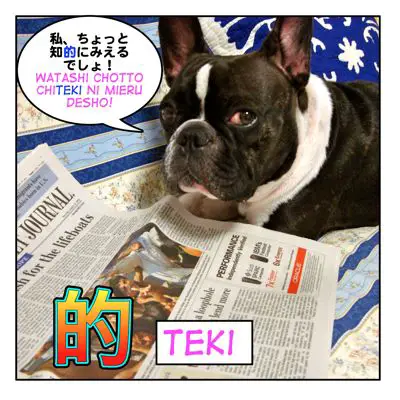
「私、ちょっと知的にみえるでしょ!」
= Watashi chotto chiteki ni mieru desho!
= I look a bit intelligent, right?
Today’s word is 的 =てき = teki=~tic, ~al, ~ine, ~able, ~ive, like~, ~ wise
We add this suffix to a noun to make an adjective that describes a characteristic.
Noun + 的 = てき ( = teki)→
 + 的 =てき ( = teki)+ auxiliary verb だ( = da) or です ( = desu) : to be ~
Adjective : 〜的な = てきな ( = teki na)
Adverb : 〜的に = てきに ( = teki ni)
⬇️
Ex. 開放 = かいほう = kaihou = openness
開放的 = かいほうてき = kaihouteki =open, open-minded
開放的だ = かいほうてきだ = kaihouteki da or 開放的です= かいほうてきです = kaihouteki desu = to be open, to be open-minded
adjective 開放的な = かいほうてきな = kaihouteki na = open-minded
adverb 開放的に =かいほうてきに = kaihouteki ni = open-mindly, openly
From the pic.
•知的 = ちてき = chiteki = intelligent
Ex. 彼は知的な人だ。
= Kare wa chitekina hito da.
= He is intelligent.
You can’t just add this suffix to any noun. It only works with certain nouns.
Here is a list for some of the words that will take 的 = teki.
⬇️
•積極的 = せっきょくてき = sekkyokuteki = positive, vigorous, aggressive, assertive, pushy, active, enthusiastic.
Ex. 彼女、積極的だね。
=Kanojo sekkyokuteki dane.
=She is aggressive*, isn’t she?
➡️Translation changes, assertive, active, pushy, etc. depending on the context.)
•消極的 = しょうきょくてき = shoukyokuteki = passive
Ex. あまり消極的だと友達ができないよ。
= Amari shoukyokuteki dato tomodachi ga dekinai yo!
= If you are too passive, you won’t be able to make any friends.
•攻撃的 = こうげきてき = kougekiteki is used for more aggressive character.
•感情的 = かんじょうてき = kanjouteki = emotional
Ex. ここは感情的にならないで冷静に話し合おう。
= Koko wa kanjouteki ni naranai de reisei ni hanashiaou.
= Let’s not get too emotional and talk about it calmly.
•現実的 = げんじつてき= genjitsuteki = realistic
Ex. ちょっと現実的に考えてみましょう。
= Chotto genjitsuteki ni kangaete mimashou.
=Let’s be realistic here.
•非現実的 =ひげんじつてき = higenjitsuteki =unrealistic
•行動的 = こうどうてき = koudouteki = active
Ex. 行動的な人ほど、運が切り開ける。
= Koudoutekina hito hodo un ga kirihirakeru.
= Active people make their luck.
•具体的 = ぐたいてき = gutaiteki = concrete, practical
Ex. もっと具体的なアイディアを出して下さい。
= Motto gutaitekina aidea wo dashite kudasai.
= Please give me more specific ideas.
•抽象的 = ちゅうしょうてき = chuushouteki = abstract
Ex. 彼の言うことはいつも抽象的だ。
=Kare no iu koto wa itsumo chuushouteki da.
=What he says is always abstract.
•一般的= いっぱんてき = ippanteki = general
Ex. この言葉はあまり一般的ではない。
= Kono kotoba wa amari ippanteki dewa nai.
= This word is not that common.
•実践的 = じっせんてき = jissenteki = practical
Ex. この仕事には、実践的な経験が必要だ。
=Kono shigoto niwa jissenteki na keiken ga hitsuyou da.
= You need practical experiences for this job.
•論理的 = ろんりてき = ronritkei =logical
Ex. 論理的に言うと…
=Ronriteki ni iu to…
=Logically speaking…
•否定的 = ひていてき = hiteiteki = negative
Ex. 彼は私の意見にいつも否定的だ。
= Kare wa watashi no iken ni itsumo hiteiteki da.
= He is always against my opinions.
•技術的 = ぎじゅつてき = gijyutsuteki =technical
Ex. 技術的なことはわからない。
= Gijutsuteki na koto wa wakaranai.
=I don’t know anything about technical things.
•美的 = びてき = biteki=aesthetic
Ex. 彼女には美的感覚が全くない。
= Kanojo niwa biteki kankaku ga mattaku nai.
= She has no sense of beauty.
•定期的 = ていきてき = teikiteki = periodical
Ex. 定期的に会議を開く。
=Teikiteki ni kaigi wo hiraku
= To have periodical meetings.
•科学的 = かがくてき = kagakuteki = scientific
Ex. 科学的な根拠は何もない。
=Kagakuteki na konkyo wa nani mo nai.
=There is no scientific proof.
•心理的 = しんりてき = shinriteki = psychological
Ex. この事件が及ぼす子供たちへの心理的な影響が心配だ。
= Kono jiken ga oyobosu kodomotachi heno shinriteki na eikyou ga shinpai da.
= I am worried this incident would have a psychological impact on children.
•経済的 = けいざいてき = keizaiteki =economical
Ex. 経済的(な)理由で旅行に行くのを断念した。
= Keizaiteki(na) riyuu de ryokou ni iku no wo dannen shita.
=For economical reason, I gave up on my trip.
•金銭的 = きんせんてき = kinsenteki = financial
Ex. 金銭的に苦しい
=Kinsenteki ni kurushii
=It is hard financially.
•理想的 = りそうてき = risouteki = ideal
Ex. 理想的な家庭を築く
=Risoutekina katei wo kizuku
=To make an ideal family.
•私的 =してき = shiteki = personal, private
•客観的 = きゃっかんてき = kyakkanteki = objectively
•主観的 = しゅかんてき = shukanteki = subjectively
•文化的 = ぶんかてき = bunkateki= cultural
•芸術的 = げいじゅつてき = geijutsuteki = artful, artistic
•友好的 = ゆうこうてき = yuukouteki = friendly
•生産的 = せいさんてき = seisanteki = productive
•科学的 = かがくてき = kagakuteki = scientific
Ex. 私的感情はまじえず客観的に対処して下さい。
= Shiteki kanjou wa majiezu kyakkanteki ni taisho shite kudasai.
= Please deal with it objectively without mixing your personal emotion.
•日本的*= nihonteki = Japanese, something typical or representative
Ex. 海外へのお土産には何か日本的なものを持っていった方がいいです。
= Kaigai eno omiyage niwa nanika nihontekina mono wo motte itta hou ga ii desu.
=You should take some typical Japanese souvenir to abroad.
(*We also say 和的=wateki for Japanese style)
(Conversational)
• 「マギー的にはどう思うの?」
= Maggieteki niwa dou omou no?
= So what do you think as Maggie?
「そうね、私的には別に悪くないと思うの。」
= Soune, watashiteki niwa betsu ni waruku nai to omou no.
=Let see.. In my personal opinion, I don’t think this is such bad idea..
Can you recognize all the words with 的 (= teki) ?
 マギー先生より= Maggie Sensei yori = From Maggie Sensei
他にも的を使った言葉が一杯ありますよ。探してみてね。
=Hoka ni mo teki wo tsukatta kotoba ga ippai arimasu yo. Sagashite mitene.
=There are a lot more. Try to find them!
何?マギー先生は「魅力的」ですって? :)
=Nani? Maggie Sensei wa miryokuteki desutte?
=What? MaggieSensei is attractive?
****
I appreciate your support! サポートありがとう! !
My supporters can access tons of audio files, PDF files, and special lessons on my Patreon page.
❤️ありがとう x 2: Mini lessons, PDF files with audio for all the lessons here from 2018
❤️ありがとう x 5 In addition to the previous benefit + Daily Japanese
Check the index of Daily Japanese Series →Index
❤️ありがとう x 10 In addition to the previous benefit + PDF file of all my Twitter lessons for a month (average 10 ~ 18 pages) with an audio file. Please check the details here

One-time support ↓ ありがとう!

37 Comments
Hi Maggie sensei!
Thank you for another wonderful post.
I saw this sentence which uses 的:
それはスケジュール的に厳しい。
Which is shown to translate to:
That’s a tight schedule.
Do you mind explaining what is 的 used for in this sentence? I’m having trouble understanding the use of 的 in this example. Seems like スケジュール的 is not used as an adjective here. スケジュール的 also feels weird to be an adjective.
Thank you!
Hi Chan,
スケジュール的に means “schedule-wise” and it modifies 厳しい (tight)
It is tight, schedule-wise.
Thanks for the kind explanation Maggie sensei!
積極的 is often mistranslated in English to “aggressive”, as in angry or pushy.
I think “assertive” is a much better match, considering the way it’s used in Japanese.
Good point. I think when I made an example sentence, she was pushy but I will add ”assertive” with other translation.
From what I notice words like「的」and 「中 only works with compound kanji with 音読み readings like 「基本」 and 「世界」. Am I correct in that assumption?
Hi,
You are right about 音読み but as for 的 but not necessary compound words.
劇的、私的、詩的, etc.
Hi Maggie Sensei! :D 久しぶりだね!
May I ask a question? I’ve noticed that in your example sentence 彼女には美的感覚が全くない there is no -na connecting 美的 to 感覚. I suppose that’s because 美的感覚can be considered one large word, right?
But then, I’ve also found this sentence in my texbook: そこまでやるのは自殺的行為だ。In his case, 自殺的行為 doesn’t seem to be ‘one large word’ as I can’t find it in a dictionary. So, is it sometimes possible to omit -na?
こんにちは、Davide!
お久しぶり!
I guess some people say 美的な感覚・自殺的な行為 but 美的感覚・自殺的行為 are much more common.
So when you check the meaning in the dictionary and can’t find the definition, you may want to separate the words (Ex. 美的+感覚・自殺的+ 行為) and figure out the meaning.
You will see a lot of words with 的 in a compound words without using な
知的好奇心 intellectual curiosity
具体的対策 a concrete measure
客観的意見 objective opinion, etc.
I see! Thank you so much for your help, I really appreciate it 😊😊😊
どういたしまして、Davide 🐶💕
Thank you very much sensei. Learned lot of new words and gramer patterns!!
Very undestandable!!
Hi Nimesh,
I’m glad to hear you learned a lot here.
Hello!!
thank you for the lesson.
I see this word a lot, I somehow understood the lesson but I still need to practice ^^”.
so I read this in a manga but I still can’t get the meaning?
” 気持ち的” and “頭的”
な came after them which means the are “adjectives” right?
but I still don’t know how to translate them into English.
the whole sentence is:
「なんかこういろいろ追いつかないから!! 気持ち的なことも頭的なことも!!」
looking forward to your reply!
Thank you in advance.
@FatimahBHR
Hi FatimahBHR!
There are a lot of colloquial ways of using 的.
In general, the most proper translation of 的 is “~ wise” or “~ ly” but you have to pick the right translation depending on the context.
気持ち的なこと = mental things / 頭的なこと= logical things
But to translate them more naturally, it will be something like
I can’t catch up with many things somehow, mentally and also logically.
Perfect! Thank you very much♥♥♥
(Sorry, I posted the comment in the wrong place 😅💔)
@FatimahBHR
You’re welcome!
Hi Maggie sensei,
As always thanks for another great lesson.
I know you said that you can’t just add 的 to any nouns. How about する-nouns? Are they usually used with 的? I noticed a bunch of your examples were する-nouns.
@アル
Hi アル?
Hmmm…You mean like a noun such as 開放(+する)、実践(+する)、行動(+する)?
It may work with some of them but not all of them.
勉強(+する)料理(+する)旅行(+する) ,They all won’t work with 的
Perfect! Thank you very much♥♥♥
hi Maggie sensei.. I wanna let you know your lessons are very very useful…
btw, i got a question. how to use noun with的 and noun w/o 的 +ni/. For example
自動的に/自動に
実際的に/実際に
appreciate your help
@Jim
Hello Jim,
First the words you can use with 的 are limited so you can’t add 的 to any words.
And 基本的に(= basically) you can’t make adverbs just deleting 的 and replacing it with に or で
Ex. 基本的に x 基本に/で
Ex.客観的に x 客観に/で
However, we can use certain words without 的
Ex. ファイルを自動的に開く = to open a file automatically
Ex. ファイルを自動で/に開く = to open a file automatically (で is more common)
Ex. ファイルが自動的に/自動に/自動で開く = A file opens automatically
*****
実際的に and 実際に
There are cases you can replace them but there is a difference
実際的には実現が難しい (It is practically difficult to make it come true.
実際には実現が難しい (It is difficult to make it come true in reality.)
実際的に means “practically/ in a practical way”
But 実際に has a meaning of “for real, in fact, actual, in reality” and a lot of time can’t replace it with 実際的に
Ex. これは実際にあった話です。(x 実際的)
= This is a true story.
I heard Teki is kanji a chinese character, did the pronouciation of the word Teki originate in China or Japan.
@Andy
Sorry but I don’t know anything about Chinese language. But I checked the pronunciation of 的 in Chinese. It is either di or da.
I’ve read the usage of -teki comes from the English -tic. Japanese grammar got changed a bit since the influence of Western languages, especially English. 精力的 energetic, 映画的 cinematic, etc…
@Bjorn
Yes, that’s right!! :)
Sorry to say but that’s completely wrong. Although the genitive in Classical Chinese was 之 zhi, 的 (pronounced “de”, which isn’t で but sort of like “dø;” in old Chinese it was pronounced “dak” or “duhk” and thus became “teki” in Japanese ) was still used as an attributive marker and was passed to Japanese and given a Japanese-style grammar. Basically 的 means “of” and な is what is used in Japanese to attach it to words.
@risu
Thank you for your comment. I don’t know any Chinese so I can’t answer the similarity or difference between Japanese and Chinese but the equivalent English word depends on the words, I think.
~ic/ ish, wise, etc.
so 一般的 can be used for other things, like food/fashion??
先生はとっても魅力的だ!!!!<3
@Aki
Yes, 一般的な食べ物。一般的な服 etc.
Thank you! Aki! You are 魅力的 as well!
Thanks for the lesson!!
The commercial is awesome, gonna learn all vocab by heart!
@DraNKa
Thank you for the comment! I think if you memorize them, you can impress many Japanese people!
はいはい、先生。どもすみません!
Thank you so much for the correction and clarification, sensei^^
I love it when you include a CM at the end. It’s a nice way to remember new words too^^
@Top-san
どういたしまして!I’ve started to work on a lesson for you. ちょっとお待ち下さいね。
@Top-san
Thank you for the comment!
All the words with 的 in this lesson are pretty common. So we use all of them. And there are lots more.. As I wrote in the lesson, you can’t just add 的 to all the nouns. So it will be faster to memorize the words with 的. For example we always use 積極的、消極的 and we don’t usually use just 積極 or 消極 without 的.
”Can you use 好き in this case too?”
魔法好き→It may work for a person who looooves magic like Harry Potter!
~好き=~ zuki is another word which works for certain nouns.
(things you like) + 好き(=zuki)
Ex.子供好き=kodomo zuki = a person who likes children
コーヒー好き=koohii zuki = coffee lover
( a little katakana correction : レッスン, マギー)
素敵なレッソン、マッギー先生!
Can I say that?
How do we know which one to use? I guess we have to remember it right? If I didn’t know, I would probably use 魔法的. Can you use 好き in this case too?